

Last month, in an Axios story, sources in the Trump administration told the story of a clandestine effort to move shipping traffic through the Strait of Hormuz, despite Iran claiming it had closed it.
After that secret operation, the story said the U.S. could transport 10 million barrels of oil a day through the Strait, about half of pre-war levels.
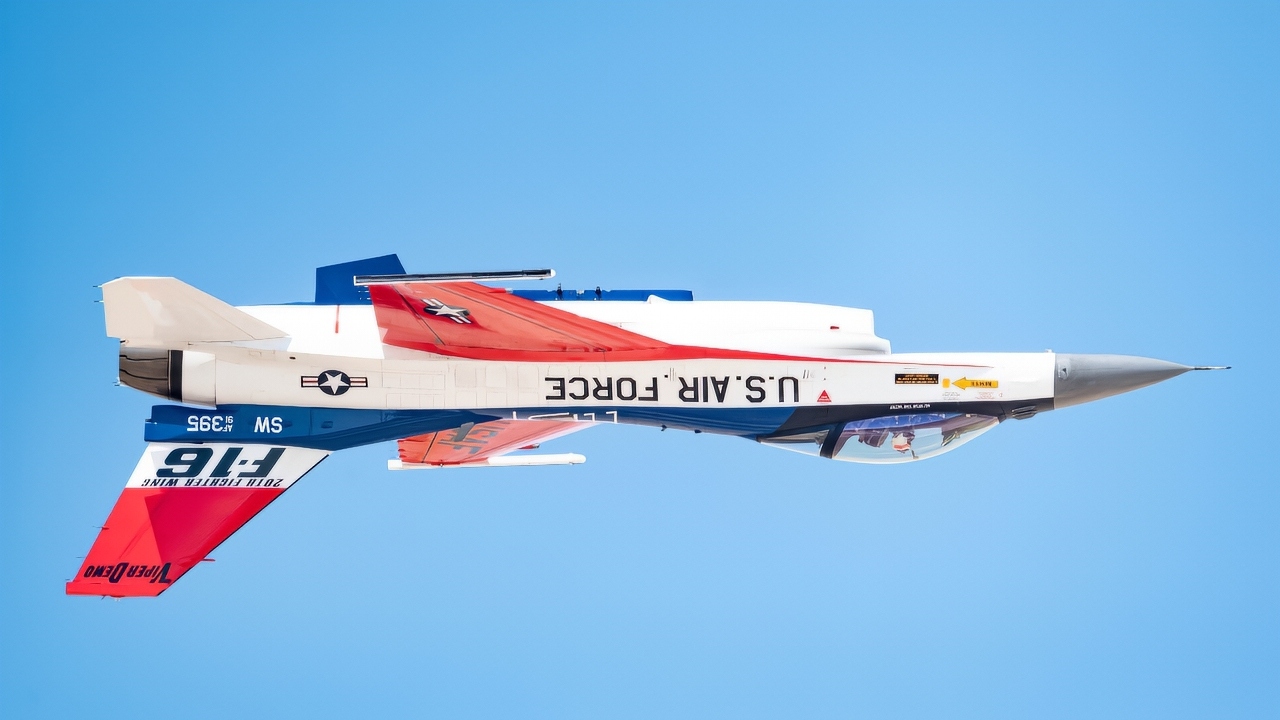
U.S. Air Force Maj. Taylor “FEMA” Hiester, F-16 Viper Demonstration Team commander and pilot, performs aerial maneuvers in an F-16C Fighting Falcon during an air show at Marine Corps Air Station Yuma, Ariz., March 15, 2025. The flight demonstration highlights the versatility of the F-16, a multi-role fighter aircraft proficient in both air-to-air and air-to-ground combat. (U.S. Air Force photo by Senior Airman Steven Cardo)

A U.S. Air Force F-16 Fighting Falcon flies over the U.S. Central Command area of responsibility Oct. 14, 2020. The F-16 Fighting Falcon is a compact, multirole fighter aircraft that has proven itself in both air-to-air combat and air-to-surface attack. (U.S. Air Force photo by Senior Airman Duncan C. Bevan)
“We have been controlling the southern lane of the Strait of Hormuz for two months now.
The Islamic Revolutionary Guard Corps can be a nuisance, but they don’t control the strait.
We do,” a U.S. official told Axios in the August 19 story.
By August 28, Axios had reported that the U.S. had the “upper hand” in the battle for the Strait of Hormuz, and that they believed they had “turned the tide” in the Strait.
“That sucker is open.
The Iranian response is very mild. They don’t want us to go back at them.
That’s the whole ball game. The rest doesn’t matter,” Trump himself told Axios in that story.
However, about two weeks later, it’s looking like that declaration of victory may have been premature.
“Single Digits”
Reuters reported Thursday that vessel transits through the Strait of Hormuz the day before fell to single digits, with just seven vessels going through, down from 12 the day before and a 10-day average of 14. Four vessels exited and three entered, the report said.
There was a reason for this: The tit-for-tat strikes between the sides of the war earlier this week, and the Axios stories about U.S. optimism on the Strait came at a time when the hostilities remained quiet.
On Tuesday, the U.S. attacked five oil tankers belonging to Iran’s Islamic Revolutionary Guard Corps (IRGC), leading Iran to retaliate.
Per The Hill, experts see the fighting worsening in the near term, with no clear solution in sight for the status of the Strait of Hormuz.
“Ironically, the harder the U.S. pushes to get the strait back open, the harder Iran pushes back, leading to heightened escalation, fewer ships passing, and higher oil prices as a result,” Mona Yacoubian, director and senior adviser of the Middle East Program at the Center for Strategic and International Studies (CSIS), told The Hill.
“In other words, U.S. efforts to get oil flowing again by military means are having the opposite effect of further constraining supply getting out.”
Fighting Words
Leaders of both countries have been talking tough.
“Originally I wanted to make a deal; we’re so far down the line, they have very little country left right now, so we’re not looking for it,” Trump said this week, per The Hill. Yes, a negotiation could possibly happen, but it’s not something we’re looking at. This war will immediately end after our election.”
Iran’s Speaker of Parliament, Mohammad Bagher Qalibaf, had warnings of his own.
“It’s simple: the oil and gas production chain here is sprawling, accessible, and exposed,” the speaker said on social media. “American oil and gas companies across these waters and facilities share that exposure. Strike our assets, and you get struck. We’ve already proven it. Ask the bases that are no longer viable.”
Oil Surges
Amid this and the ongoing renewal of hostilities between the Houthis and Saudi Arabia, oil prices have surged this week. Brent crude was approaching $107 per barrel on Thursday afternoon, a 20 percent increase month-over-month and a 61 percent growth year over year.
That represented the benchmark’s highest level since May.
“The deteriorating backdrop from the Middle East dims expectations that supply from the region could be normalized as Asian economies are forced to re-enter the energy market,” Trading Economics reported this week. Per the Associated Press, this caused stocks to fall on Thursday.
This follows a Labor Day when gas prices broke records, with diesel prices nearing an average of $6 a gallon for the first time in history. As a result, trucking experts have warned of peril.
“It costs about $1,000 to fill that truck up on diesel fuel,” Tom Milby, vice president of operations at Home Run Inc, told TV station WHIO. “So you do that every other day if you do that two or three times a week, and at our operation here, we have 150 trucks. It’s a lot of cost that’s passed on to the consumer.”
About the Author: Stephen Silver
Stephen Silver is an award-winning journalist, essayist, and film critic, and contributor to the Philadelphia Inquirer, the Jewish Telegraphic Agency, Broad Street Review, and Splice Today. The co-founder of the Philadelphia Film Critics Circle, Stephen lives in suburban Philadelphia with his wife and two sons. For over a decade, Stephen has authored thousands of articles that focus on politics, national security, technology, and the economy. Follow him on X (formerly Twitter) at @StephenSilver, and subscribe to his Substack newsletter.


