


Key Points and Summary – The new F-16 Block 70/72, known as the “Viper,” is a massive leap in capability for the legendary fighter.
-It boasts a top speed of over Mach 2, making it faster than an F-35.

F-16 Fighting Falcons assigned to the 114th Fighter Wing sit ready on the ramp while conducting an elephant walk at Joe Foss Field, South Dakota, July 2, 2025. The 114th Fighter Wing conducted an elephant walk to demonstrate its ability to project fighter airpower. (U.S. Air National Guard photo by Master Sgt. Luke Olson)
-The real upgrade is its “5th-generation brain,” featuring an advanced AESA radar that can track multiple targets simultaneously, a state-of-the-art digital cockpit, and a powerful new electronic warfare suite.
-This turns the proven and versatile F-16 airframe into one of the most capable 4th-generation++ fighters on the planet, keeping it lethal for decades to come.
The F-16V Viper Fighter Is Fast
The latest version of the F-16 Fighting Falcon is the Block 70/72, which adds a significant amount of capability to the base model F-16.
Known as the F-16V or Viper, the fighter jet can cruise at a MACH 2+ maximum speed – over 1,500 miles per hour. The F-16V is the most updated jet in the family and adds the kind of modernization that pilots are drooling over.
The MACH 2+ speed brings it in line with the new F-15EX, itself a blisteringly fast warbird.
The F-16V also has the same maximum velocity as the F-22 Raptor; however, the Block 70/72 is faster than the F-35, which has a top speed of Mach 1.6.
Powerful Engine Makes the Viper Strike Quickly
The F-16V is characterized by its high combat performance and agility, enabling it to sustain 9 G maneuvers.
It has a range of 1,740 nautical miles. This is enabled by a single Pratt & Whitney F100-PW-229 or a General Electric F110-GE-129 turbofan engine that pushes out 29,100 pounds of thrust.
Multi-mission Set Makes It So Valuable
The F-16V is versatile, flying above MACH 2.
It can perform air policing duties to protect the sovereignty and borders of many nations that fly the base model Fighting Falcon.
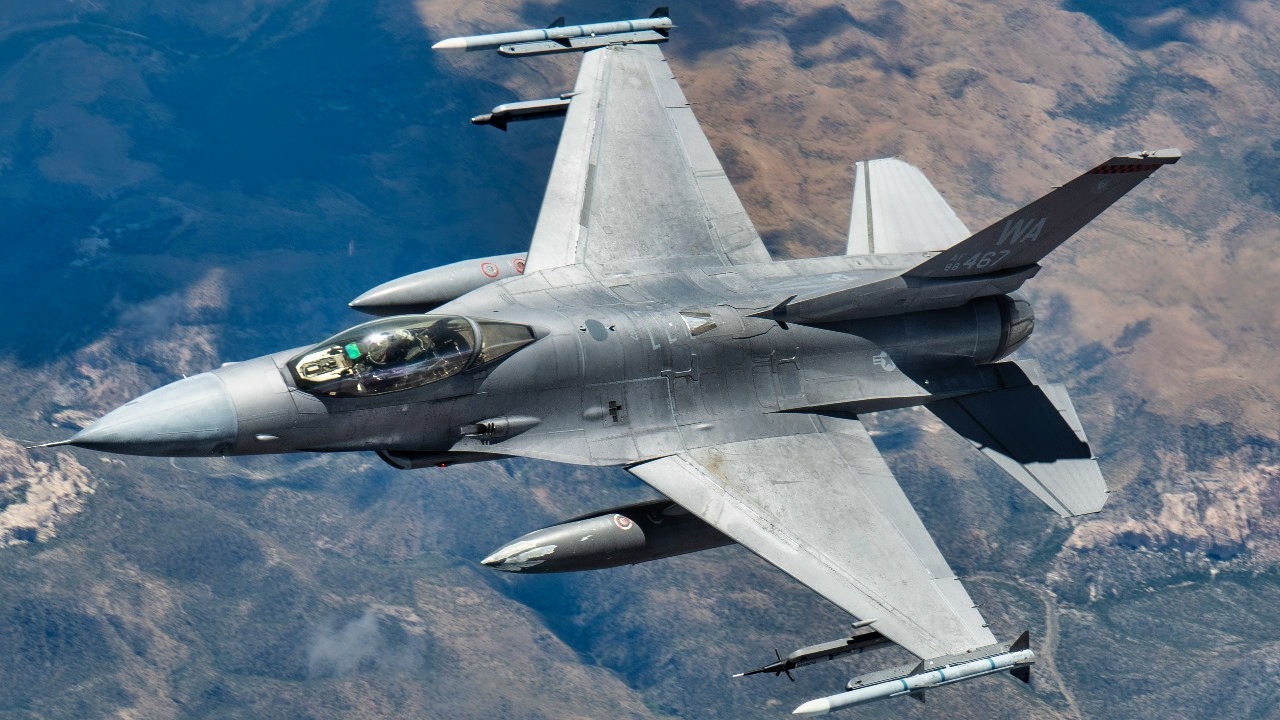
A U.S. Air Force F-16 Fighting Falcon assigned to the 16th Weapons Squadron flies over the Nevada Test and Training Range during a Weapons School Integration (WSINT) mission, June 9, 2025. WSINT is a graduate-level training event that combines multi-domain assets in large-force scenarios, enabling U.S. Air Force and joint service members to hone tactical expertise and integrate advanced capabilities in a dynamic threat environment. (U.S. Air Force photo by Staff Sgt. Jose Miguel T. Tamondong)

Israel F-16I Fighters IDF. Image Credit: IDF.
It is capable of performing enviable dog-fighting feats. This airplane has many roles that encompass ground strike and hunter-killer missions for driving enemy aircraft away from Air Defense Identification Zones or destroying bogeys that are ready to attack the homeland.
More than 20 countries fly various versions of the F-16.
Modern AESA Radar Won’t Let Pilots Down
Block 70/72 features a great avionics suite, and the APG-83 AESA radar is comparable to the sensors on board the new F-15EX.
The software is similar and can “talk” to F-22s and F-35s. The AESA can perform well at night and in all weather.
This system is featured on fifth-generation warbirds and enables the F-16V to have improved situational awareness.
Electronic warfare capabilities are referred to as the “Viper Shield,” featuring a fully digital radar warning receiver.
The F-16V has “Infrared Search and Track (IRST); precision GPS navigation and advanced Common Digital Flight Control Computer with an enhanced Autopilot/Auto Throttle with life-saving Automatic Ground Collision Avoidance System,” according to Lockheed Martin.
Cockpit Is Ready for Prime Time
Block 70/72 is pilot-friendly, featuring a modernized cockpit that aviators love.
There is a 6-inch by 8-inch digital display.
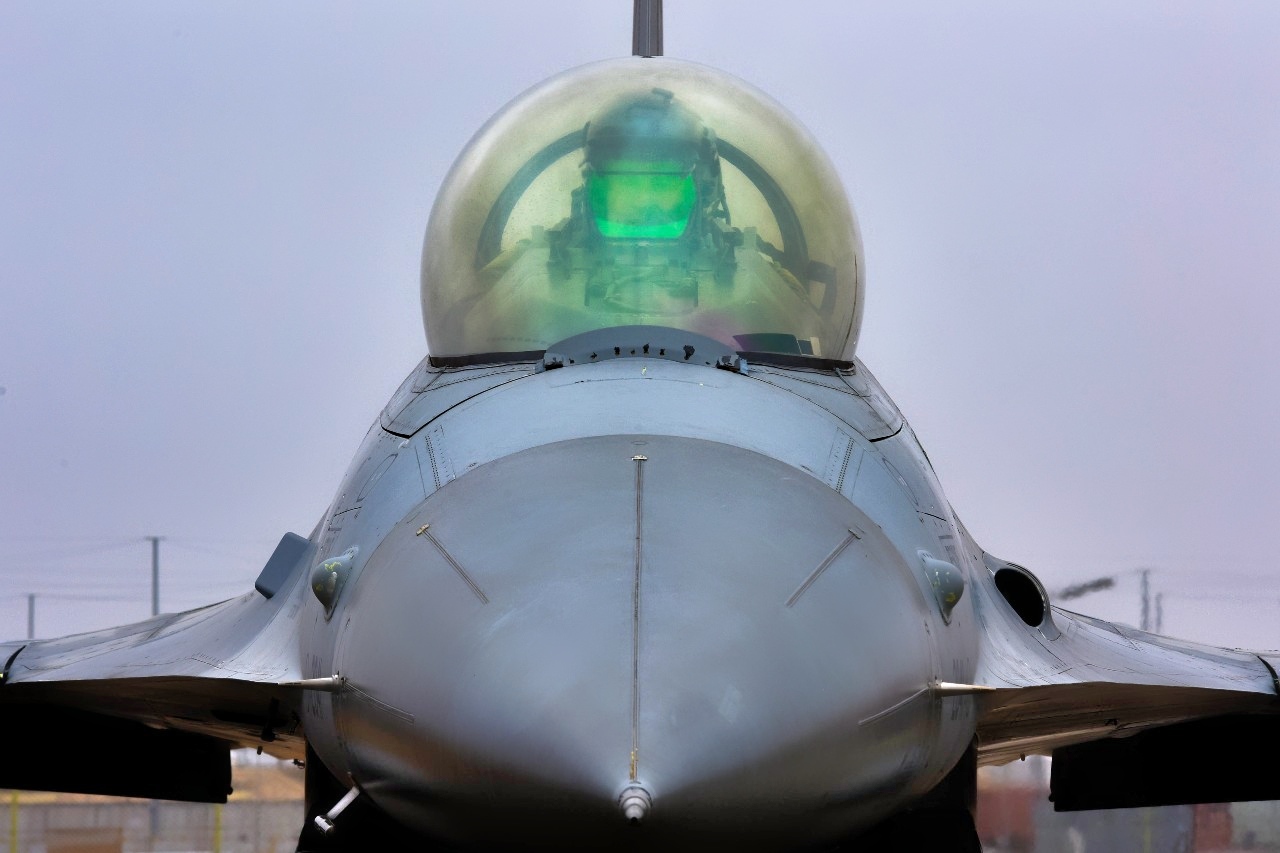
U.S. Air Force Lt. Col. John Ryan, 555th Fighter Squadron F-16 Fighting Falcon pilot, prepares to take off for a routine training flight at Aviano Air Base, Feb. 17, 2022. The flights will support NATO’s enhanced air policing mission; integrate with allies and partners in the Black Sea region in an increased defensive posture along NATO’s border and to reinforce regional security. (U.S. Air Force photo by Senior Airman Brooke Moeder)
This is where the AESA and targeting pod data are available to operators.
The pilot can then toggle to flight instruments at a moment’s notice.
Maps from the radar are colorized and constantly moving as the airplane speeds along at high speed.
There’s a flight control computer with air-to-air situation displays too, along with enhanced autopilot and auto-throttle.
A Multitude of Weapons Options
Like all F-16s, the F-16V is a weapons hog. It can carry “AIM-9 Sidewinder, Magic II and ASRAAM short-range AAMs, as well as AIM-7, Sky Flash and AIM-120 medium-range AAMs. High off-bore-sight, infrared AAMs such as AIM-9X, Python IV, AIM-132 ASRAAM, and IRIS-T are also available,” according to Airforce-Technology.com.
That’s quite a loadout, making the F-16V one to watch in combat. Don’t forget ground strike missions. There are anti-ship missiles, Maverick air-to-ground missiles, and Paveway laser-guided bombs. These can engage multiple targets – either stationary or moving.
More – Russia’s Hypersonic Missiles Summed Up in 4 Words
More – America’s Hypersonic Missiles Summed Up in 4 Words
Lockheed Martin test pilot Ryan “Cujo” Blake has ample experience on this airplane. Blake is enamored with the radar controls of the F-16V.
“From an operator’s perspective, the AESA radar is the first thing that jumps out – for those who are used to the earlier blocks with mechanically-scanned radar – when you jump into a Block 70 with an AN/APG-83, you’re immediately seeing longer ranges, faster scan time, better tracks. Fighter pilots often focus on the air-to-air portion. Still, as a multi-role fighter, all the air-to-ground capabilities of the APG-83 are the next thing that stands out. The fact that you can multi-task with the AESA between air-to-air and air-to-surface, so you can be taking air-to-ground maps at the same time you’re doing air-to-air engagements, Blake told the War Zone.

U.S. Air Force Nathalie Olarte, crew chief, launches an F-16 Fighting Falcon from an undisclosed location within the U.S. Central Command area of responsibility, Jan. 14, 2024. The F-16 can fly more than 500 miles (860 kilometers), deliver its weapons with superior accuracy, defend itself against enemy aircraft, and return to its starting point. The U.S. Air Force’s expeditionary capability enables U.S. and coalition forces to rapidly establish credible, combat-ready forces within U.S. Central Command’s area of responsibility to proactively deter potential adversaries. (U.S. Air Force photo by Tech. Sgt. Alexander Cook)
The F-16V has a stellar future ahead of it. These improvements, along with the high speed, are ready to take on the enemy, whether in in-air combat or ground strike. It will only be a matter of time before international customers clamor for this fast jet with all of its updated features.
MACH 2+ will keep the airplane from getting shot down, and its high agility and AESA are a thing of beauty. This could become one of the quickest and most maneuverable airplanes in any Air Force fleet. It’s not stealthy, but it has high interoperability with allies.
Look for the F-16V to be featured as a jet at combined military exercises with foreign air forces. Other governments will witness the speed and high-G maneuvers and want to order the latest Block 70/72 version.
About the Author: Dr. Brent M. Eastwood
Brent M. Eastwood, PhD is the author of Don’t Turn Your Back On the World: a Conservative Foreign Policy and Humans, Machines, and Data: Future Trends in Warfare plus two other books. Brent was the founder and CEO of a tech firm that predicted world events using artificial intelligence. He served as a legislative fellow for U.S. Senator Tim Scott and advised the senator on defense and foreign policy issues. He has taught at American University, George Washington University, and George Mason University. Brent is a former U.S. Army Infantry officer. He can be followed on X @BMEastwood.
NOTE: This piece has been updated to include a missing but key word that was accidently deleted.
More Military
We Almost Touched the F-117 Stealth Fighter


Parris
July 30, 2025 at 10:03 pm
FYI,The US Airforce does not fly the block 70/72 F-16 only the 30 year old block 50/52 series which by the way has the 29,000 pound thrust class engines. Also these older planes have also been upgraded to an AESA radar. The block 70/72 planes are foreign sales only.
Reinhardt Rossouw
August 1, 2025 at 8:37 am
Well, facts and figures being correct, to a certain degree. The Mach 2+ speed is in clean condiguration. Slap the same armament on the pylons as a F-35 can carry internally, and the F-35 will still go M1.6, while the Viper will have trouble staying above M1.2. Context is important – and you chose to not include this important piece of information in your article.