

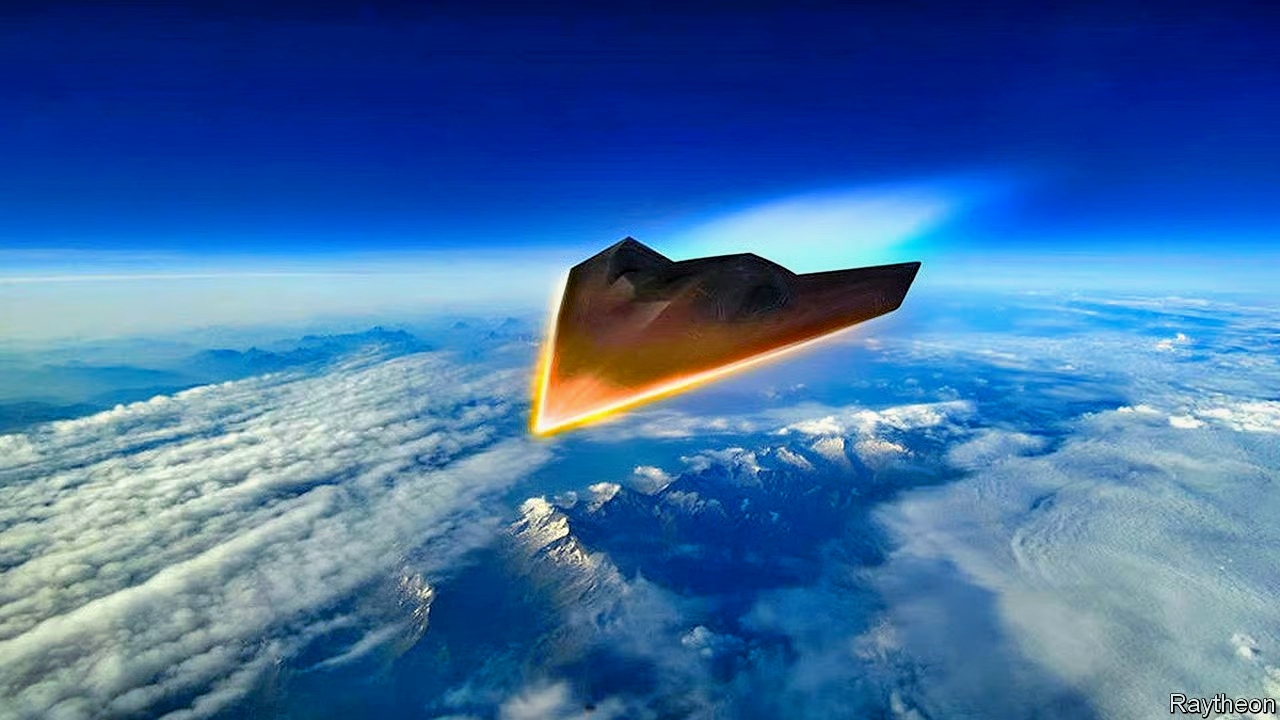
Summary – The war in Ukraine keeps getting worse by the second. And there are fears Russia could use hypersonic weapons more and more on the battlefield.
-Russia’s claims of hypersonic missile supremacy are largely overhyped and serve as a tool for political intimidation rather than reflecting battlefield dominance.
-The Kinzhal, essentially an air-launched ballistic missile, has been repeatedly intercepted by US-made Patriot systems in Ukraine, shattering its myth of invulnerability.
-Other touted “super weapons” like the Avangard glide vehicle are operational but unused, while systems like the Burevestnik nuclear-powered cruise missile have reportedly failed in testing.
-With limited inventories and questionable effectiveness, Russia’s hypersonic arsenal is more propaganda than a decisive military game-changer, described by some experts as “Moscow’s Wunderwaffe.”
Russia and Hypersonic Weapons
The longer the Russian President Vladimir Putin’s failed effort to subdue Ukraine militarily goes on the more the words “Russian hypersonic missiles” are mentioned by his surrogates.
This is usually without much detail, which is sometimes due to Russian spokesmen really not knowing what they are talking about.
Typically, “hypersonic” means any speed above Mach 5, which leaves a fairly broad spectrum.
Then there is the issue of when and where on a missile’s flight path that the missile crosses that hypersonic mark.
Usually, when Russian missiles have achieved hypersonic speed, it is through a combination of propulsion methods.
Most commonly this is by using a rocket-powered propulsion system as a boost-phase motors and then a scramjet engine takes over.
The two most commonly mentioned Russian hypersonic arsenals include the Kh-47 M2 Kinzhal and the Avangard.
The Kinzhal was fired on a number of occasions against targets in Ukraine.
However, the Kinzhal must be air-launched from a Mikoyan MiG-31K fighter aircraft or a Tupolev Tu-22M3 bomber when either is already travelling at close to Mach 2.7.
Launching from high altitude and at this velocity is part of the equation of the missile ultimately achieving hypersonic speed.
Russian Hypersonic Weapons in Theatre
The Kinzhal, which is essentially an air-launched adaptation of the Iskander ground-launched ballistic missile, then uses its rocket propulsion to reach a top speed of Mach 10.
But Iskander has been in the Russian arsenal for decades, so it is not a new weapon.
The Avangard, on the other hand, is a hypersonic glide vehicle designed to be launched by a ballistic missile as a booster and then deliver a nuclear warhead. It has not been used operationally.
Putin and his surrogates keep mentioning hypersonic weapons in an effort to intimidate western leaders into believing he is ready to escalate the war with Ukraine beyond the nuclear threshold.
But what most of the news about these weapons leaves out is that the number of them actually in inventory and/or deployed remains – and is likely to remain – small.
The other factor that has and will continue to prevent these missiles from having any significant impact on the conflict is that, to date, Ukrainian air defense crews operating the US-made Patriot missile defense system have successfully intercepted them multiple times.
The Major Russian Hypersonic Programs
There is also what could be called a misperception about how many of the hypersonic programs that are also nuclear capable, which Putin has previously announced, are actually real.
He discussed details of five of these nuclear delivery systems during his annual address to the Russian Federal Assembly (a joint session of the two houses of the Russian parliament) in 2018. At the time that he delivered this speech, only one of them, the Kinzhal, was even in service.
The others were the Avangard mentioned above, the 9M730 Burevestnik nuclear-powered cruise missile, the Poseidon unmanned underwater vehicle, and the Tsirkon hypersonic cruise missile. Each of these systems is dual-variant compatible in that there are supposedly nuclear-armed variants of each one, and all but the Poseidon have a conventionally armed version.
But because it is Putin presenting them to an audience of senior legislators and other officials – and since what he shows are only computer-generated reels and images of them instead of real footage – he can claim that there is no missile defense system operated by any country that is capable of taking them out.
In 4 Words: A Bunch of Hype?
A paper from the US Army War College from March of this year points out that the actual performance of the Kinzhal and the Tsirkon to date “suggests that Russian claims about their invulnerability are either intentional disinformation or misperceptions of their own capabilities.’
It is likely that some element of this same type of disinformation or misperception “is also present in Russian comments about the Avangard, Burevestnik, or Poseidon, even if it is not guaranteed that such comments are as disingenuous or inaccurate as those regarding the Kinzhal and the Tsirkon.”
To put it plainly, these claims of invulnerability are like so many of “the Fuhrer’s promises about a new generation of ‘Moscow’s Wunderwaffe’,” as several anti-Putin Russian military experts have described the claims made by the Russian president about these hypersonic systems.
“Some of these missiles are not even in service, and the Burevestnik blew up during its last test firing” they point out. “More fairy tales,” said another. “More boasting about weapons you will never see more than one or two examples of – if any.”
“Putin – this is the man who oversaw the decline, dismantling and asset-stripping of a once mighty Russian industrial complex. Now he wants to say that same industry is still capable of performing miracles instead of taking responsibility for destroying it,” he said.
About the Author:
Reuben F. Johnson is a survivor of the February 2022 Russian invasion of Ukraine and is an Expert on Foreign Military Affairs with the Fundacja im. Kazimierza Pułaskiego in Warsaw. He has been a consultant to the Pentagon, several NATO governments and the Australian government in the fields of defense technology and weapon systems design. Over the past 30 years he has resided in and reported from Russia, Ukraine, Poland, Brazil, the People’s Republic of China and Australia. This was recently updated due to breaking events in the Ukraine war.
Russia’s Bomber Forces
Tu-22M3: The Bomber Ukraine Hit With Drones


Pingback: China Can't Invade Taiwan So Easily - National Security Journal
Pingback: Russia Launches Yasen-M Submarine Armed with 'Zircon' Hypersonic Missiles - National Security Journal
Pingback: The Navy's New Block VI Virginia-Class Submarine Is Built to Fight Russia - National Security Journal
Pingback: F-35: How Fast Can This US Military Fighter Fly? - National Security Journal
Pingback: China's Hypersonic Missiles are a Threat to America's Military - National Security Journal
Pingback: The Only Way to End the War in Ukraine - National Security Journal
Pingback: F/A-18E/F Super Hornet: How Fast Can This Navy Fighter Fly? - National Security Journal
Pingback: Putin's Mistake? Russia Isn't Moving Bombers Away from Ukraine - National Security Journal
Pingback: Foxtrot-Class: Russia's Best Cold War Diesel-Electric Submarine - National Security Journal
Pingback: Russia Has No Way to Win the War in Ukraine - National Security Journal
Pingback: The Walls Are Closing in on the F/A-XX Stealth Fighter - National Security Journal
Pingback: Russia Is Winning the Ukraine War and NATO Can't Stop It - National Security Journal
Intp1
June 10, 2025 at 12:07 pm
What a bunch of coping.
Avanguard is ICBM re-entry device so like all ICBM (even American) travel at hypersonic speeds as does any rocket which reaches orbit (e.g. SpaceX). This one should therefore not technically be included in this roundup.
The Kh-47 dismissed because it uses rocket boosters (duh!) and isnt even that new ( which means Russia has had hypersonics even longer while USA still failing to aquire one. The related Iskander is also technically hypersonic without benefit of launch platform speeds which you got wrong because the Mig-31 doesnt lanch them at Mach 2.7. Patriots have occasionaly intercepted the khinzal but you dont mention how many dozens of launches to get one? Though pathetic Patriots is another subject.
You leave out the Zircon which is rocket boosted then scramjet, is a proven building leveller (in kiev) and designed as anti-ship.
Oreshnik is also proven leveller (Dniepro) in its 1st test and is a mini itra-continental rentry which Russia only developed because the US tore up the INS treaty, good move? Your country is disappearing mate but the green goblin doesn’t care does he?
Pingback: Trump Is Getting Ready to 'Cut Military' Aid to Ukraine - National Security Journal
Pingback: 'War Exhaustion' Could Mean Russia Is Defeated in Ukraine - National Security Journal
Pingback: NATO Fears Russia Will Attack Within 5 Years - National Security Journal
Pingback: F-35 'Clone'? Why China's J-35 Fighter is More Than Just a 'Copy' - National Security Journal
Pingback: Iran's Cruise Missiles Summed Up in 4 Words - National Security Journal