


Key Points and Summary – The American-built F-111 Aardvark became an unlikely Australian icon.
-Adopted by the RAAF in the 1970s and nicknamed the “Pig,” the swing-wing bomber brought Mach-2 speed, deep-strike range, Harpoon anti-ship missiles and precision bombs to a country that suddenly had one of the most formidable strike jets in Southeast Asia.

F-111. Image Credit: Creative Commons.
-Aussie Aardvarks never dropped ordnance in combat, but they did famously sink the drug-running freighter Pong Su and stood ready during East Timor’s crisis.
-Retired in 2010—with some airframes literally buried—the F-111 still symbolizes an era when Australia could hit hard, fast and alone across the region.
The F-111 Aardvark Has a Big Message for Australia’s Air Power
Australia is a country (and continent) that, among other things, is known for some weird and wacky wildlife, from kangaroos to venomous taipan snakes to bird-eating spiders to sea snakes to crown-of-thorns starfish.
Meanwhile, the Aardvark (Orycteropus afer) is not an Australian species but rather an African animal; indeed, “aardvark” is an Afrikaans word meaning “earth pig.” However, given its weird appearance, the Aardvark would probably fit right with Aussie fauna.
In addition to the flesh-and-blood mammal, “Aardvark” is also the name of a deadly mechanical warbird, namely the F-111 Aardvark supersonic fighter-bomber. Like its ground-dwelling mammalian namesake, the flying Aardvark is not native to Australia.
The F-111 is American-made, but that didn’t stop the Royal Australian Air Force (RAAF) from adopting it, making it the longest-serving bomber/strike aircraft in RAAF history, with a service life spanning 37 years.
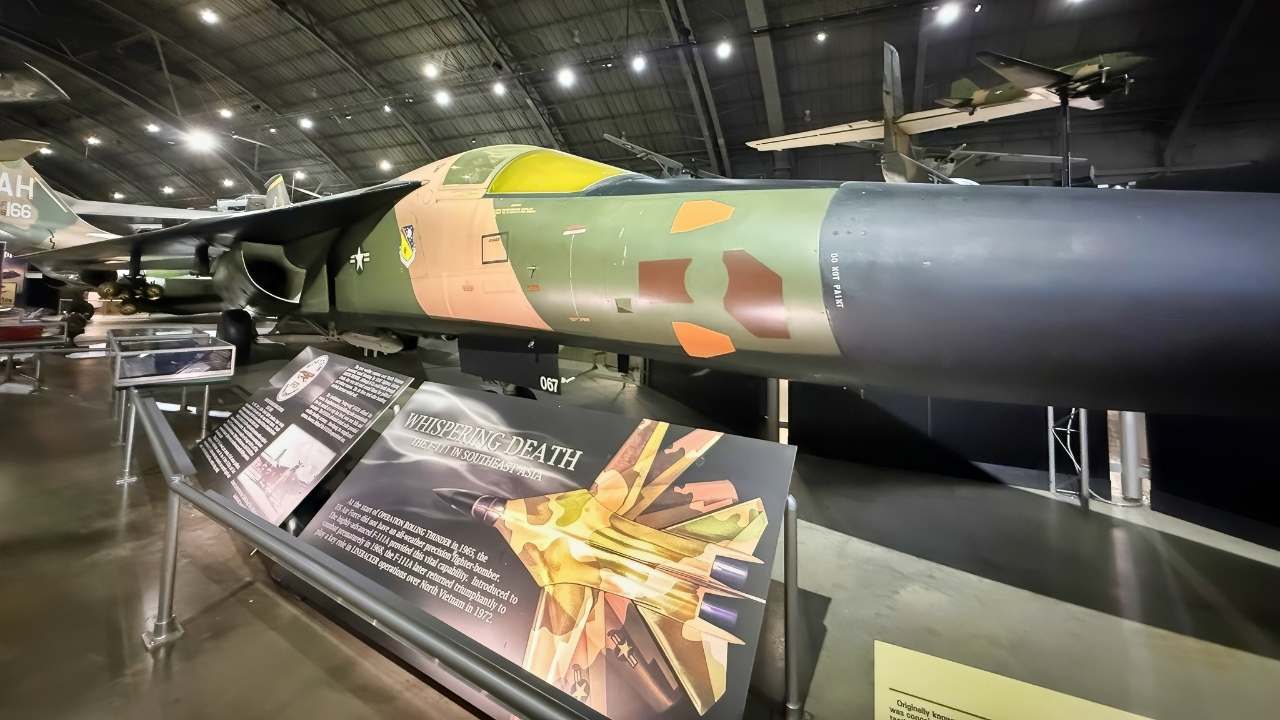
USAF Museum F-111 National Security Journal New Photo.
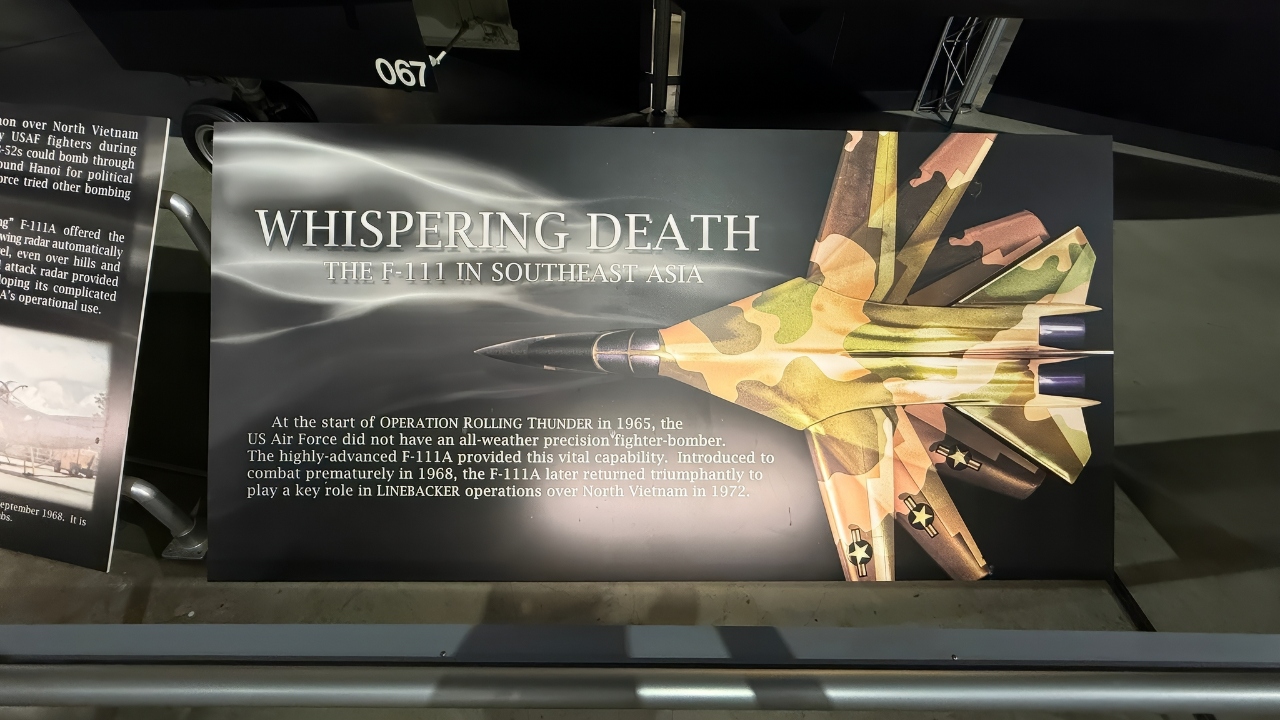
F-111 Photo from USAF Museum in Dayton. Image Credit: National Security Journal.
F-111 Aardvark Initial History (American and Aussie Alike)
Built by General Dynamics (which later gained additional fame as the original builder of the F-16 Fighting Falcon, although nowadays that’s a Lockheed Martin product), the F-111 Aardvark made its maiden flight on December 21, 1964, and officially entered into service with the US Air Force (USAF) on July 18, 1967.
The RAAF followed suit by first flying the warbird in 1968 and officially adopting it in 1973. The Yanks nicknamed her the “Vark” for short, whilst the Aussies, perhaps in a nod to the South Africans, nicknamed her the “Pig.”
The “Vark”/”Pig” was a groundbreaking aircraft for the USAF and the RAAF alike, thanks to advanced features such as swept-wing technology, afterburners, and a terrain-following guidance system.
F-111 Tech Specs and Vital Stats
Crew: 2 (pilot and weapon system officer [WSO or “Wizzo”])
Fuselage Length: 23.03m (75ft 6.5in) including nose probe
Height: 5.22m (17ft 1.5in)
Wingspan: 21.34m (70ft 0in) fully extended; 10.35m (33ft 11.5in) fully swept
Empty Weight: 24,270kg (53,505lb)
Maximum Takeoff Weight (MTOW): 51,845kg (114,297lb)
Powerplant: 2 × Pratt & Whitney TF30-P-103 or TF30-P-109 turbofan engines, each generating 43.6kN (9,800lb) dry thrust or 82.3kN (18,500lb) with afterburner
Max Unrefueled Range: 5950km (3697 miles)
Service Ceiling: 15,240m (50,000ft)
Max Airspeed: Mach 2.4 (Mach 1.1 at sea level)
Armament:
2 × Harpoon anti-ship missiles; combinations of Mk 82 and Mk 84 bombs or Paveway II laser-guided bombs with AIM-9 Sidewinder infrared (IR) air-to-air missiles.
Also capable of delivering GBU-15 electro-optical glide bombs or AGM-142 stand-off missiles
Pig Power: Aussie Aardvarks’ Operational History
By the time the RAAF officially adopted the “Pig,” it had already demonstrated its combat efficacy in the hands of the Aussies’ USAF counterparts during the Vietnam War, particularly in Operation Linebacker II, i.e., the so-called “Christmas bombing” of Hanoi in December 1972.
(American Aardvarks would gain their biggest battle-related claim to fame during Operation Eldorado Canyon—an airstrike ordered by then-U.S. President Ronald Wilson Reagan against then-Libyan strongman Muammar Gaddafi’s Libya on April 15, 1986—and then, unbeknownst to many, actually turned out to be a bigger killer of then-Iraqi dictator Saddam Hussein’s main battle tanks (MBTs) than the far-more-ballyhooed legendary A-10 Warthog during the 1991 Persian Gulf War AKA Operation Desert Storm.)
The RAAF F-111s, by contrast, never got to fire shots or drop their bombs in anger.
However, they didn’t miss out entirely on seeing action against the assets of an adversary nation. On March 24, 2006, a “Pig” sank the captured North Korean freighter Pong Su with two GBU-10 bombs; the 3,500-ton vessel had been used to smuggle 150 kilos of heroin into Australia before being captured in April 2003, and the derelict drug vessel was duly disposed of 140 kilometers off Jervis Bay, New South Wales (NSW) during a military exercise.
Moreover, the Australian F-111 crews stood ready to strike Indonesian forces during the establishment of East Timor’s independence (finalized in 2002) and the subsequent deployment of the Australian-led International Force for East Timor.
The F-111 nonetheless gave Australia bragging rights as the home of the fastest, longest-ranged combat aircraft in Southeast Asia, not to mention providing that island nation with independent strike capability.
Early in its RAAF career, an F-111C was also used to commemorate a historical peacetime achievement, as noted by the RAAF Wagga Aviation Heritage Centre: “In 1974, [Serial No.] A8-142 was used to re-enact the 1924 flight around Australia as undertaken by Wing Commander Jimmy Goble and Flying Officer Ivor McIntyre in a Fairey IIID seaplane. While the original tour took 90 hours in the air over 44 days, A8-142 accomplished the task in 12½ hours. Pilot Wing Commander Ray Funnell and navigator Squadron Leader John Miller undertook the commemorative flight.”
Where Are They Now?
The RAAF officially retired the Aardvark on December 3, 2010, with the final flight being carried out by an F-111C bearing serial number A8-125, touching down at RAAF Base Amberley (the nation’s largest operational air base; located in Queensland, 40km southwest of Brisbane).
Ironically enough, after the retirement, 23 of these “Pigs” were buried at the Swanbank landfill site outside of Ipswich, Queensland, between November 21 and 23, 2011! (As for a detailed explanation as to why, read the July 10, 2020, article by Dario Leone of The Aviation Geek Club.)
Although roughly 40 surviving F-111s have been preserved for posterity as static displays across various military bases and museums across the United States (including the National Museum of the United States Air Force at Wright-Patterson AFB, Dayton, Ohio, and the Historic Aviation Memorial Museum, Tyler Pounds Regional Airport, Tyler, Texas), as far as we’ve been able to ascertain, only two such surviving specimen has been saved at Australian museums:
-Serial No. A8-272, an F-111G housed at the RAAF Museum, Point Cook, Victoria
-The aforementioned A8-142, on display in the Wagga Aviation Heritage precinct since November 2016.
(If any of our dear readers out there know of any additional Australian Aardvark survivors, please let us know in the Comments section. Thanks in advance!)
About the Author: Christian D. Orr, Defense Expert
Christian D. Orr is a Senior Defense Editor. He is a former Air Force Security Forces officer, Federal law enforcement officer, and private military contractor (with assignments worked in Iraq, the United Arab Emirates, Kosovo, Japan, Germany, and the Pentagon). Chris holds a B.A. in International Relations from the University of Southern California (USC) and an M.A. in Intelligence Studies (concentration in Terrorism Studies) from American Military University (AMU). He is also the author of the newly published book “Five Decades of a Fabulous Firearm: Celebrating the 50th Anniversary of the Beretta 92 Pistol Series.”


