

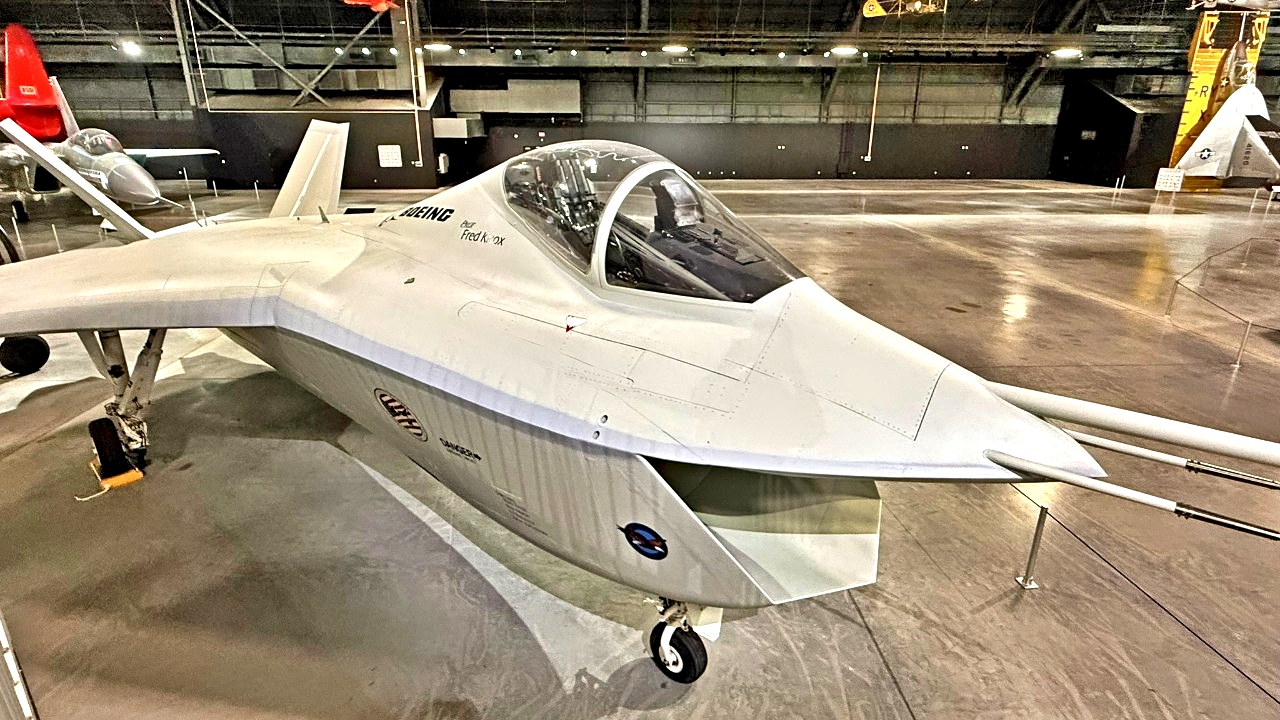
Key Points and Summary – The Boeing X-32 was the unconventional “ugly duckling” that lost to the X-35 in the historic Joint Strike Fighter competition.
-While a competent aircraft with impressive handling, its ultimate downfall was a series of critical design flaws.
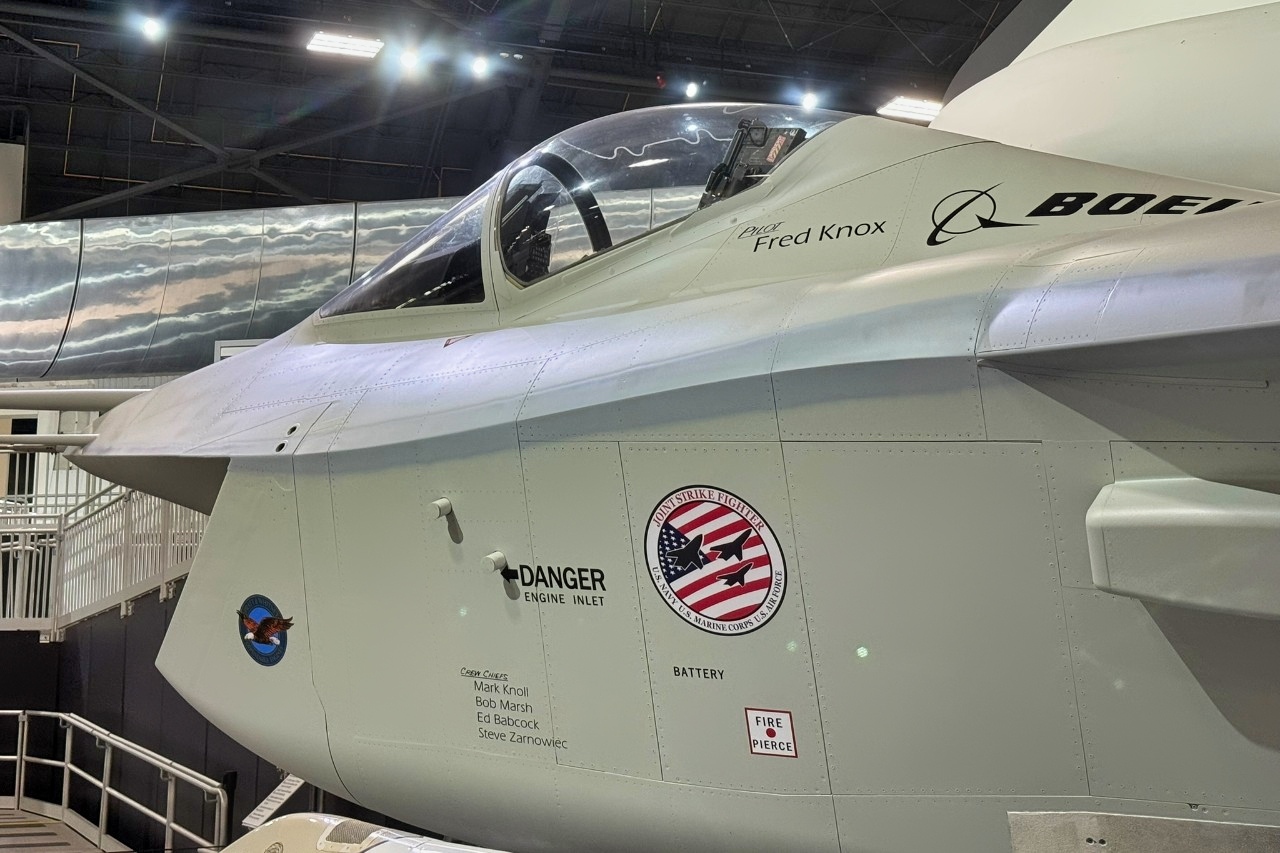
Boeing X-32 Fighter from USAF National Security Journal Original Photo. Taken July 20, 2025.
-The primary reason for its failure was its inefficient and thermally stressful vertical landing (STOVL) system.
-It was also less agile, less stealthy, and poorly suited for carrier operations compared to its rival.
-Despite some innovative features, the X-35 (which became the F-35) was simply the superior, more advanced design, making it the clear winner.
The Boeing X-32 Fighter Failure
The Boeing X-32 was an experimental aircraft that competed in the Joint Strike Fighter program. The X-32 boasted a highly unconventional design that gave it a distinctive look (to put it kindly). The fighter competed against the X-35, which later became the venerable F-35.
The X-32 lost the competition because of its inferior performance in certain key areas. Despite its loss, the X-32 remains a fascinating case-study in aerospace engineering and the importance of balancing stealth, maneuverability, and aesthetics.
The Unique Design of the X-32
The X-32 was a striking aircraft, both in appearance and in its design philosophy. Boeing opted for a large, tailless delta-wing configuration, which provided structural efficiency and ample internal volume for fuel and weapons.
The aircraft was powered by a single, and its most distinctive feature was a massive chin-mounted air intake that gave it a unique, somewhat awkward appearance. Boeing’s approach emphasized simplicity and cost-effectiveness, aiming to meet the JSF program’s goals with fewer moving parts and a more straightforward design.
Two X-32 prototypes were built: the X-32A, which focused on conventional takeoff and landing (CTOL) and carrier operations, and the X-32B, which was designed to demonstrate short takeoff and vertical landing (STOVL) capabilities.
The X-32A made its first flight on Sept. 18, 2000, and the X-32B followed shortly thereafter. Both aircraft successfully completed their flight test programs, demonstrating the feasibility of Boeing’s design concepts.
Flight Performance
The X-32 was capable of supersonic speeds in its CTOL configuration. However, the STOVL version had to sacrifice supersonic capability in order to accommodate vertical lift. The aircraft’s large delta wing provided good lift and stability, but the absence of horizontal tail surfaces limited its pitch control authority, which in turn affected its agility and maneuverability. While the X-32 could perform basic combat maneuvers, it was not as nimble or responsive as its competitor, the X-35.
The STOVL system used in the X-32 was based on a direct-lift approach, where the main engine nozzle could swivel downward to provide vertical thrust. This system was simpler than the shaft-driven lift fan used in the X-35, but it came with significant drawbacks.
The direct-lift method placed enormous thermal and mechanical stress on the engine and airframe, reduced payload capacity, and limited the aircraft’s range. Although the X-32B successfully demonstrated vertical takeoff, hover, and transition to forward flight, the system was less efficient and more taxing than Lockheed Martin’s solution.
Stealth Capabilities
Stealth was another critical aspect of the JSF program, and while the X-32 incorporated some stealth features, it was not as well optimized for low observability as the X-35. The large chin intake and overall shape of the aircraft made it more difficult to manage radar and infrared signatures effectively.
The X-35, with its more refined contours and internal layout, offered better stealth performance and greater potential for future upgrades.
One of the JSF program’s primary goals was to develop a common airframe that could be adapted for different service requirements. Boeing attempted to achieve this through a modular design approach, but the need to accommodate both STOVL and carrier operations in a single airframe led to compromises that affected performance and maintainability. The X-32’s design was less flexible and less suited to the Navy’s demanding carrier landing requirements. The aircraft’s configuration made it harder to achieve the proper angle of attack and pilot visibility during carrier approaches, which raised concerns among Navy evaluators.
The X-32’s Strengths
Still, the X-32 had many compelling fetures. It demonstrated the feasibility of a tailless delta-wing fighter with STOVL capability, and it provided valuable data on stealth, modularity, and multirole adaptability. Boeing’s rapid prototyping and flight-testing efforts were impressive, and the company showed that it could deliver a working prototype on a tight schedule and budget.
Still, the Department of Defense chose the X-35, and several factors contributed to the choice. The X-35’s lift-fan STOVL system was more efficient and cooler, and it allowed the aircraft to retain supersonic capability. Its conventional tail and larger wing made it better suited for carrier operations, and its stealth design was more advanced. Additionally, the X-35 had better growth potential, with an internal layout that facilitated maintenance and future upgrades.
In 2 Words: ‘The Looks’
Let’s be honest, the X-32’s looks did not help.
While aesthetics were not an official evaluation criterion, its unusual appearance may have influenced perceptions. The X-32’s ungainly shape and large intake made it look less like a cutting-edge fighter and more like a prototype, whereas the X-35 had a sleek, modern appearance that inspired greater confidence in its future viability. Put simply, the X-35 looked cooler than the X-32.
In terms of overall performance, the X-32 was a competent aircraft, but the X-35 ultimately outperformed it in several key areas. Its flight performance was adequate but not exceptional, particularly in the STOVL configuration.
Its stealth characteristics were acceptable but inferior to those of the X-35. Its agility was limited by its tailless delta configuration, and its STOVL system, while functional, was less efficient and more thermally challenging. The aircraft was less suitable for carrier operations because of compromises made in its design.
There have been many instances where unconventional designs have been unfairly dismissed; however, in my opinion, this is not one of those cases.
Boeing X-32 Photo Essay from Our Trip to the U.S. Air Force Museum
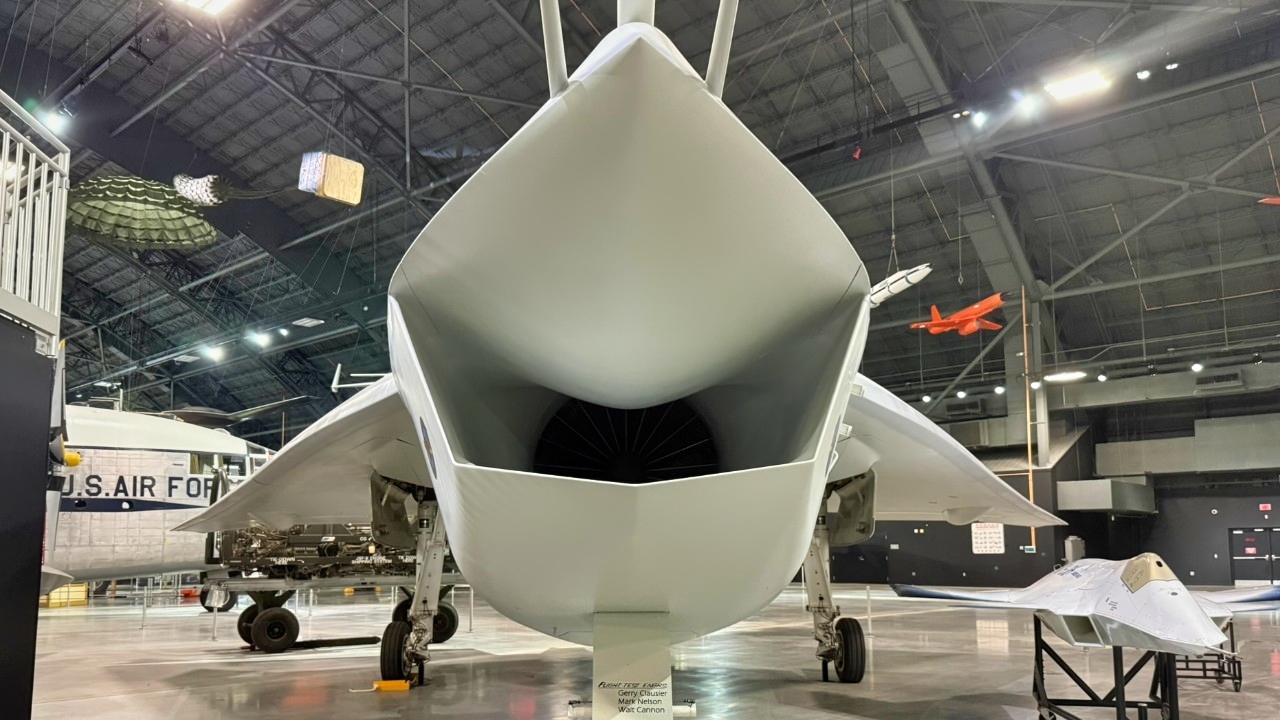
Head On Boeing X-32 Fighter. Image Credit: National Security Journal.
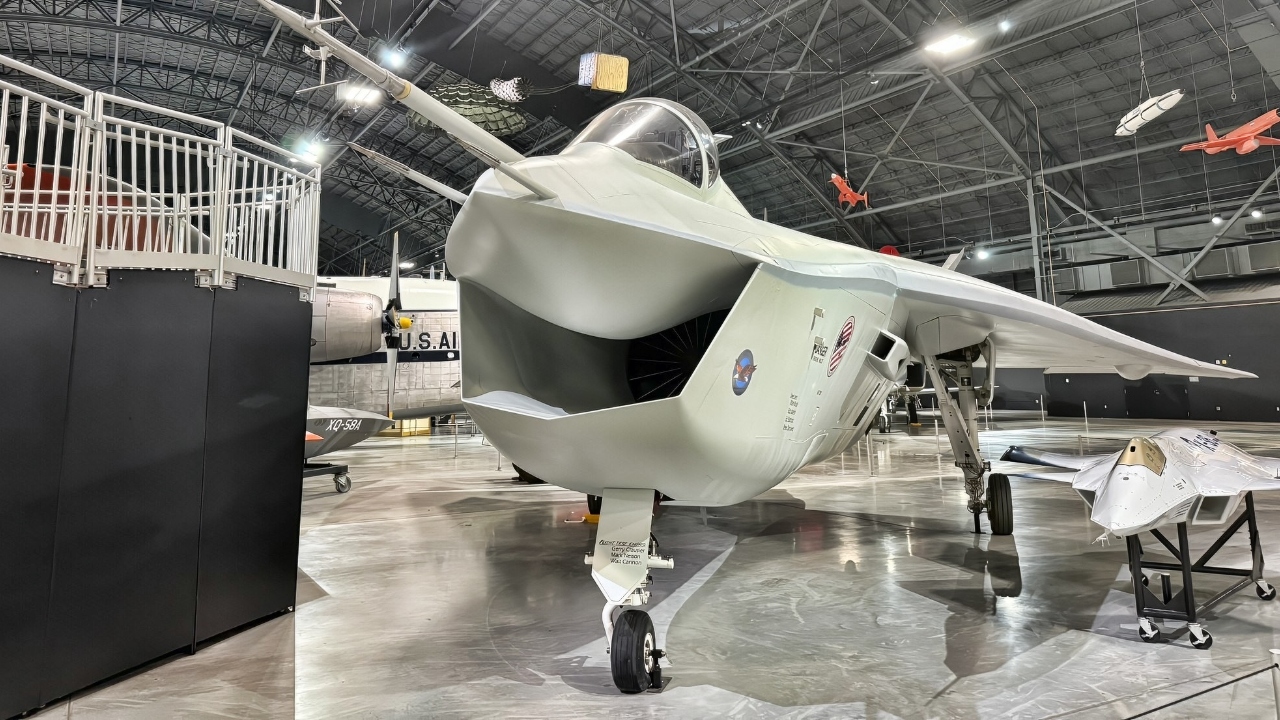
Boeing X-32 Bright Image 2025. Credit: National Security Journal.
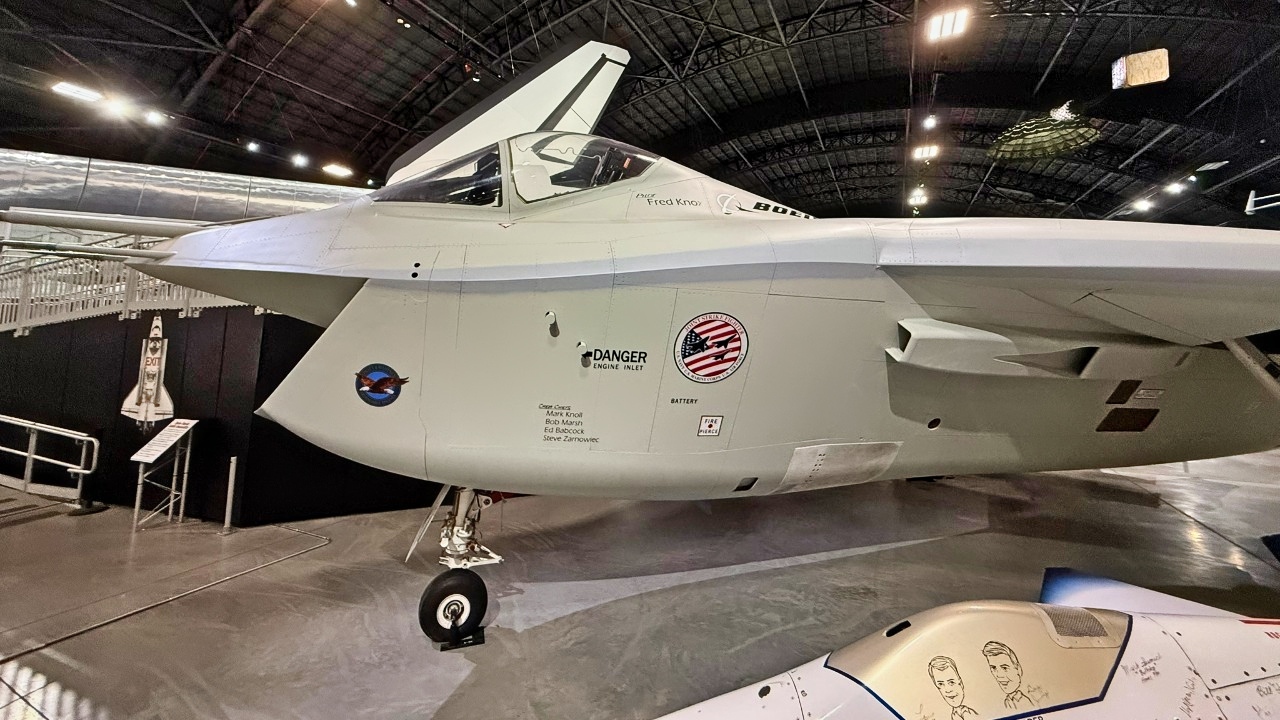
Boeing X-32 Fighter USAF Museum Dayton Ohio. Image Credit: National Security Journal.
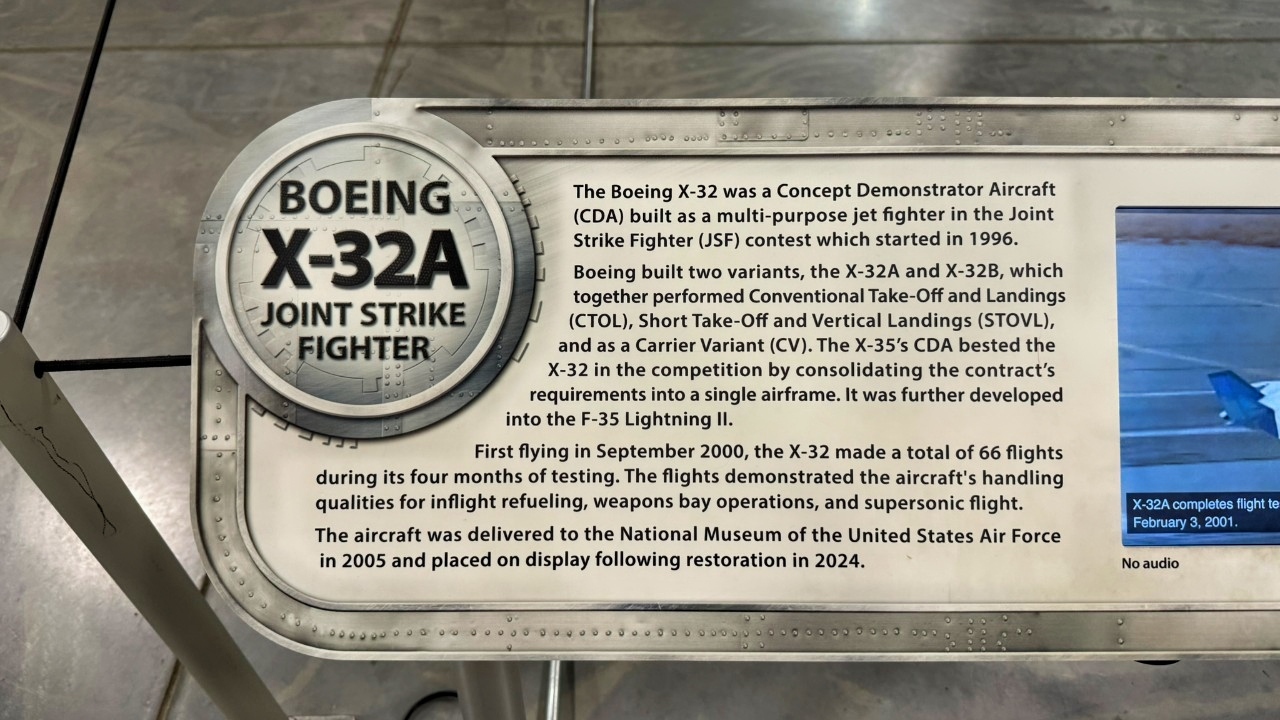
Boeing X-32 Fighter at USAF Museum July 2025. Image Credit: National Security Journal.
About the Author:
Isaac Seitz, a Defense Columnist, graduated from Patrick Henry College’s Strategic Intelligence and National Security program. He has also studied Russian at Middlebury Language Schools and has worked as an intelligence Analyst in the private sector.
More Military
We Almost Touched the F-117 Stealth Fighter


