

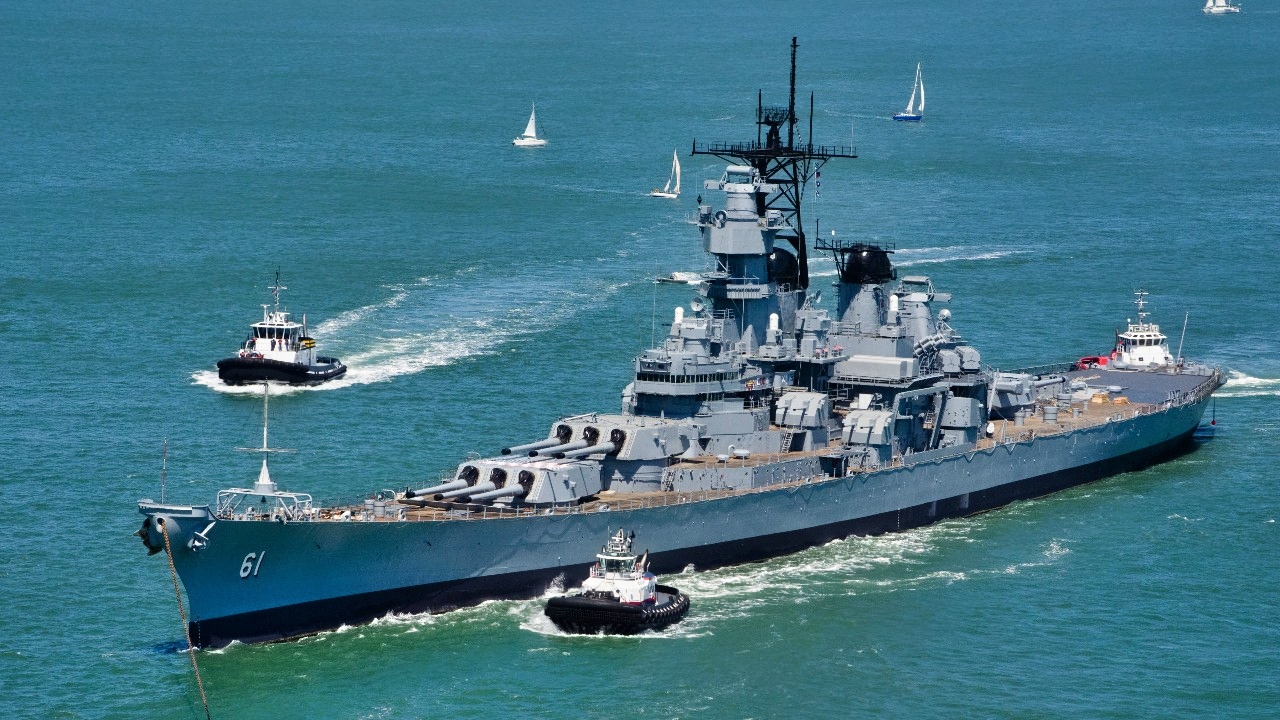
Key Points and Summary on Iowa-Class Battleship – While the idea of reactivating the US Navy’s iconic Iowa-class battleships is popular among enthusiasts, it is a logistical and financial nightmare that makes their return to service a near impossibility.
-These 80-year-old warships are unsuited for modern naval warfare, lacking the advanced air defense and electronic warfare systems needed to survive.
-The immense cost of modernization, which would run into the billions, combined with the insurmountable challenges of finding a 1,500-sailor crew and restarting production for their unique 16-inch shells, means the era of the battleship is definitively over.
The Great Iowa-Class Battleship Debate
Ever since their retirement, there have been discussions circulating about whether or not to reactivate the old Iowa-class battleships. These ships have garnered a lot of popularity due to their large size, sturdy build, and hefty 16-inch gins. As interesting as it would be, reactivating the Iowa-class battleships, practically, the economic and industrial hurdles render this idea impractical for the modern age of naval warfare.
Could the Iowa-Class Make a Comeback?
The Iowa-class battleships were formidable vessels, especially for their time. Each ship was armed with nine 16-inch guns capable of firing 2,700-pound shells over 20 miles. They were also equipped with a range of secondary weapons and, during their 1980s modernization, received Tomahawk cruise missiles and Phalanx close-in weapon systems. Despite their massive size, they could reach speeds exceeding 30 knots, making them the fastest battleships ever built. Their armor was thick and extensive, designed to withstand heavy punishment in ship-to-ship combat.
One of the arguments occasionally made in favor of reactivating the Iowa-class ships is their ability to provide naval gunfire support for amphibious operations. Their 16-inch guns could deliver devastating firepower against shore targets. However, this role has largely been taken over by missile systems and aircraft.
The Navy has explored alternatives, such as the Zumwalt-class destroyers, which were intended to carry advanced long-range guns. Although the Zumwalt program has faced its own challenges, it demonstrates the Navy’s preference for new technologies over legacy systems.
Naval Warfare has Changed
However, the strategic landscape of naval warfare has changed dramatically since the Iowa-class ships last saw combat. The age of the battleship has long since passed, replaced by the dominance of aircraft carriers, submarines, and missile-equipped destroyers. Modern naval doctrine emphasizes flexibility, stealth, and precision over brute force. The massive guns of the Iowa-class, while awe-inspiring, are no longer the most effective tools for delivering firepower. Precision-guided munitions launched from aircraft, submarines, or smaller ships can achieve similar or greater effects with far less logistical burden.
One of the most significant limitations of the Iowa-class ships today is their lack of modern air defense and electronic warfare capabilities. They were not designed to operate in the highly networked, sensor-rich environments of modern naval combat. Their radar systems, communications equipment, and defensive countermeasures are outdated by today’s standards. Retrofitting them with modern systems would be a monumental task, requiring extensive redesign and integration work.
The physical condition of the ships also poses a major hurdle. These vessels are over 80 years old. While they have been maintained as museum ships, they have not been kept in a state of readiness for combat. Reactivating them would require thorough inspections, revealing corrosion, metal fatigue, and other age-related issues. Many of the original components are no longer manufactured, meaning replacements would need to be custom-built or reverse engineered. This would add significantly to the cost and complexity of any reactivation effort.
Economically Impractical
From an economic standpoint, the cost of reactivating and modernizing even one Iowa-class battleship would likely run into the billions of dollars. This money could be more effectively spent on building new ships, developing unmanned systems, enhancing cyber capabilities, or investing in other emerging technologies. The opportunity cost of bringing back a battleship is simply too high when compared to the strategic benefits it would offer.
The issue of ammunition is also important to consider. The 16-inch shells used by the Iowa-class battleships are no longer in production. Restarting production would involve reestablishing supply chains, manufacturing facilities, and quality control processes, all for a weapon system that is no longer central to naval strategy. Moreover, the logistics of storing, transporting, and handling such massive munitions would be a significant burden. While the 16-inch guns are powerful, they lack the accuracy and versatility of missiles carried by modern destroyers.
Another major challenge is the manpower required to operate these ships. Each Iowa-class battleship needed a crew of approximately 1,500 to 1,800 sailors. In contrast, modern warships are far more automated and require significantly fewer personnel. Training and maintaining such a large crew would be inefficient and expensive, especially in an era when the Navy is already facing recruitment and retention challenges.
Unlikely to See Service Ever Again
Politically, there is little momentum behind the idea of reactivating the Iowa-class ships. While there is certainly public admiration and nostalgia for these vessels, the Navy and Department of Defense have consistently prioritized modernization and innovation over the revival of legacy platforms.
In 2006, Congress allowed the Navy to remove the Iowa-class ships from the Naval Vessel Register, provided they were maintained in a condition that could allow for potential reactivation. However, this was more of a symbolic gesture than a practical plan.
To be fair, there may be some hypothetical scenarios in which the reactivation of an Iowa-class battleship might be considered. In the event of a large-scale global conflict with a peer adversary such as China or Russia, they might be used to fill highly niche roles. Alternatively, if technological breakthroughs allowed for cost-effective modernization and automation, the idea might gain some traction. However, even in these extreme cases, it is more likely that the Navy would choose to invest in new platforms rather than resurrect outdated ones.
About the Author:
Isaac Seitz, a Defense Columnist, graduated from Patrick Henry College’s Strategic Intelligence and National Security program. He has also studied Russian at Middlebury Language Schools and has worked as an intelligence Analyst in the private sector.
Russia’s Bomber Forces
Tu-22M3: The Bomber Ukraine Hit With Drones


Jim
July 10, 2025 at 10:29 pm
We did it once, but I don’t think we’ll do it again.
The big sixteen inch guns have been surpassed by missile technology. The range is impressive at around twenty miles, but missiles have such longer range and can be pinpointed as well or better.
Also, for a battleship to be twenty miles from a possibly strong missile barrage to have its shells matter puts it in harms way, especially when hypersonic missiles are factored into consideration.
So if the big guns have been surpassed there isn’t a reason to send them back to sea on active duty.
Could it be that one of the Iowa-Class Battleships could be retained in a “touring” condition? I don’t know. They are heavy and take a large crew to operate (a ‘touring’ crew??).
The battleships are symbolic of naval & military might.
Somehow, the thought of being able to call out one of the best battleships ever built and see it parade makes me nostalgic for the sleek lines and big guns that made little kids thrill and men watching them go off to war on the high seas proud and hopeful for the result.
Somehow… just a thought.
HCII
September 7, 2025 at 12:40 am
Missiles and Aircraft will never replace artillery as seen in Ukraine it’s still called the God of war. Missiles are far too expensive and limited in number to use in shore bombardment, they would burn through the stockpile in less than a day, and the airspace in a beachhead of something like Chinese shores would be highly contested and unsafe. The sad truth is the Navy has no asset still floating that could fill NGFS except four museum ships. If war broke out with a peer requiring beachheads the Navy would have no choice but to rush them into service somehow.