
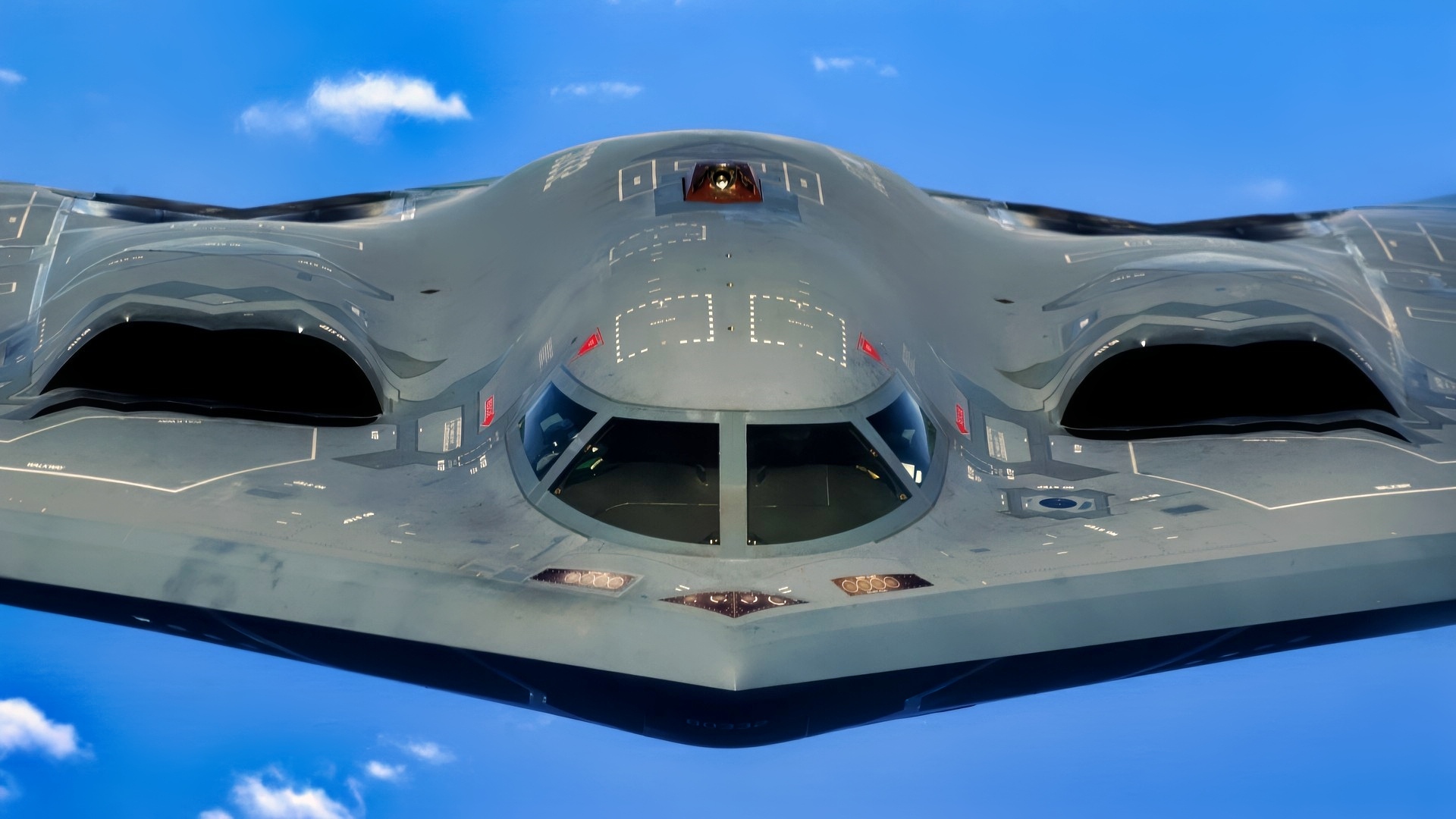
It’s been almost nine months of fighting, and Iran has suffered extensive military losses and economic damage.
The country has also lost most of its senior leadership. But despite the losses, the war continues, and Tehran insists it will continue fighting no matter what.

A U.S. Air Force B-52H Stratofortress aircraft flies in a seven-ship formation during the Hyundai Air and Sea Show at Miami Beach, Florida, May 24, 2025. The flyover represented the Air Force’s total force, integrating active duty, guard, and reserve pilots flying the B-1B Lancer, B-2 Spirit, F-22 Raptor, A-10 Thunderbolt II, B-52H Stratofortress, F-16C Fighting Falcon, and F-15C Eagle aircraft. (U.S. Air Force photo by Staff Sgt. Bailee A. Darbasie)

U.S. Air Force Senior Airman Colby Delia, 9th Expeditionary Bomb Squadron crew chief, and Airman 1st Class Olivia Ward, 9th Expeditionary Bomb Squadron crew chief, prepare for a B-1B Lancer to take off for a mission at Misawa Air Base, May 9, 2025. BTF missions provide opportunities to train and work with our allies and partners in joint and combined operations and exercises. (U.S. Air Force photo by Airman 1st Class Mattison Cole)
As President Donald Trump considers whether to launch another major round of airstrikes against Tehran, some analysts are now questioning whether the conflict could ultimately leave Iran with greater influence over its neighbors than it had before the war began.
Writing for The New York Times on November 17, Thomas L. Friedman warned that Iran may emerge from the conflict more dominant over its neighbors, even after the destruction.
Friedman made the argument after attending a regional conference in Abu Dhabi, where he spoke with diplomats about growing concerns within Persian Gulf governments.
Recent developments suggest that, while Tehran has suffered greatly from U.S. and Israeli strikes, it retains significant military capabilities and a large stockpile of missiles, including in what has been described as an underground missile “city.”
But with the economic consequences of the naval blockade and sanctions, questions remain about just how much power Iran will retain when the fighting eventually ends.
Could Iran Gain More Regional Influence?
Friedman’s warning that Iran could gain more regional influence comes amid uncertainty about how exactly the war will end.
If the incoming Democratic-controlled Congress gets its way, the Trump administration could face hurdles in securing the funding it needs to continue the war, suggesting that a segment of the American political establishment would prefer that the United States withdraw and Iran be allowed to control traffic through the Strait of Hormuz, charge a toll, and profit as the oil industry recalibrates.
The Republicans, and Trump more specifically, would prefer to see Iran concede or the regime in Tehran fall. Others speculate that a deal is inevitable.
Writing in the New York Times, Friedman described how Gulf governments are becoming increasingly concerned that Washington entered the conflict without a clear strategy for ending the fighting, and he warned that Iran could emerge from the conflict “more dominant than ever over its neighbors.”
“The Gulf Arabs never urged the United States to start this war, but once it did, they assumed it had a plan to finish it,” he wrote. “They assumed the Americans understood that the only government they ever toppled primarily with air power was Japan’s — and that took two nuclear bombs.”
So, how could Iran gain greater influence?
In short, neighboring governments may conclude that the United States ultimately cannot guarantee their security against future Iranian attacks, and therefore begin working with Tehran to mitigate the threat it poses to them.
Despite months of American military operations, Tehran has proven that it is capable of disrupting shipping through the Strait of Hormuz and that it can continue to target energy infrastructure across the Gulf.
That could encourage countries such as Saudi Arabia and the United Arab Emirates to negotiate directly with Tehran, and even make concessions to the regime, rather than relying exclusively on Washington for protection.
Iran could also use its ability to threaten commercial shipping as leverage in future negotiations, potentially securing favorable economic deals and security guarantees without actually rebuilding its military to pre-war levels.
Could Iran Emerge Weaker, Instead?
There are good reasons to believe that Iran will actually emerge weaker from the conflict, however — and that’s certainly the intent for the U.S. and Israel.
While Tehran may retain the ability to threaten its neighbors for now, its economic and military capabilities have suffered severe damage, and U.S. sanctions on countries and entities doing business with Tehran could be enough to prevent many of Tehran’s neighbors from working too closely with it.
And with the enormous pressure on Iran’s economy, economic measures would well prove effective in forcing the regime to make concessions.
The Trump administration is also hoping that the economic pressure may be sufficient to encourage Iranian civilians to rise against the regime.
This month, reports described how Iranian leaders were becoming concerned about public dissatisfaction and potential dissent as the country prepares for winter gas shortages.
The shortages come after months of military strikes against the country’s energy infrastructure, and the economic pressure is adding to the existing problems that Iranian civilians struggle with daily.
Iran’s military capabilities have also been significantly degraded.
While the country can still theoretically produce about 50 ballistic missiles per month, that figure is around half of its pre-war rate — and another round of strikes, should it occur, could degrade those capabilities further.
A four-to-seven-day campaign, as Israel is reportedly proposing, could further degrade Iran’s military stockpile and its ability to manufacture them.
Ultimately, though, Iran’s ability to threaten commercial shipping and regional infrastructure doesn’t mean that it will emerge from the conflict stronger.
In fact, the regime will certainly be much weaker. The questions are: how does it end, and how much power will Tehran have left?
About the Author: Jack Buckby
Jack Buckby is a British researcher and analyst specializing in defense and national security, based in New York. His work focuses on military capability, procurement, and strategic competition, and he produces and edits analysis for policy and defense audiences. He brings extensive editorial experience, with a career output spanning over 1,000 articles at National Security Journal, and has previously authored books and papers on extremism and deradicalization.


