

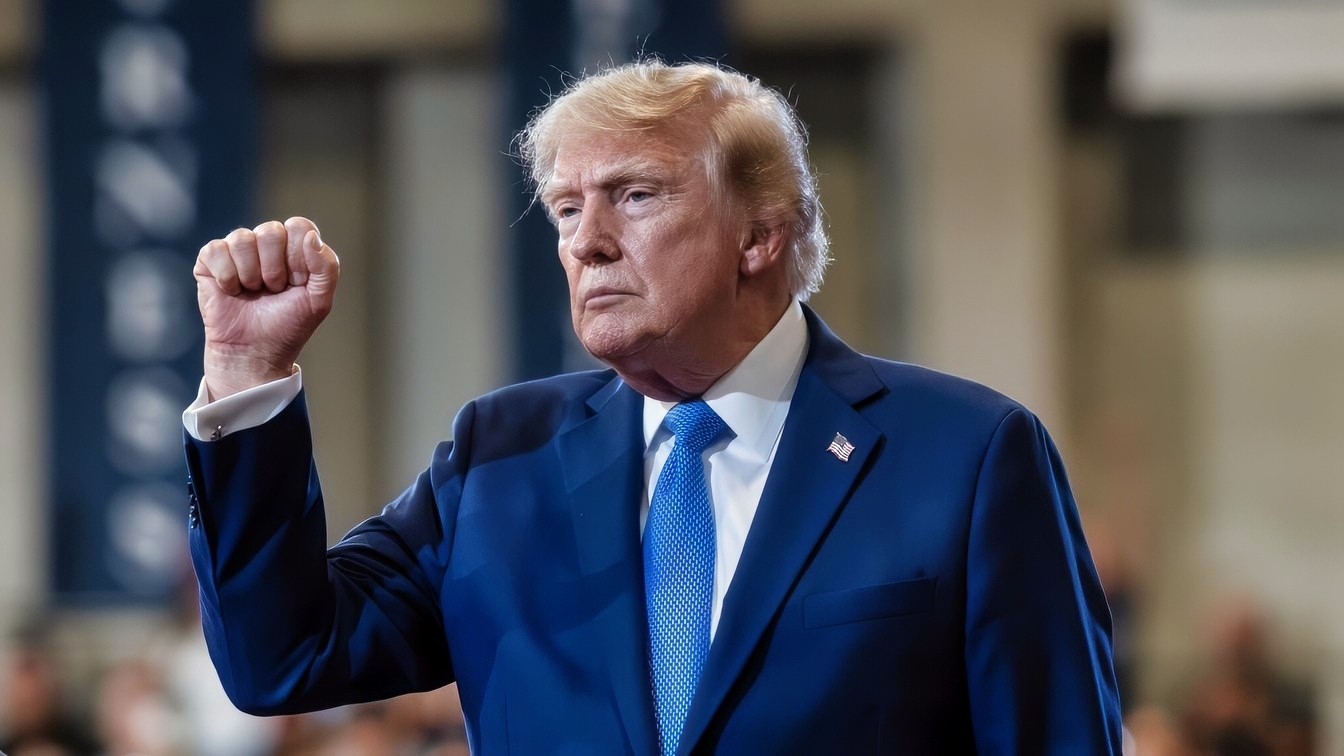
Throughout the home stretch of the midterm elections, President Donald Trump indicated that he would decide what to do next in Iran after the vote, and possibly very soon after.
Weeks before the vote, he vowed not to attack Iran again until after November 3.

Four B-1B Lancers assigned to the 9th Expeditionary Bomb Squadron, deployed from Dyess Air Force Base, Texas, arrive Feb. 6, 2017, at Andersen AFB, Guam. The 9th EBS is taking over U.S. Pacific Command’s continuous bomber presence operations from the 34th EBS, assigned to Ellsworth AFB, S.D. The B-1B’s speed and superior handling characteristics allow it to seamlessly integrate in mixed force packages. While deployed at Guam the B-1Bs will continue conducting flight operations where international law permit. (U.S. Air Force photo/Tech. Sgt. Richard P. Ebensberger)

A U.S. Air Force B-1B Lancer departs after conducting aerial refueling with a 28th Expeditionary Air Refueling Squadron KC-135 Stratotanker during a mission in the U.S. Central Command area of operations, Oct. 25, 2019. The B-1B flew directly from its home station of Ellsworth Air Force Base, S.D., demonstrating the U.S. Air Force’s ability to rapidly deploy strategic bombers anywhere in the world. (U.S. Air Force photo by Master Sgt. Russ Scalf)
Then, the Republicans suffered a midterm election wipeout, and the next day, Vice President JD Vance agreed with the conventional wisdom that the Iran war was the main reason the GOP had such a bad night.
This left the president in a position where restarting the war right away might not have been politically tenable. That’s to say nothing about Democrats controlling the purse strings and possibly being able to stop funding the war starting in January.
And now, the president says a final decision on what to do next in Iran may wait for the new year.
According to Reuters, which interviewed Trump this week, the president said: “Well, I’ll talk to you about it after the beginning of the year.”
“We’ve got time,” the president added.
The outlet spoke to the president on his plane, as he returned to the United States from his visit to China.
Going Back and Forth
Trump, Reuters noted, spent most of the fall going back and forth on whether to launch a major attack on Iran, or to pursue a diplomatic deal that would end the conflict.
In October, the U.S. launched a renewed campaign of economic pressure on Iran, which included the threat of sanctions on countries that do business with Iran.
No attack was ever launched, and while mediated talks have taken place between the two sides, there have been no breakthroughs.
The U.S., for now, seems content to leave things in limbo and to continue putting economic pressure on Iran, in what The Atlantic describes as “an unstable standoff.”
In the Reuters interview, Trump didn’t seem upset about Vance distancing himself from the Iran War.
“JD was fine,” Trump told the news outlet. “What he said was right. He said that the whole situation is one of the reasons, certainly, that the election didn’t go our way.”
Still, Trump said that he doesn’t regret launching the war if it means Iran does not obtain a nuclear weapon.
Also in the interview, Trump downplayed a report that Iran was planning to launch a “dirty bomb” in Washington, D.C. Iran’s foreign ministry has denied any plans to do so.
“There is indication that Iran is looking at gases, looking at bio, because we’ve shut them out with the nuclear. Nuclear is much harder,” Trump told Reuters. “And they’re looking at gas and … biological weapons — not nice — and other things.”
A Vague Peace Declaration
The president, in China, had held an historic meeting with Russian President Vladimir Putin and Chinese President Xi Jinping. The three leaders issued a “Peace Declaration” after the meeting, which included vague language and did not mention Iran or the Russia-Ukraine war.
The three leaders, in their statement, “reaffirmed that a nuclear war cannot be won and must never be fought,” and also agreed to “conduct a dialogue on reducing nuclear risks and preventing proliferation of nuclear weapons.” However, there was no treaty or agreement on specific limitations of such weapons, which have sometimes historically taken place as a result of summits between the leaders of the U.S. and Russia (and before that, the Soviet Union).
In the Reuters interview, Trump called the China summit a success.
“On a scale of zero to 10, I think it was a 12,” the president said. “Fantastic relationships built.” He also called the summit “bigger than Yalta,” which is true in the sense that China participated, but certainly not in terms of the significance of the results.
Sen. Charles Schumer (D-NY), the Senate minority leader running to return to the majority leader position, ripped the summit while touting its significance.
The meeting, and Trump’s behavior there, was ”a historic embarrassment that people will remember long into the future,” Schumer told Reuters.
“It’s a betrayal of the United States by a president who loves nothing more than to bow down to our adversaries for a photo op,” Schumer added.
About the Author: Stephen Silver
Stephen Silver is an award-winning journalist, essayist, and film critic, and contributor to the Philadelphia Inquirer, the Jewish Telegraphic Agency, Broad Street Review, and Splice Today. The co-founder of the Philadelphia Film Critics Circle, Stephen lives in suburban Philadelphia with his wife and two sons. For over a decade, Stephen has written thousands of articles on politics, national security, technology, and the economy. Follow him on X (formerly Twitter) at @StephenSilver, and subscribe to his Substack newsletter.


