


U.S. Central Command just flatly denied claims from Iran’s IRGC-aligned Fars News Agency that an American Navy frigate was hit by Iranian missiles in the Strait of Hormuz. The denial holds up because no U.S. Navy warship has ever been hit in the Red Sea or Strait of Hormuz despite hundreds of attempted Iranian and Houthis’ missile and drone attacks—a record made possible by some of the most sophisticated multi-layered ship defenses ever fielded.
Iran Can’t Hit the U.S. Navy
U.S. Central Command has simply said “no,” a U.S. Navy warship was “not” hit by Iranian missiles in the Strait of Hormuz, despite claims from Iran’s IRGC-aligned Fars News Agency that a U.S. Frigate was hit.

Nimitz-class carrier USS George H.W. Bush (CVN 77) transits the Atlantic Ocean while offloading munitions via helicopter to the world’s largest aircraft carrier, USS Gerald R. Ford (CVN 78), June 27, 2025. Gerald R. Ford, a first-in- class nuclear aircraft carrier and deployed flagship of Carrier Strike Group Twelve, incorporates modern technology, innovative shipbuilding designs, and best practices from legacy aircraft carriers to increase the U.S. Navy’s capacity to underpin American security and economic prosperity, deter adversaries, and project power on a global scale through sustained operations at sea. (U.S. Navy photo by Mass Communication Specialist Seaman Jarrod Bury)

Ford-Class Aircraft Carrier. Image Credit: Creative Commons.
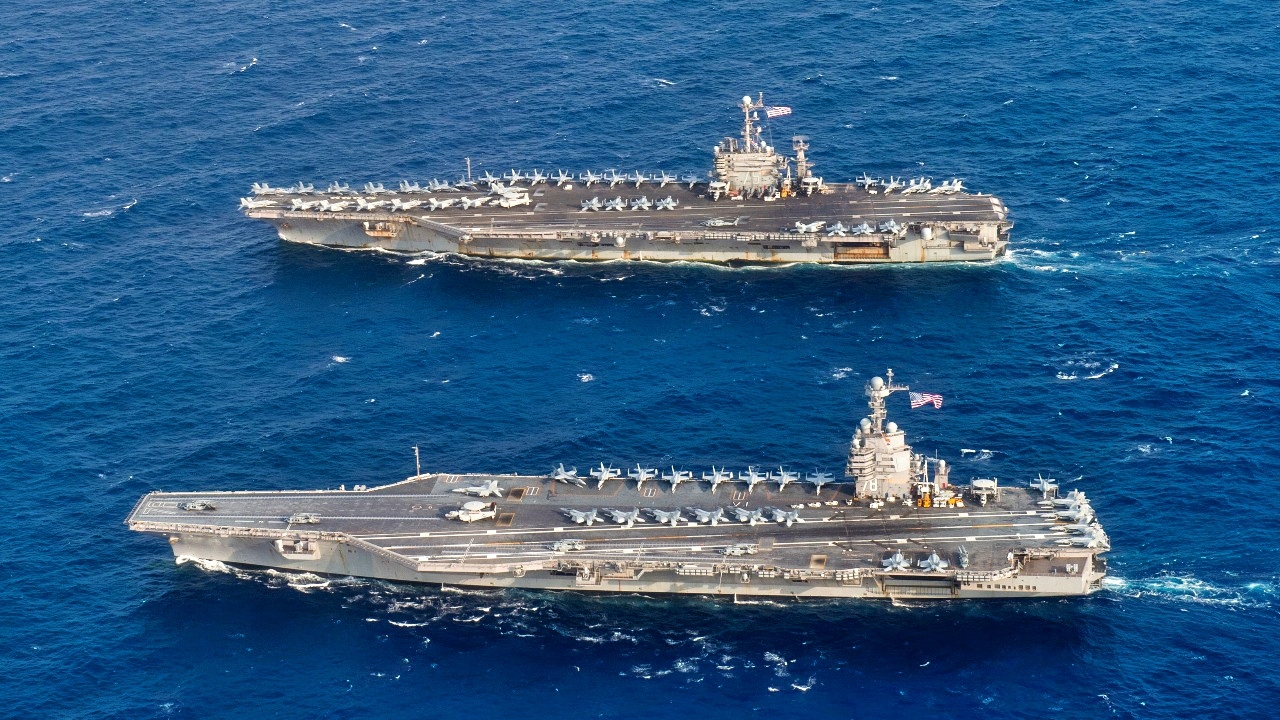
The U.S. Navy Gerald R. Ford–class aircraft carrier USS Gerald R. Ford (CVN-78) and the Nimitz-class aircraft carrier USS Harry S. Truman (CVN-75) underway in the Atlantic Ocean on 4 June 2020, marking the first time a Gerald R. Ford–class and a Nimitz-class aircraft carrier operated together underway.
A statement from U.S. Central Command acknowledged that the U.S. was operating in the region but said unequivocally that “no” U.S. ships were hit.
This CentCom statement aligns with the U.S. Navy’s experience thus far, as no U.S. Navy warships have actually been “hit” in the Red Sea or Strait of Hormuz in recent years, despite hundreds of attempted Iranian and Houthis’ missile and drone attacks.
As for “why” there has been no actual “hit” of a U.S. Navy warship, there are numerous reasons or variables that explain this, pertaining to weapons, tactics, doctrine, sensing, and multi-domain “sensing.”
U.S. Navy Warship Defenses
The U.S. Navy’s multi-layered warship defenses are extremely significant, as they operate with a ‘tiered” or “range-based” ability to destroy incoming threats from great distances all the way into close-in threats.
In the unlikely event that a threat manages to pass through several longer-range layers of ship defenses, U.S. Navy warships are armed with deck-mounted guns, close-in interceptor missiles, and “area” weapons such as the Close-in-Weapons System (CWIS).
The CWIS
It is a phalanx gun capable of firing 4,500 tungsten “steel” projectiles per minute to blanket an area with defensive fire. Approaching drones or small boats that manage to get within close range of Navy warships will be quickly “hit” with these weapons.
However, in most cases in the Middle East in recent years, it seems threats have not often penetrated the outer layers of ship defenses, so they have had to be engaged by the closest-in systems.
Multi-Domain Sensing
There are many reasons for this, pertaining to U.S. Navy multi-domain sensing and command and control. One of the critical lessons learned in the Red Sea.
For example, multi-domain command and control technologies are increasingly able to “share” threat-related data between ground command and control centers, surface ships, and airborne assets such as drones, fighter jets, and surveillance planes.
This means approaching threats and their trajectories can be “seen” and countered from many angles at greater stand-off distances than ever before.
Specifically, the Commanding Officer of Carrier Strike Group 2 in the Red Sea in 2024 said carrier-launched fighter jets proved valuable as air sensors, helping surface warships “see” and “track” incoming missile and drone attacks.
Additional Targeting Support
Ship-integrated Aegis Combat Systems, software-enabled air defenses that connect advanced, high-fidelity radar with ship-based fire control, enabling the launch of interceptor missiles to destroy incoming missiles and drones.
The Baseline 10 combines ballistic missile defense and air-and-cruise missile defense into a single, integrated system, enabling anti-ship cruise missiles, ballistic missiles, and enemy aircraft or drones to be “seen.”
How it Works
Using electromagnetic “pings,” the ship-based Aegis radar bounces signals off of threat objects and analyzes the “return” signals to develop a picture or “rendering” of a threat object.
Therefore, Aegis radar can discern the distance, speed, shape, and trajectory of an approaching missile, then “cue” a countermeasure, interceptor, or defensive measure to destroy the threat. Ship-based defenses are “tiered” and “layered.”
They have an integrated way to ensure a threat is sufficiently destroyed. The longest-range interceptor is likely the SM-3 Block IIA, a large, modern interceptor upgraded with software to track and destroy long-range ballistic missiles and even ICBMs in the terminal phase of flight as they re-enter the Earth’s atmosphere.
Mid-range interceptors include the SM-6 and SM-2 interceptors, yet these Vertical Launch System-fired interceptors are heavily fortified by additional layers of ship defenses for even closer-range intercept. The SM-6 and SM-2 are “long-range” interceptors, meaning they can “hit” threats from 100-to-150 miles away.
Close-in-Defenses
Closer-in defenses include the Evolved Sea Sparrow Missile Block II, a cruise missile interceptor capable of flying in “sea-skimming” mode at lower altitudes parallel to the surface to destroy incoming cruise missiles. The ESSM Block II is listed with a range of roughly 27 miles. Also in this general mid-to-close-range defensive sphere, the Navy’s Rolling Airframe Missile can fire targeted interceptors and explosives out to 5 miles.
The Navy’s Coyote Block 2 drone interceptor
Operates at ranges of roughly 6 miles, yet this weapon is a drone vs. drone destroyer, meaning it is a small drone that can fire from the ship’s deck and use a proximity fuse to “explode” fragmentation across an “area” to counter a drone swarm.
Non-kinetic countermeasures
Alongside these “kinetic” or explosive defensive options, there are many non-kinetic countermeasures, such as electronic warfare systems that can “jam” incoming missiles. Laser weapons are also increasingly arming U.S. Navy warships, weapons which not only travel at the speed of light but are scalable, meaning they can disable, burn through, or fully incinerate incoming drone and missile threats.
About the Author: Kris Osborn
Kris Osborn is a Military Technology Editor. Osborn is also President of Warrior Maven – Center for Military Modernization. Osborn previously served at the Pentagon as a highly qualified expert in the Office of the Assistant Secretary of the Army—Acquisition, Logistics & Technology. Osborn has also worked as an anchor and on-air military specialist at national TV networks. He has appeared as a guest military expert on Fox News, MSNBC, The Military Channel, and The History Channel. He also has a Masters Degree in Comparative Literature from Columbia University.


