
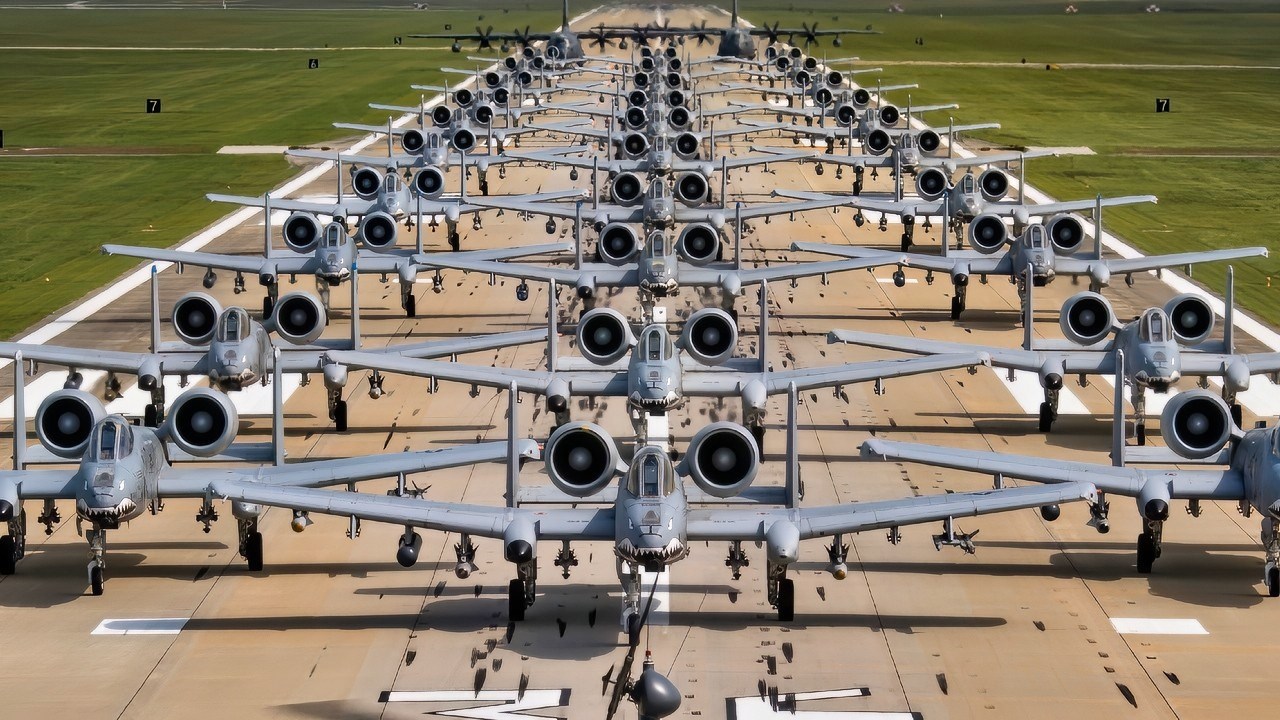
Key Points and Summary – The A-10 Warthog, a Cold War-era tank-buster, has found a “surprising new role” as a cost-effective drone hunter.
-Recent photos from CENTCOM show kill marks for two Iranian-style Shahed drones on an A-10.

U.S. Air Force Major Lindsay “MAD” Johnson, A-10C Thunderbolt II Demonstration Team commander and pilot, flies during the National Cherry Festival Air Show in Traverse City, Mich., June 29, 2024. It took a team of highly skilled individuals to keep the A-10 flying and make Johson’s demonstrations possible. (U.S. Air Force photo by Senior Airman Devlin Bishop)

A-10 Warthog. Image Credit: Creative Commons.
-This new mission leverages the A-10’s long “loiter” time and slow speed, combined with cheap, laser-guided APKWS rockets (using new FALCO software) to counter inexpensive drone threats.
-While the A-10 lacks advanced radar, this “niche” role proves the legacy platform can be adapted to modern warfare as the Air Force plans its retirement.
A-10 Warthog: Tank Buster to Drone Hunter
The U.S. Air Force’s venerable A-10 Thunderbolt II – nicknamed the “Warthog” – may have found a surprising new role: shooting down drones.
Recent imagery shows one of the jets recently returning from the U.S. Central Command (CENTCOM) area of responsibility with painted kill-marks that suggest it destroyed two Iranian-style Shahed attack drones during its deployment. The news reveals that the Warthog may have found itself a brand new role at a time when global air forces are all competing to adapt to new unmanned aviation technology.
In the past, the A-10’s mission was squarely focused on close air support (CAS), in which it helped ground troops by attacking tanks, armored vehicles, and enemy positions.
But now, the aircraft is armed for different kinds of fighting – including counter-unmanned aerial systems.
The key weapon on board the A-10 is the Advanced Precision Kill Weapon System II (APKWS II) rocket, which is a laser-guided version of the 2.75-inch Hydra rocket, which has been modified with “Fixed-Wing Air-Launched Counter-Unmanned Aerial Systems Ordnance” (FALCO) software designed specifically for drone intercepts.
Compared to high-end air-to-air missiles, these rockets cost a fraction of the price. That matters when facing inexpensive drone threats where traditional missiles by simply be overkilled – too expensive, too powerful, and harder to deploy.
The new kill-mark photos strongly suggest that the A-10 has now become a counter-UAS asset.
Why the A-10 Is (and Isn’t) A Good Fit
The Warthog brings several key strengths to the counter-drone role. First, it has a long “loiter” time, meaning it can stay in one area for extended periods. It flies relatively low and slow compared to high-speed fighters, giving it more time to detect and engage slower-moving drone threats.

Airman Brandon Kempf, 757th Aircraft Maintenance Squadron assistant dedicated A-10 Thunderbolt II crew chief, watches as an aircraft taxis into position after landing May 9, 2013 at Nellis Air Force Base, Nev. Upon landing, the A-10 Thunderbolt receives numerous post-flight checks and maintenance including strut servicing and ammunition downloads. (U.S. Air Force photo by Airman 1st Class Joshua Kleinholz)
The aircraft can also carry a large set of rockets, and its cannon provided a backup options for close-range targets.
The Warthog is clearly well-suited for engaging slower, propeller-driven attack drones that now pose a growing threat, with more being manufactured than ever before.
That being said, the A-10 also has some drawbacks. It lacks a built-in high-performance radar optimized for fast aerial targets, so it must instead rely on external sensors, targeting pods, or cues from other platforms to aid drone detection. It is also not ideal for intercepting high-speed cruise missiles for advanced jet fighters.
So, what we’re seeing now is more of a niche mission than a complete replacement for high-end aircraft—but even filling this niche role with the U.S. Air Force could be hugely beneficial, as it considers options for long-term drone defense.
Why the A-10 Exists and What It Means Now
The A-10 was built for a different era.
Its original mission was close air support (CAS), which saw it flying low over battlefields, attacking tanks, armored vehicles, and enemy positions, and generally protecting ground troops. It first flew in the early 1970s and entered service officially in 1977.
Over the decades, its experience and successes in war earned it a reputation for toughness, precision in support missions, and overall survivability. Today, it is one of the United States’ most recognizable military aircraft.
And now, as the Air Force prepares to retire the A-10 fleet fully, one of its final missions may be counter-drone work. An aircraft designed to kill tanks in the Cold War could be the first to fully assume the role of confronting an entirely new generation of threats, hunting small unmanned aircraft in the Middle East and beyond.
The story comes with some broad lessons. First, it’s clear that the rise of inexpensive drones—a trend that has emerged primarily as a result of the war in Ukraine but was inevitable given recent technological advances—is forcing adaptation.
Traditional air defense often required high-value, high-cost interceptors—but when adversaries begin deploying large numbers of cheap drones, the calculations change dramatically.
Lower-cost guided rockets become necessary, even though they may not match the range or speed of high-end missiles. They are, however, “good enough” for many drone threats.
Secondly, this new role for the A-10 shows that even legacy platforms can contribute meaningfully rather than simply being retired, as long as they can be upgraded and reassigned. The pairing of the A-10 and APKWS could serve as a cost-effective bridge between older systems and future missions, buying the U.S. Air Force time.
What We Don’t Know
There is not yet any official confirmation of exactly when and how many drones the A-10 has downed using APKWS rockets. The kill markings are strong circumstantial evidence, but the Air Force has not publicly detailed the engagements.
And while the missions make sense in some theaters, the A-10 cannot replace high-altitude aircraft or fighter jets designed for contested airspace. But it doesn’t need to.
In plain terms, the Warthog appears to have found a new niche—and we could well hear more about how the Air Force plans to deploy or adapt it further.
About the Author:
Jack Buckby is a British author, counter-extremism researcher, and journalist based in New York. Reporting on the U.K., Europe, and the U.S., he works to analyze and understand left-wing and right-wing radicalization, and reports on Western governments’ approaches to the pressing issues of today. His books and research papers explore these themes and propose pragmatic solutions to our increasingly polarized society. His latest book is The Truth Teller: RFK Jr. and the Case for a Post-Partisan Presidency.
More Military
The British Army’s Big Challenger 3 Tank Mistake Still Stings
F-35 Stealth Fighter Program Has Passed the Point of No Return
The Iowa-Class Battleships Have A Message for Any Navy on Earth
Canada Has a Big Message for the Eurofighter Typhoon
The Mach 2 F-16 Fighting Falcon Fighter Has a Message for the U.S. Air Force


