

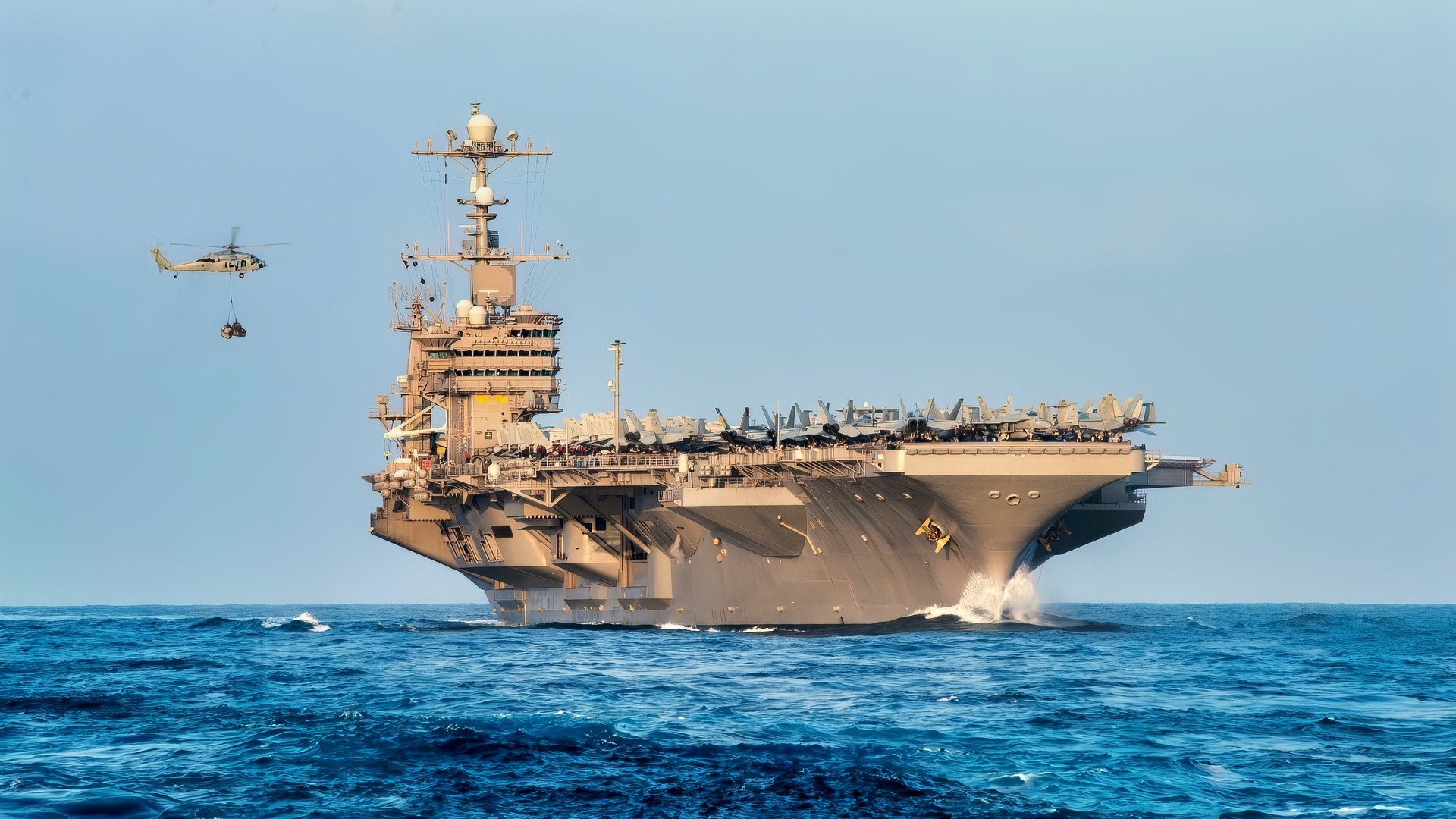
The Pentagon is sending the US Navy Nimitz-class nuclear aircraft carrier Theodore Roosevelt and the Makin Island Amphibious Ready Group toward the Middle East and Iran.
This will bring about 9,000 more sailors and Marines to the region where two American carriers are currently operating.

Norfolk Naval Shipyard welcomed USS George H.W. Bush (CVN 77) for a Planned Incremental Availability Jan. 11. In addition to equipment maintenance, this availability will improve ship safety along with communications and combat system upgrades.
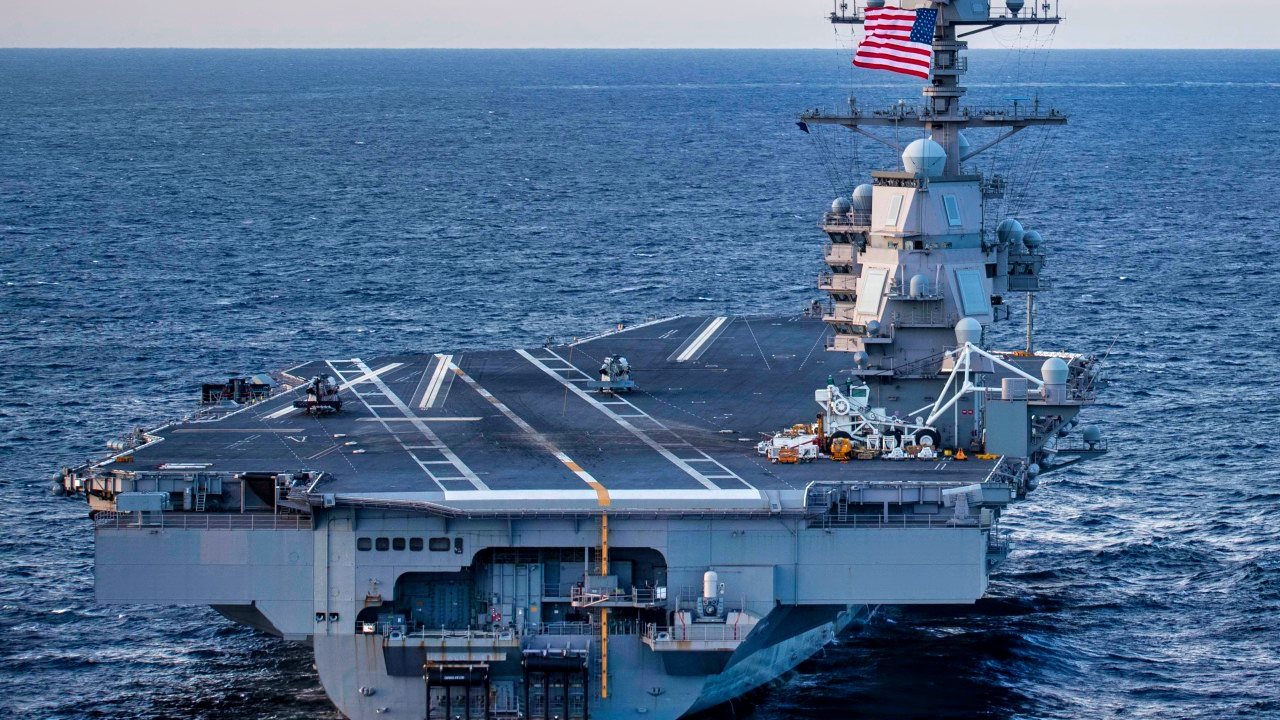
The Ford-class aircraft carrier USS Gerald R. Ford (CVN 78) and the Italian aircraft carrier ITS Cavour (CVH 550) transit the Atlantic Ocean March 20, 2021, marking the first time a Ford-class and Italian carrier have operated together underway. As part of the Italian Navy’s Ready for Operations (RFO) campaign for its flagship, Cavour is conducting sea trials in coordination with the F-35 Lightning II Joint Program Office’s Patuxent River Integrated Test Force to obtain official certification to safely operate the F-35B. Gerald R. Ford is conducting integrated carrier strike group operations during independent steaming event 17 as part of her post-delivery test and trials phase of operations. (U.S. Navy photo by Mass Communication Specialist 3rd Class Riley McDowell)
The Associated Press reported Thursday that the incoming formations together contain more than 7,000 sailors and about 2,000 Marines. George H.W. Bush and George Washington are already in the region, as is the Boxer Amphibious Ready Group.
If the deployments overlap, three American aircraft carriers could be present in the region by the end of October.
Roosevelt Sets Off with an Eight-Month Warning
Theodore Roosevelt left San Diego on Sept. 27 with Carrier Air Wing 11. USNI News reported that the strike group is expected to enter U.S. Central Command after crossing the Pacific.
Its sailors knew not to expect a routine deployment. Master Chief Petty Officer of the Navy John Perryman said in August that the Roosevelt personnel knew they would be away for “longer than seven months.” He added that their commanding officer told families to plan for eight months.
Makin Island followed the Anchorage and John P. Murtha on Sept. 28.
The three ships carry the 13th Marine Expeditionary Unit, whose aviation component contains F-35B Lightning II fighters, MV-22B Ospreys and AH-1Z Vipers.
The deployment adds a carrier air wing and a Marine expeditionary force to the theater that has been exceptionally busy for the Navy since the Iran conflict began in February.
Three Carriers – For Now
AP reported that the incoming ships could bring the U.S. naval presence in the region to more than 20,000 sailors and Marines, with hundreds of aircraft.
The Navy last had three carrier strike groups in the region in April, marking the first time since 2003.
But USNI News reported before Thursday’s confirmation that Theodore Roosevelt is expected to relieve George Washington.
The Japan-based carrier was itself sent west after the USS Abraham Lincoln’s exceptionally long deployment.
Marks warned against reading the Roosevelt deployment as a sign that another strike was being planned.
When CNN asked retired Army Maj. Gen. James “Spider” Marks about the carrier in August, he noted: “Mostly what this means is it provides the commander, the Central Command commander, options.” Marks warned against reading too much into the deployment of another carrier as a sign that another attack was being planned.
The figures are nonetheless striking: According to the Associated Press, Roosevelt is set to join cruiser Chosin while the Makin Island Amphibious Ready Group includes the John P. Murtha and the Anchorage, for a total of over 7,000 sailors and another 2,000 Marines.
With George H.W. Bush and George Washington already in the region, a U.S. official told the AP that all three carriers could be in the area by the end of October.
So the significance is less that three carriers will be stationed in the Middle East – for at least a little while – and more that, for at least a little while, CENTCOM will have that capability.
Trump Issues Warning
TIME spoke with the President at the White House on Monday, where he was asked about why he rejected Iran’s latest offer. “It’s just, it’s just, it’s not good enough. Nearly,” Trump said. When TIME asked him whether he would consider stepping up the bombing campaigns after the November 3 elections, he replied, “Possible.” When TIME pushed him on whether he was considering another attack, he declined to say, but noted that “we’ve been stocking up for the last six months.”
The AP wrote that Roosevelt’s deployment was happening as Trump considered his options, rather than as an immediate response to new tensions.
Roosevelt was prepared to deploy weeks ago, and Marks was chatting with CNN as early as August 27th.
Trump seems more confident in his rhetoric this week, partly because he believes he may have already turned the corner on winning over public opinion.
He spoke at the Peterbilt plant in Denton, Texas, on Thursday, saying that Iran was “ready to fold up.”
“I believe right after the election we’ll win, but maybe before the election,” Trump said. Iran’s economic issues, including inflation, the loss of its naval and air power, and the loss of missiles, were all factors in his thinking, he reasoned, although he offered no proof of his claims about Iran’s capabilities.
So Roosevelt is in an interesting position: Trump is already discussing renewed attacks while he continues working to end the conflict.
Qatar Is Still Serving as a Mediator
Meanwhile, talks continue behind the scenes: According to Reuters, Iran’s foreign minister Abbas Araghchi met with Qatari officials to discuss Washington’s response to Iran’s seven-day proposal.
The Americans and Iranians aren’t discussing anything directly: Qatar is serving as a middleman.
About the Author: Georgia Gilholy
Georgia Gilholy is a journalist based in the United Kingdom who has been published in Newsweek, The Times of Israel, and the Spectator. Gilholy writes about international politics, culture, and education.


