


The U.S. is sending the USS Theodore Roosevelt carrier strike group and thousands of additional sailors and Marines to the Middle East, potentially placing three American aircraft carriers in the region and fueling ongoing indirect negotiations between Washington and Tehran.
9,000 Personnel

A Sailor directs an F/A-18E Super Hornet from the “Kestrels” of Strike Fighter Squadron (VFA) 137 on the flight deck of the aircraft carrier USS Nimitz (CVN 68) in the South China Sea, May 12, 2025. Nimitz is underway in the U.S. 7th Fleet area of operations on a scheduled deployment, demonstrating the U.S. Navy’s unwavering commitment to a free and open Indo-Pacific. (U.S. Navy Photo by Mass Communication Specialist Seaman Apprentice Franklyn M. Guage)
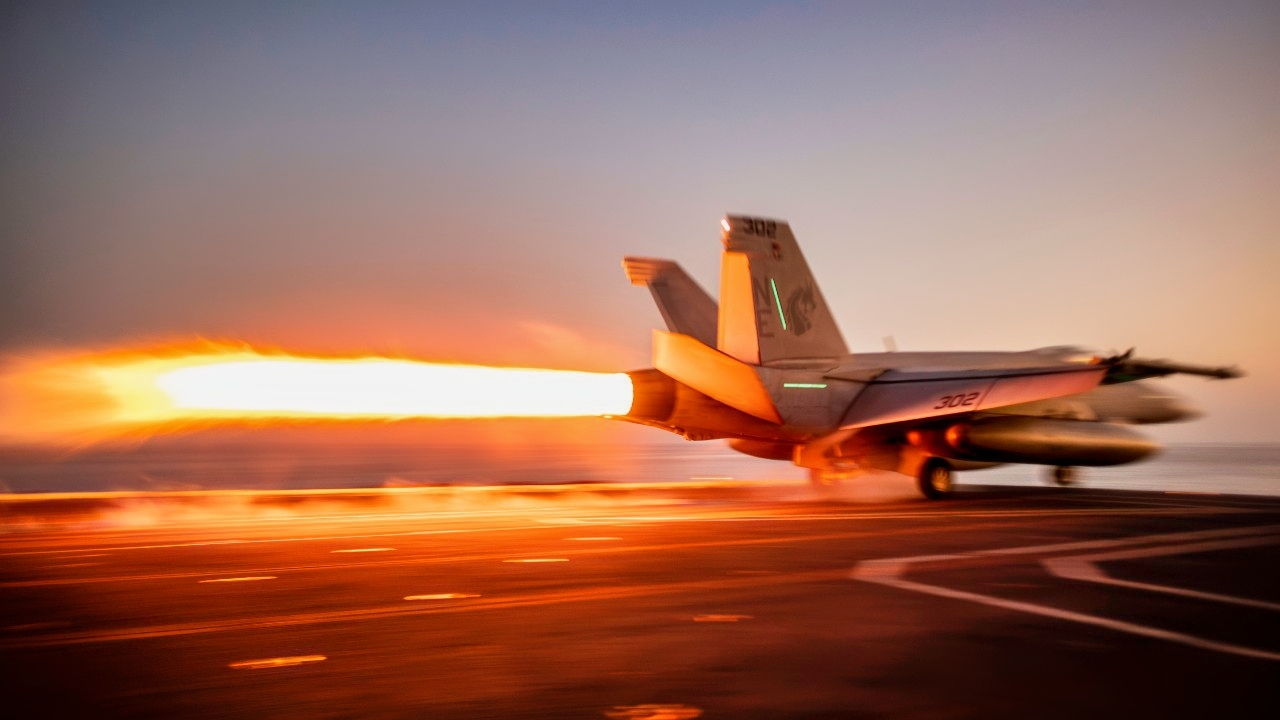
250429-N-FS097-1154 U.S. CENTRAL COMMAND AREA OF RESPONSIBILITY (April 28, 2025) An F/A-18E Super Hornet, attached to Strike Fighter Squadron (VFA) 192, launches from the flight deck of the Nimitz-class aircraft carrier USS Carl Vinson (CVN 70) in the U.S. Central Command area of responsibility. (Official U.S. Navy photo)
The Associated Press (AP) reported on Thursday that about 9,000 are aboard the Theodore Roosevelt strike group and are joining the Makin Island Amphibious Ready Group.
Two carriers — USS George H.W. Bush and USS George Washington — and the Boxer Amphibious Ready Group are already in the region.
The Roosevelt departed San Diego on Sept. 27 with Carrier Air Wing 11.
USNI News reported that it is expected to enter the U.S. Central Command area, and the AP said the ships heading toward the Middle East carry more than 7,000 sailors and 2,000 Marines.
The Makin Island group began its travels on Sept. 28 with three ships – USS Makin Island, USS Anchorage and USS John P. Murtha – carrying the 13th Marine Expeditionary Unit, whose aviation includes F-35B Lightning II fighters, MV-22B Ospreys and AH-1Z Vipers.
This deployment will not be short – Master Chief Petty Officer of the Navy John Perryman said, “They know they’re going to be there longer than seven months.”
Three Carriers Will Be In Region
AP reported that the incoming ships could put three carriers in the region by the end of October, pushing U.S. naval presence above 20,000 sailors and Marines, and backed by hundreds of aircraft.
Wall Street Journal separately reported that the Pentagon is adding 9,000 to 10,000 and expects the ships, aircraft, and troops to be there by the end of November.
But a three-carrier presence may not be permanent — USNI News previously reported that the Roosevelt was expected to relieve George Washington, which was sent from the Pacific after the deployment of the USS Abraham Lincoln.
Retired Army Maj. Gen. James “Spider” Marks made the same point on CNN: the distinction gives the commander more options.
Could the U.S. Strike Again?
Trump is no longer being coy about the possibility of another round of U.S. strikes on Iran.
TIME put the question to him directly in an interview published Thursday: Would he ramp up the bombing after the Nov. 3 midterm elections?
“Possible,” Trump replied.
Pressed on why he had rejected Iran’s latest offer, Trump said Tehran had proposed opening “some aspects” of the Strait of Hormuz, but added: “It’s just, it’s just, it’s not good enough. Nearly.”
TIME then asked whether renewed bombing was under consideration.
Trump would not answer directly. “I can’t tell you that because look, you know, you’re asking, where are you going to bomb?” he said. A moment later, however, he pointed to the U.S. weapons stockpile: “We have a lot of weapons. You know, we’ve been stocking up for the last six months.”
Trump sounded equally confident about Iran during an appearance at the Peterbilt plant in Denton, Texas, on Thursday night. He said Iran was “ready to fold up” and predicted the conflict would be over “right after the election.”
“Maybe before the election,” he added.
A U.S. official told Reuters last week that the two sides were having positive, constructive discussions through mediators and were still discussing Iran’s nuclear program.
Iran’s proposal would reopen the Strait of Hormuz and restart nuclear negotiations within seven days, but only after a series of U.S. steps.
According to the Associated Press, Tehran wants Washington to lift its naval blockade of Iranian ports, waive sanctions on Iranian oil sales, and observe a ceasefire that includes Lebanon.
Talks Remain Tense
Iranian Foreign Minister Abbas Araghchi has made clear that Tehran is preparing for either outcome.
“We are fully prepared for the war to be resumed,” Araghchi told NBC’s Meet the Press on Sunday. “We stand firm in the face of any new aggression, even if it comes to a doomsday war.”
Then came the qualification: “At the same time, we stand ready for diplomacy. It is up to President Trump to choose.”
U.S. Ambassador to the United Nations Mike Waltz, interviewed on the same program, called Iran’s proposal a “pretty cynical attempt” to obtain sanctions relief and access to frozen assets. Asked about reports of strikes after the midterms, Waltz declined to confirm them.
“What I can tell you is the president will leave all options on the table,” he said.
Nor is Washington relying on military pressure alone.
The Treasury Department on Thursday sanctioned Iran’s two largest automakers, several rail companies and businesses tied to the country’s manufacturing and steel industries.
The measures also reached foreign suppliers in countries including Turkey, the United Arab Emirates and Indonesia.
Treasury Secretary Scott Bessent said the latest round was designed to target Iran’s remaining sources of income and “lays the groundwork for the United States and our partners to drain the regime’s revenue once and for all.”
About the Author: Georgia Gilholy
Georgia Gilholy is a journalist based in the United Kingdom who has been published in Newsweek, The Times of Israel, and the Spectator. Gilholy writes about international politics, culture, and education.


