

U.S. Rejects Iran Attack Disinformation – The U.S.-Iran war continues to ramp up in the Strait of Hormuz. Tehran now says it has attacked commercial shipping and a base in Jordan after American forces torched five Iranian oil tankers.
U.S. Denies IRGC’s Hit Claims
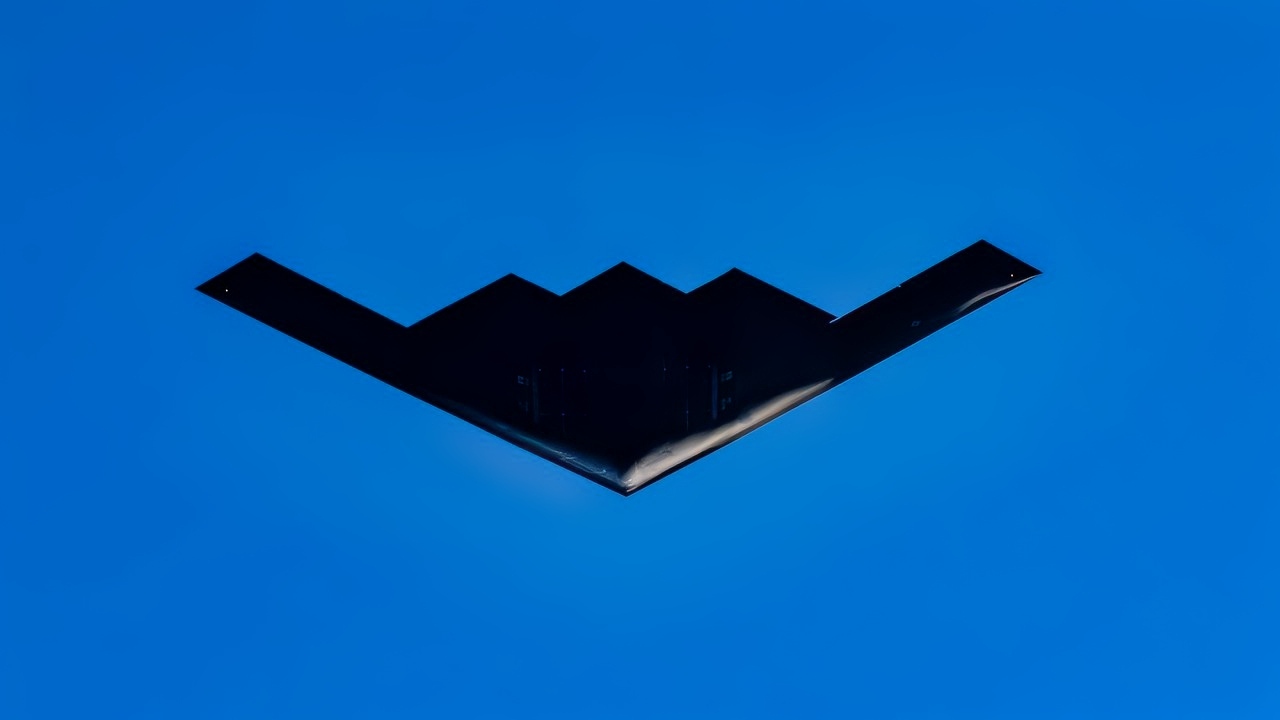
The B-2 Spirit flies over the Rose Parade at Pasadena Ca., Jan. 1, 2024. The Rose Parade is a parade of flower covered floats, marching band, and equestrian units that is produced by the Tournament of Roses. (U.S. Air Force photo by Airman 1st Class Bryce Moore)
Iran’s Islamic Revolutionary Guard Corps (IRGC), which is listed as a terrorist group by Washington, said on Wednesday that it had targeted a pair of U.S. vessels and eight oil tankers close to the narrow waterway. They said the ships had entered an area Tehran now considers “prohibited and unsafe.” The United States has denied Iranian claims that warships were hit. And U.S. Central Command said every single attempted IRGC attack on American naval vessels had failed.
The latest exchange came after CENTCOM said U.S. forces destroyed five Iranian crude carriers on September 8. The military said the strikes came after the IRGC launched ballistic missiles at U.S. Navy warships in recent days.
“The U.S. warship successfully evaded the attempted Iranian attacks,” CENTCOM said, adding that no American personnel were harmed.
The five ships, Kaviz — Charminar, Horizon 1, Riesco, and Derya — were hit in the Gulf of Oman and near Kharg Island. CENTCOM said crews were ordered to abandon the vessels before they were attacked. A trio of other Iranian crude carriers was destroyed on September 5 after missiles were fired at a U.S. aircraft carrier and guided-missile destroyer.
Rubio Stands Firm
Secretary of State Marco Rubio framed Washington’s new policy firmly, telling reporters during a visit to Colombia: “For every time they do that or try to do that, they’re going to lose tankers.”
Iran hit back by firing ballistic missiles at a base used by U.S. forces close to Al Azraq in eastern Jordan. Amman claimed that it had intercepted 18 of 20 missiles. The remaining two fell in sparsely populated areas, with no reported casualties.
Prior to the current conflict, around one-fifth of global oil shipments passed through Hormuz, according to Reuters. Tehran is now also threatening to impose a “maritime exclusion zone” in the strait and around the Gulf stretching all the way toward waters off Chabahar near Pakistan. Iranian officials claimed that maps depicting the zone were forthcoming. The announcement follows warnings that ships entering restricted areas without coordinating with Tehran could face consequences.
Panama-Flagged Ship Set Ablaze
Commercial shipping is still getting caught up in the conflict. The United Kingdom’s Maritime Trade Operations agency said that a slew of merchant vessels had been hit by disabling fire in the Gulf of Oman and the northern Gulf. Meanwhile, Iraqi officials said the Panama-flagged New Andros, which had been transporting around 2 million barrels of fuel oil, had been set ablaze due to a drone strike in its waters. A further vessel was reported listing close to the United Arab Emirates’s Port Rashid.
A mere six commodity vessels passed through Hormuz on Tuesday, according to preliminary Kpler data cited by Reuters, compared with a 10-day average of 12 and roughly 125 commercial ships a day before the war.
Iranian leaders appear increasingly willing to use military pressure to restore leverage. Parliament speaker Mohammed Bagher Ghalibaf said Sunday that the period of “proportionate responses” to U.S. attacks was over. Farzan Sabet, a geopolitical analyst at the Geneva Graduate Institute, told The New York Times that the Iranian regime’s calculation was to “escalate” in order to “regain the momentum.”
On Tuesday, Tehran also claimed to have captured the U.S. Dive-LD autonomous underwater vehicle close to the entrance to the Strait of Hormuz. The Pentagon has stressed that it lost the drone, noting that it had malfunctioned recently and carried no sensitive data. The manufacturer, Anduril, said that the system was “attritable.”
The Telegraph reported that although the model was “older,” the risk of Tehran “reverse-engineering” the technology remained.
Brent crude surged toward $100 a barrel on Tuesday as traders moved to respond to continued disruption in the Middle East. 73 people were reportedly wounded in the attack, the largest Houthi barrage since the start of the U.S.-Iran war in February.
According to the Saudi authorities, women and children were among the casualties when the cities of Abha, Khamis Mushait, Jazan and Najran were hit. Houthi terrorists also targeted a Saudi airbase in Khamis Mushait, along with Aramco sites in the other three cities.
About the Author: Georgia Gilholy
Georgia Gilholy is a journalist based in the United Kingdom who has been published in Newsweek, The Times of Israel, and the Spectator. Gilholy writes about international politics, culture, and education.


