


Key Points and Summary – Former Reagan White House Offical and Expert Doug Bandow argues that Donald Trump’s new National Security Strategy risks turning Taiwan into the trigger for a catastrophic U.S.–China war.
-The NSS openly plans to preserve U.S. military dominance along the First Island Chain and to deny any Chinese move against Taiwan, despite America’s soaring debt and stretched forces.

ATLANTIC OCEAN (June 14, 2011) The Nimitz-class aircraft carrier USS Dwight D. Eisenhower (CVN 69) conducts rudder turns during sea trials. Dwight D. Eisenhower completed a nine-month planned incremental availability at Norfolk Naval Shipyard on June 10 and is scheduled to resume underway operations this summer. (U.S. Navy photo by Mass Communication Specialist 1st Class Christopher Stoltz/Released)
-Bandow contends Beijing’s aims are regional, not global, and that Taiwan—while important—is not vital enough to justify a nuclear-tinged great-power conflict.
-Instead of preparing for war, he urges “tripartite restraint,” economic deterrence, and preserving Taiwan’s de facto autonomy rather than chasing the illusion of formal independence.
Trump, Taiwan, and China: Are We Sleepwalking Into Disaster?
The Trump administration has created the façade of foreign policy consistency where none exists with the release of its National Security Strategy. Broadly speaking, the NSS looks inward, but that doesn’t mean President Donald Trump isn’t preparing for war, perhaps several wars. Unfortunately, he has urges, not principles, and the former could have catastrophic consequences.
The Taiwan Concern
Despite attacks on the NSS by the usual suspects—especially the bipartisan War Party, which seeks confrontation and conflict on every continent except Antarctica—the Trump administration is far from isolationist. For instance, the NSS indicates the president’s apparent willingness to wage war on the People’s Republic of China over Taiwan. The PRC has an economy comparable to America’s and a fast-growing military. Beijing’s desire to return Taiwan to mainland control has grown accordingly.

J-10 Fighter From China. Image Credit: Creative Commons.
One reason is simple nationalism: the island was seized by Japan after Japan defeated Imperial China in 1895 and is the last unreclaimed territory from the infamous “Century of Humiliation.” Another concern is security, with Taipei aligned with the PRC’s most significant military rival. The US almost started a nuclear war to prevent the Soviet Union from loading the similarly situated Cuba with missiles and nukes.
Reunification of Taiwan
Of course, forced reunification would be an atrocity for the more than 23 million Taiwanese who have made a nation, a robust, lively, and prosperous democracy. Understandably, the vast majority of Taiwanese have no interest in being ruled by Beijing.
Support among younger Taiwanese for absorption is almost nonexistent. Why would any sane Taiwanese want to submerge their independent community into a vast nation of 1.4 billion people, in which their present land would be the equivalent of just another large city?
Add to that the PRC’s history, in which scores of millions of people—the top estimates, probably exaggerated, but no one really knows, hit 100 million—were killed in various violent campaigns and repressions, swelled by the disastrous Great Leap Forward and capped by the bizarre Cultural Revolution.
And recent control by Xi Jinping, under which the PRC has grown dramatically more repressive in almost every way. Beijing’s recent successes, particularly its rapid economic growth, only reflect the Chinese Communist Party’s abandonment of its core political policies after 27 years of misrule by the increasingly deranged Red Emperor, Mao Zedong.
Great Power Grab
Despite Beijing’s growing power, it could not easily conquer the island state. However, Taiwan could be otherwise coerced—blockaded, perhaps, and forced to choose between starvation and surrender. The Trump administration appears determined to prevent either one.
The new NSS declares that a favorable conventional military balance remains an essential component of strategic competition. There is, rightly, much focus on Taiwan, partly because of Taiwan’s dominance of semiconductor production, but mainly because Taiwan provides direct access to the Second Island Chain and splits Northeast and Southeast Asia into two distinct theaters.
Given that one-third of global shipping passes through the South China Sea each year, this has significant implications for the US economy. Hence, deterring a conflict over Taiwan, ideally by preserving military overmatch, is a priority. The US will also maintain its longstanding declaratory policy on Taiwan, meaning that the United States does not support any unilateral change to the status quo in the Taiwan Strait.
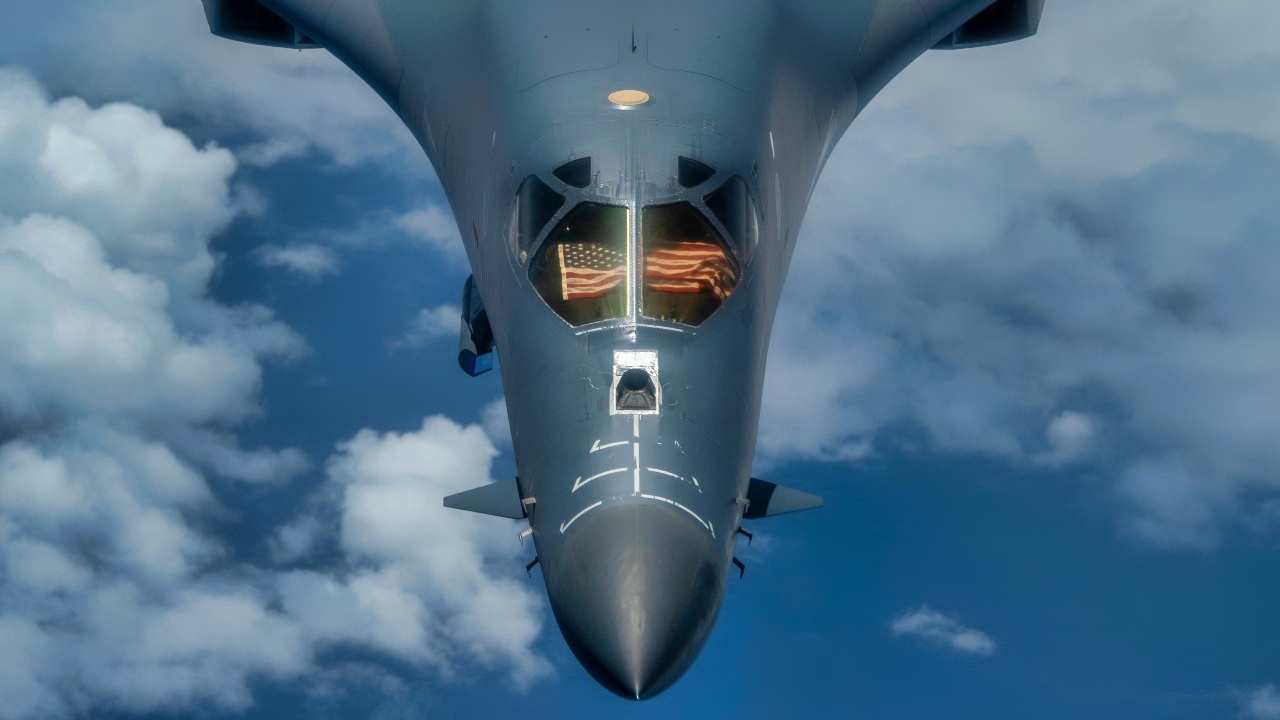
A 9th Expeditionary Bomb Squadron B-1B Lancer flies over the East China Sea May 6, 2020, during a training mission. The 9th EBS is deployed to Andersen Air Force Base, Guam, as part of a Bomber Task Force supporting Pacific Air Forces’ strategic deterrence missions and commitment to the security and stability of the Indo-Pacific region. (U.S. Air Force photo by Senior Airman River Bruce)
How to achieve this? Explains the NSS: “We will build a military capable of denying aggression anywhere in the First Island Chain.” However, Washington should safeguard “maritime security issues along the First Island Chain while reinforcing US and allies’ capacity to deny any attempt to seize Taiwan or achieve a balance of forces so unfavorable to us as to make defending that island impossible.”
The hope, or perhaps more accurately, fantasy, is that the PRC would then back down. However, Washington would have to maintain military superiority in China’s neighborhood not just next year, but the next decade and well beyond, an incredible burden for a nation running $2 trillion annual deficits and paying more than $1 trillion in interest as a matter of course. And what if America’s bankrupt policy fails to deter Beijing? Then the administration would have to retreat or go to war, which could trigger nuclear conflict. And a national catastrophe.
A Sophisticated Leninist State
The PRC poses a complex challenge—economic, diplomatic, political, and military. Despite careless talk of a new cold war, the competition between the US and China looks nothing like that between the US and the Soviet Union. To the good, the PRC is only nominally communist.
The Chinese state is, to be sure, Leninist. It is, however, not Marxist. Beijing is not interested in spreading its form of governance and cares not at all how other nations, including America, choose to govern themselves.
However, the PRC has become an economic giant. Long derided as a copycat producer of cheap consumer goods, it has become a sophisticated innovator and a massive manufacturer. China now competes for control of the commanding heights of technology. The PRC is also well integrated into the world. Indeed, China has greater economic ties with most of the world than the US does. The USSR was long derided as a gas station with nuclear weapons and could be largely isolated from the rest of the non-communist world. In contrast, today even America’s allies—Italy and Germany, Australia and South Korea, and many more—have expansive and profitable economic relations with the PRC. This limits Washington’s ability to engage in economic warfare against China.

DF-41 ICBM from China. Image Credit: Creative Commons.
And then there is security. The PRC’s ambitions are regional, not global. It seeks in Asia what the US enjoys in the Western Hemisphere: dominance. For all of the paranoid rhetoric about the Chinese “threat,” the PRC covets no American territory, targets no American lands, and patrols no American waters. Beijing and Washington risk a military clash not because the former is operating 100 miles off America’s coast, like in Cuba, but because the US is acting roughly 100 miles off China’s coast, in Taiwan.
The latter is East Asia’s, and probably the world’s, most dangerous flashpoint. The PRC hopes to acquire the territory through intimidation but appears ready to go to war if necessary. Beijing is wrong to threaten military action to absorb the island state, just as Russia was wrong to invade Ukraine.
However, Taipei’s fate, though of understandable interest to Americans, is not vital to Americans as it is to China. And only a truly existential interest could warrant going to war, especially one that could escalate to nuclear war.
A conflict would be disastrous for all sides. Any war would destroy Taiwan’s critical semiconductor chip industry and wreck global and regional trade, with massive economic consequences. The US would have to project power several thousand miles away, no mean feat, especially since allied support is not guaranteed. For Japan and South Korea to participate would ensure the destruction of bases on their territory. The ROK would also risk a concurrent invasion by North Korea. In contrast, China would be able to use mainland bases, a massive advantage. The US would have to strike them, almost forcing Beijing to escalate.
A succession of war games inspires pessimism. More often than not, Washington has lost, but even victory has required extraordinary effort and come at hideous cost. And these exercises conveniently ignore the significant risk that either party could go nuclear. Finally, even a US victory would not be permanent, with the PRC likely to rearm and try again, ala Germany after World War I. Whether to play such a dangerous game of international chicken, risking the country’s very existence, certainly warrants a national debate.

Type 076 China Amphibious Assault Ship. Image Credit: Chinese Social Media.
Yet stating the obvious is unpopular in Washington’s hawkish precincts, in which most policymakers assume US intervention is inevitable. So, too many of the president’s supporters are even cautious about confronting the PRC militarily.
For instance, Steve Bannon has tried to silence yours truly, trashing my reputation among colleagues for talking with Chinese officials. For Bannon, and others like him, the way to make America great again—and perhaps to promote his own side-ventures—is apparently to risk plunging the country into a destructive war.
Rather than plan for war, the US should press China and Taiwan to adopt a policy of tripartite restraint to defuse political and military confrontation. Washington also should promote an international coalition prepared to threaten severe economic punishment in response to any attack on the island state.
The greater the potential consequences, the less likely Xi Jinping or his successor—who would likely end up unemployed, or worse, in the event of failure—would risk war absent a trigger, such as Taipei declaring independence. US policy should not risk the existing, good, peaceful, but unofficial autonomy for Taiwan to promote the unattainable ideal of its formal independence.
Donald Trump claims to be a man of peace, but his foreign policy has proved to be anything but. The worst possible conflict is one with China. The Taiwanese people deserve to set their own future.
But that is not a sufficient reason for the American people to risk theirs. In this case, Trump can be a man of peace only if he keeps the peace.
About the Author: Doug Bandow
Doug Bandow is a senior fellow at the Cato Institute, specializing in foreign policy and civil liberties. He worked as special assistant to President Ronald Reagan and editor of the political magazine Inquiry. He writes regularly for leading publications such as Fortune magazine, National Interest, the Wall Street Journal, and the Washington Times. Bandow speaks frequently at academic conferences, on college campuses, and to business groups. Bandow has been a regular commentator on ABC, CBS, NBC, CNN, Fox News, and MSNBC. He holds a JD from Stanford University.


