

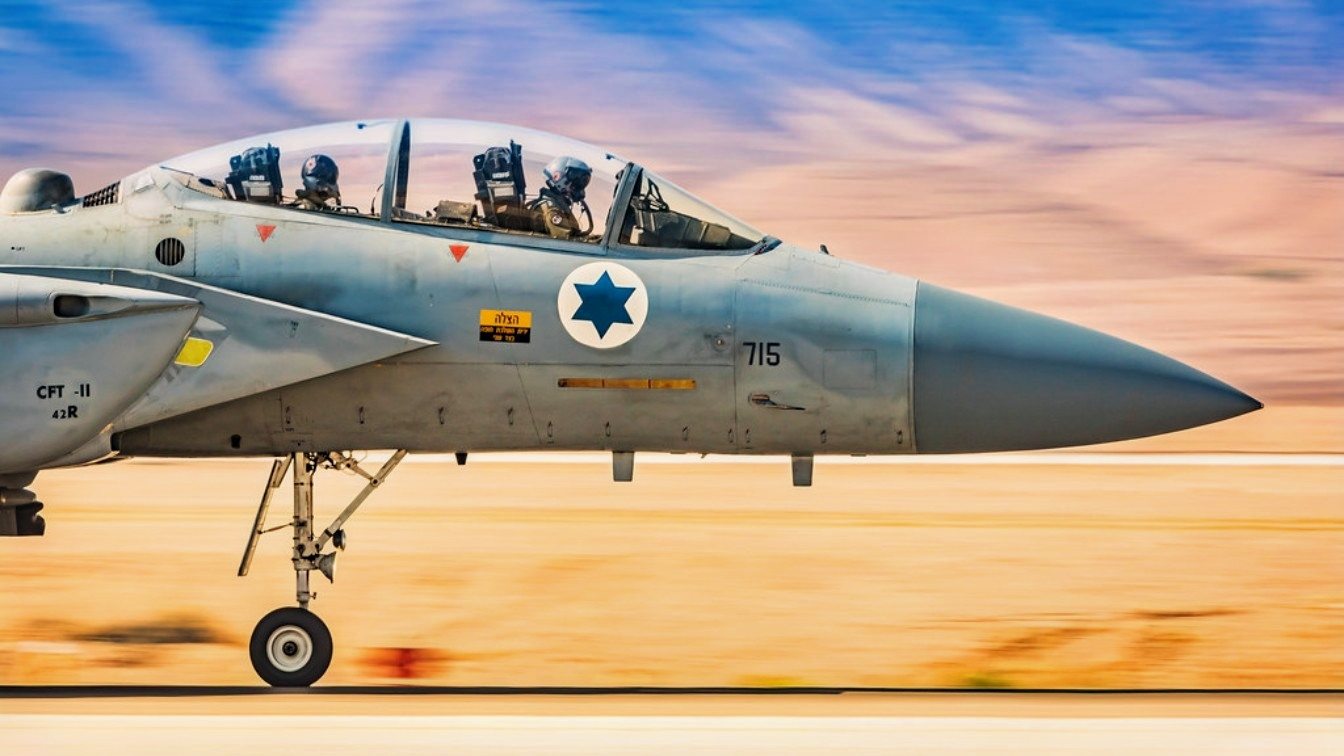
While the world braces itself for renewed attacks against Iran from the U.S. and Israel, the Israeli Air Force has been conducting training flights in the Middle East, some of which have flown as close to the Iranian border.
The event took place on the same day that U.S. Secretary of Defense Pete Hegseth made an unannounced visit to Israel and spoke with Prime Minister Benjamin Netanyahu.

Israeli Air Force 69th Squadron – Operation New Order: F-15I jets eliminating Hezbollah and Hassan Nasrallah.

Israeli Air Force 69th Squadron – Operation New Order: F-15I jets eliminating Hezbollah and Hassan Nasrallah
With the war expected to enter a new hot phase after November’s midterm elections in the U.S., Israel may be probing Iran’s defenses, looking for vulnerabilities and preparing itself for a new wave of air strikes.
Israeli Fighter Jets Near Iran’s Border
According to an Axios report, dozens of Israeli fighter jets conducted training sorties on Monday.
The aircraft flew towards the Iranian border, 800 miles away from their home base in Israel, before returning. The U.S. was notified in advance of the aerial exercise.
According to American and Israeli officials, the flight was a routine exercise, involving dozens of fighter jets and aerial tankers aimed at deterring Iran.
The aircraft used Syrian and Iraqi airspace, flying close to the border with Western Iraq.
The officials note, however, that while the exercise was not unusual, there was a risk that Iran could have retaliated, reigniting the war that has been mostly silent for the last few months.
US officials told Axios that they were aware that Iran would detect the Israeli planes on their approach to the border.
They told the news outlet that while the flight was a routine exercise, they suspected that the flights were a deliberate provocation towards Iran, hoping that an incident could reignite the war.
Earlier this month, President Trump and Israeli Prime Minister Netanyahu reportedly discussed launching strikes earlier in October, ahead of Israel’s upcoming elections on October 27.
These elections matter especially for Netanyahu, as they will determine whether he retains office.
Trump apparently denied Netanyahu’s request, opting instead to postpone attacks until after November’s midterm elections.
According to IDF Chief of Staff Lt. Gen. Eyal Zamir, restarting the war in that timeframe would likely have postponed the elections.
Some suspect that the air incursion near the Iranian border was an attempt by Israel to provoke Iran and postpone the upcoming elections. However, this is purely speculation.
The Lt. General clarified that he would not allow any military activity to undermine the country’s upcoming elections.
Iran Prepares For Action
The Israeli activity near Iran’s Western border seems to have spooked the regime in Tehran.
Over the past several days, the Iranian Air Force (IRIAF) has flown multiple sorties daily since Monday.
According to Military Watch Magazine, the IRIAF scrambled dozens of fighters, including some of its remaining F-14 Tomcats and F-5 fighters.
Heavy fighter activity has persisted throughout the week in the country’s Western regions as Tehran grows more paranoid about the possibility of renewed airstrikes from Israel and the U.S. Earlier this week, Secretary of Defense Hegseth traveled to Israel on an unannounced visit.
Hegseth reportedly discussed future strike options with Netanyahu, who gave him an updated target bank based on Israel’s latest intelligence.
Tehran, growing suspicious of Israeli and American activity, is preparing for the worst, threatening massive consequences if the war were to resume.
Iranian news media threatened that oil infrastructure and other valuable sites across the Middle East could come under fire if civilian infrastructure in Iran gets hit by airstrikes.
Additionally, the IRGC threatened to target undersea internet cables around the Strait of Hormuz or data centers if the war resumes.
However, the regime is also open to diplomacy. “We are just as prepared for diplomacy as we are for war,” said Foreign Minister Abbas Araghchi. “Any scenario is conceivable, including the possibility of an attack by the U.S. and Israel.”
Waiting for the Inevitable Attacks
While the Israeli Air Force conducts training flights near Iran, the U.S. Military has been quietly moving more assets towards the Middle East.
In September, the aircraft carrier USS Theodore Roosevelt (CVN-71) departed her home port in San Diego for the Middle East.
The carrier is joined by the 13th Marine Expeditionary Unit, which is comprised of around 4,200 Marines.
According to U.S. Officials, Roosevelt is expected to join the USS George H.W. Bush (CVN-77) and the USS George Washington (CVN-73), both of which are currently stationed in the Middle East.
This would bring the current force up to three Carrier Strike Groups, along with the USS Boxer and her Amphibious Ready Group.
President Trump has stated that the U.S. will not launch any attacks against Iran until after the midterm elections on November 3.
With the elections less than 2 weeks away, both sides are preparing for the inevitable hot phase ahead. According to reports, Israel is set to deliver a massive airstrike against Iran, larger than the ones delivered in February and March.
At the same time, Iran has been restocking its depleted stock of ballistic missiles, with oil infrastructure in its sights.
The next phase of the war, whenever it happens, will likely be brutal as the U.S. and Israel seek to end the war once and for all.
About the Author: Isaac Seitz
Isaac Seitz, a Defense Columnist, graduated from Patrick Henry College’s Strategic Intelligence and National Security program. He has also studied Russian at Middlebury Language Schools and has worked as an intelligence Analyst in the private sector.


