

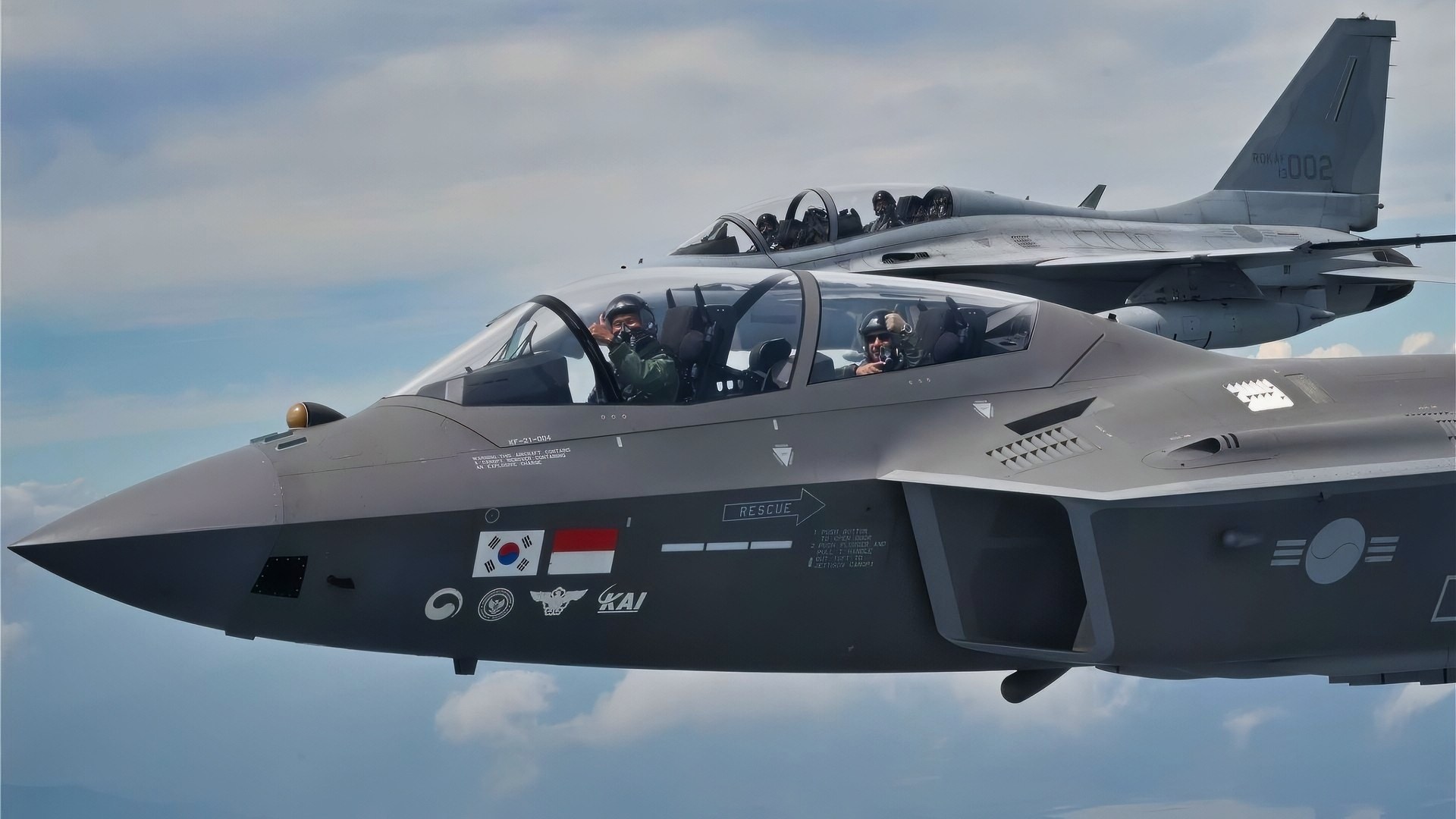
Article Summary – South Korea’s KF-21 Boramae is a sleek, twin-engine 4.5-generation fighter designed to replace aging F-4s and F-5s and offer a cheaper “semi-stealth” alternative to top-end jets.
-It boasts strong kinematics, modern AESA radar, and advanced missiles—but lacks internal weapons bays and the deep sensor fusion that define true fifth-generation platforms.
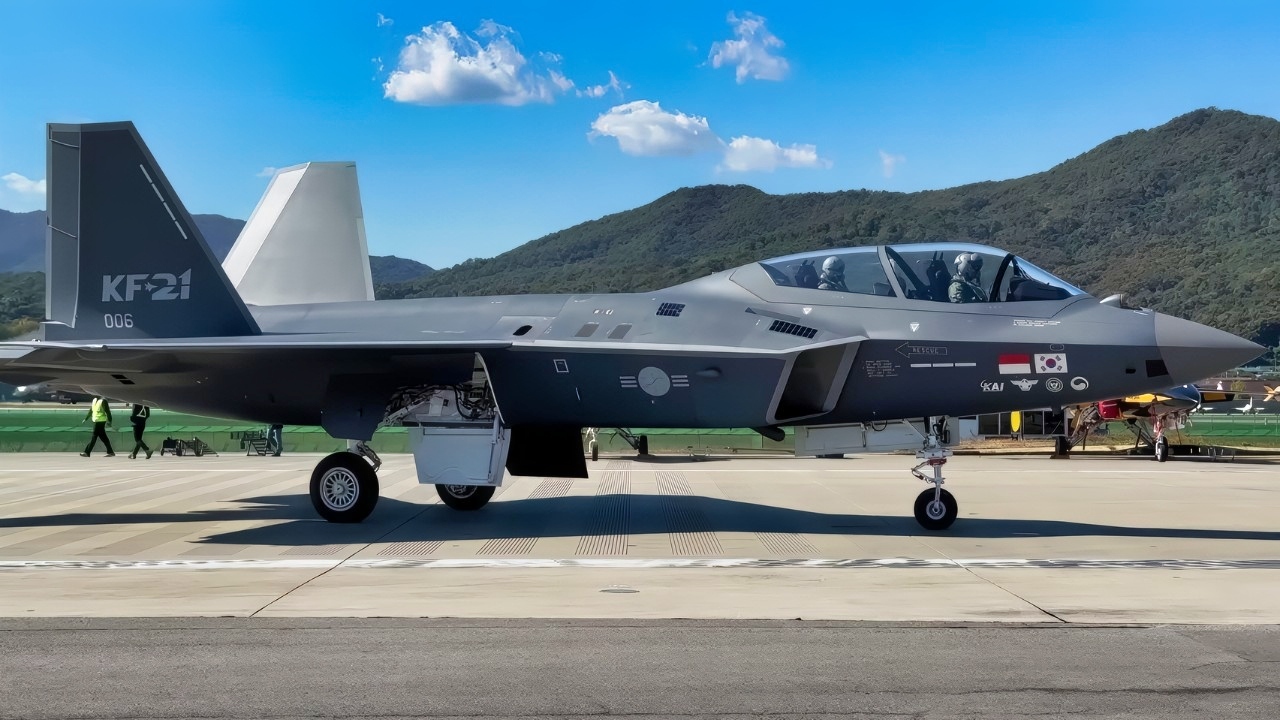
KF-21 Fighter from South Korea. Image Credit: Creative Commons.
-The F-35’s tiny radar cross-section, powerful electronics, and data-sharing give it a decisive edge in beyond-visual-range combat, likely killing the KF-21 before it can shoot back.
-Even in a close-in dogfight, the Korean jet’s agility only narrows the gap. For now, it remains a promising but clearly inferior F-35 rival.
KF-21 vs F-35: South Korea’s ‘Budget Stealth’ Fighter Has a Problem
The KAI KF-21 Boramae is South Korea’s most recent fighter jet, which is currently under development.
Currently designed as a 4.5-generation fighter, it is expected to achieve full fifth-generation capabilities with future upgrades.
The aircraft was built in collaboration with Lockheed Martin, which gives it a similar visual appearance to the F-35. Both aircraft are built with state-of-the-art avionics and sensors, and both are designed as single-seat multi-role aircraft, but which one would win in a one-on-one combat encounter?
South Korea’s Best vs the F-35
The KF-21 Boramae was designed to replace South Korea’s aging fleet of F-4 Phantom II and F-5E/F Tiger II fighter jets.
The goal was to create a stealth fighter with a lower RCS than other fourth-gen fighters like the Dassault Rafale and the Eurofighter Typhoon, but not on the same level as the F-35.
The aircraft has many visual similarities to the F-35, with a similar airframe shape, but it uses two engines instead of one.

F-35 Stealth Fighter in Red. Image Credit: Lockheed Martin.
The aircraft is designed as a multi-role fighter with future variants expected to achieve full fifth-generation capabilities.
The KF-21 was designed to be cost-effective without compromising quality, placing its estimated price below that of the F-16 or the Saab Gripen.
Meanwhile, the F-35 is Lockheed Martin’s prized fighter. It is widely regarded as one of the most advanced fighter jets in the world, and for good reason.
It excels at stealth and sensor fusion, providing the pilot with a broad, comprehensive view of the battlefield.
The aircraft was designed as a multi-role aircraft, and variants such as the F-35B and C are compatible with aircraft carrier operations.
Its airframe is designed to minimize RCS through stealth shaping, DSI engine intakes, and RAM coatings.
While the F-35 was initially criticized for its high cost, its success on the market has created economies of scale, which have offset much of its original costs and have gradually lowered its price tag.
General Specs and Stealth
In terms of specifications, the F-35 measures about 15.7 meters in length with a wingspan of 11 meters, powered by a single Pratt & Whitney F135 engine producing 43,000 pounds of thrust with afterburner.
It reaches speeds of Mach 1.6 and operates at a service ceiling of roughly 50,000 feet. The KF-21 is slightly longer at 16.9 meters and has a similar wingspan, but it uses two GE F414 engines, each generating 22,000 pounds of thrust.
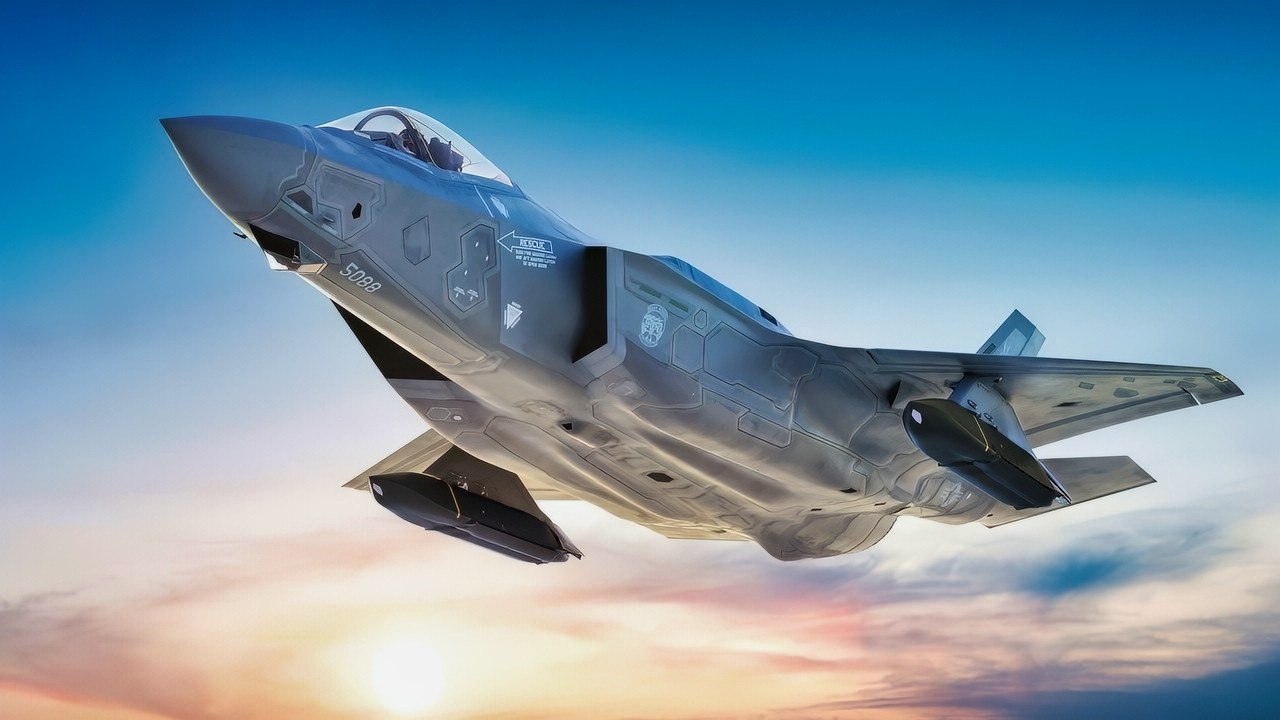
F-35 Fighter With LRASM Missiles. Image Credit: Lockheed Martin.
This twin-engine configuration gives it a slightly higher top speed of Mach 1.81 and a service ceiling of around 65,000 feet. Both aircraft have comparable combat radii, with the KF-21 slightly ahead at about 926 kilometers versus the F-35’s 833 kilometers.
Stealth is where the F-35 truly excels. Its radar cross-section is minimal thanks to advanced shaping, radar-absorbent materials, and internal weapons bays, allowing it to penetrate contested airspace with minimal detection risk.
It also integrates sophisticated electronic warfare systems that can jam enemy radars and defeat missile threats.
The KF-21, while incorporating stealth shaping and coatings, lacks internal weapons bays in its initial production blocks.
External stores significantly increase its radar signature, making it more detectable than the F-35. Future upgrades aim to address this, but for now, the KF-21 remains a stealth-enhanced 4.5-generation fighter rather than a true fifth-generation jet.
Avionics and Weaponry
In terms of Avionics, both aircraft are well-equipped. The F-35’s AN/APG-81 AESA radar, Distributed Aperture System, Electro-Optical Targeting System, and advanced sensor fusion provide unmatched situational awareness.
It can share data seamlessly across platforms, acting as a force multiplier in joint operations. The KF-21 uses an AESA radar developed by Hanwha Systems and includes infrared search-and-track capabilities, as well as EW systems.
This provides the aircraft with decent capabilities, though its avionics are unlikely to be as sophisticated as those of the F-35.
This difference is critical in modern air combat, where information dominance often determines victory.
In terms of weaponry, the F-35 can carry weapons internally for stealth missions, including AIM-120 AMRAAM and AIM-9X missiles, as well as precision-guided bombs.
When stealth is not required, it can mount external stores for a total payload of up to 18,000 pounds.
The KF-21 offers ten hardpoints and supports advanced missiles like Meteor and IRIS-T, but most of these are external, compromising stealth when fully armed.
Does the KF-21 Stand a Chance?
In every combat scenario, the outcome favors the F-35. In beyond-visual-range combat, the F-35’s stealth and sensor fusion give it a decisive advantage.
It likely detects and engages the KF-21 long before it is detected, using long-range missiles to neutralize the threat without entering visual range.
In a within-visual-range dogfight, the KF-21’s superior agility and speed could allow it to outmaneuver the F-35, giving it a narrow edge if it survives to merge. However, even then, it is unlikely to remain undetected by the F-35’s superior sensors.
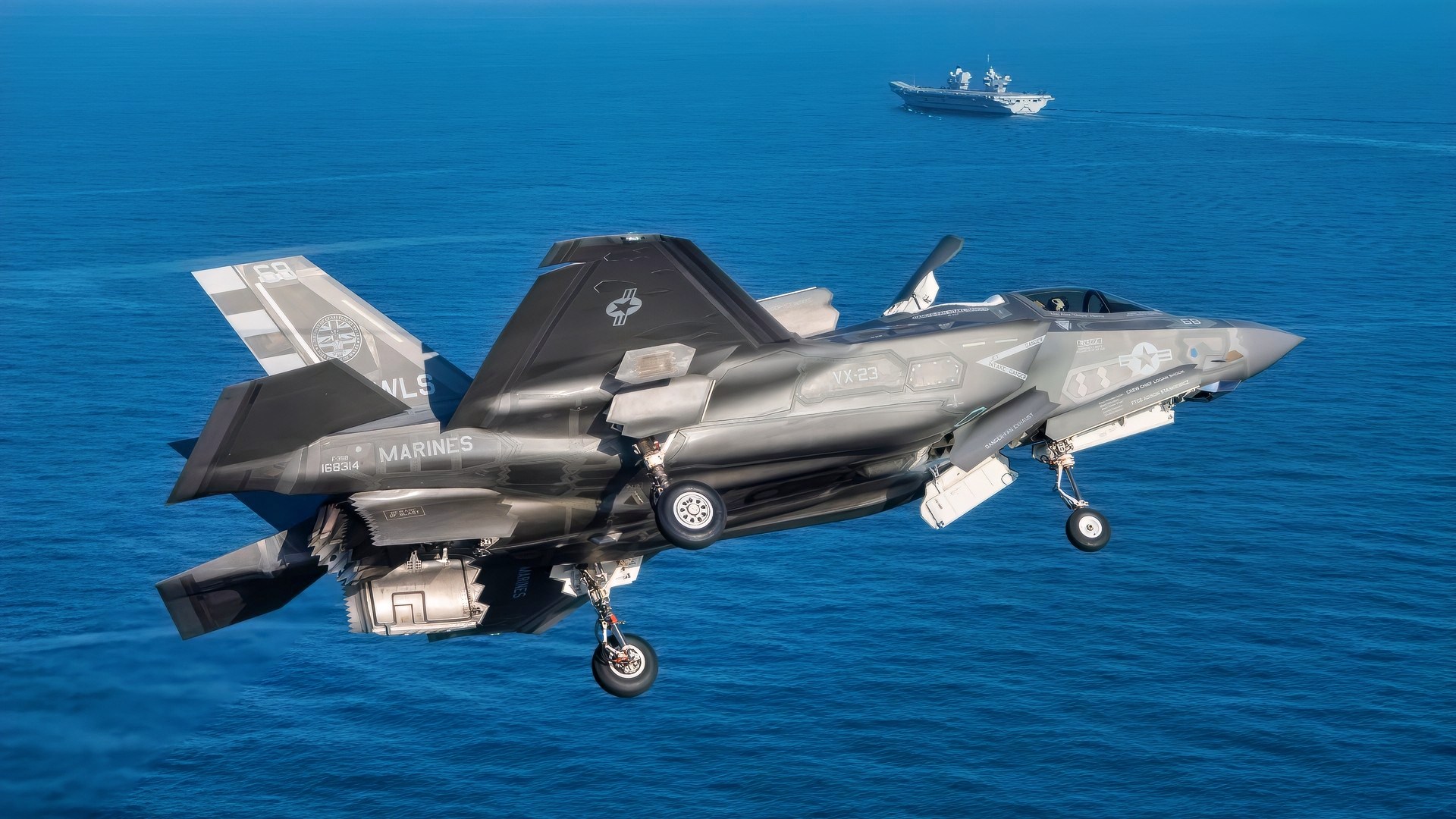
F-35 test pilot Marine Maj. Paul Gucwa from Air Test and Evaluation Squadron Two Three (VX-23), Naval Air Warfare Center Aircraft Division (NAWCAD), flies an F-35B Lightning II fighter aircraft to the U.K. HMS Prince of Wales aircraft carrier in the Western Atlantic Oct. 11, 2023. Gucwa will embark with a detachment from the Patuxent River F-35 Integrated Test Force (ITF) to conduct developmental test phase 3 (DT-3) sea trials with the specially instrumented, short takeoff vertical landing variant of the stealth jet aboard Britain’s largest warship.
The U.K. Queen Elizabeth-class (QEC) aircraft carrier HMS Prince of Wales (R09)’s participation in WESTLANT 23 encompasses a range of U.K. and U.S. naval aircraft trials in the Western Atlantic throughout the autumn of 2023.The HMS Prince of Wales continues to push the boundaries of naval aviation capabilities and operations from QEC aircraft carriers, including increasing the range and lethality of F-35 operations. The U.K. is the only Tier I partner in the F-35 Joint Strike Fighter (JSF) Program. U.K. and U.S. interactions during this deployment are characterized by cooperation and reinforce international relationships, as well as enhance interoperability between the U.S. Navy and Royal Navy.
The F-35 Joint Program Office is the U.S. Department of Defense’s focal point for the 5th-generation strike aircraft for the Navy, Air Force, Marines, and our allies. The F-35 is the premier multi-mission, 5th-generation weapon system. Its ability to collect, analyze and share data is a force multiplier that enhances all assets in the battle space: with stealth technology, advanced sensors, weapons capacity, and range. The F-35 has been operational since July 2015 and is the most lethal, survivable, and interoperable fighter aircraft ever built.
(US Navy photo by Dane Wiedmann)

An F-22 Raptor assigned to the 1st Fighter Wing, Joint Base Langley-Eustis, Va., takes off for a training mission during Northern Lightning, a training exercise held annually at Volk Field, Wisc., Aug. 12, 2020. This is the first time the 158th has participated in the exercise with the F-35s, which sees them working with F-22 Raptors assigned to the 1st Fighter Wing, Joint Base Langley-Eustis, Va., F/A-18E Super Hornets assigned to VFA-151, Naval Air Station Lemoore, Calif., F-16 Falcons assigned to the Wisconsin National Guard, as well as T-38 Talons and L-159Es from Draken International acting as aggressor aircrafts conducting simulated combat missions in a joint-service environment. (U.S. Air National Guard photo by Airman 1st Class Jana Somero)

A U.S. Air Force F-35 Lightning II assigned to the 56th Fighter Wing, Luke Air Force Base, Arizona, performs a strafing run during Haboob Havoc 2024, April 24, 2024, at Barry M. Goldwater Range, Arizona. Haboob Havoc is an annual total force exercise that brings together multiple fighter squadrons from numerous bases to practice skills and test abilities in various mission sets. (U.S. Air Force photo by Staff Sgt. Noah D. Coger)
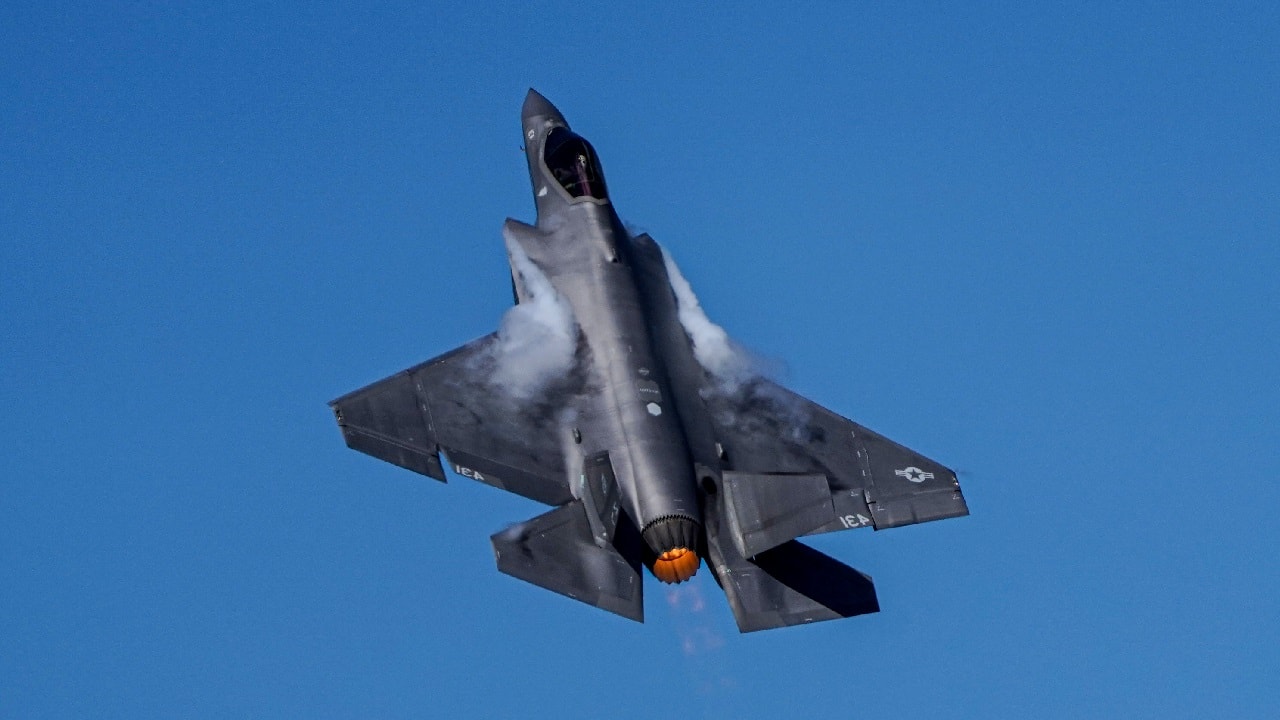
F-35 Fighter Heading Into the Sky. Image Credit: Creative Commons.
The KF-21 is not a bad fighter. In fact, it is a promising platform and a significant upgrade compared to South Korea’s older fighter jets.
However, as it stands, the aircraft is unable to match some of the most advanced stealth fighters. In the future, with an internal weapons bay and a better stealth profile, the KF-21 may improve its position, but as it stands, it is an inferior version of the F-35.
About the Author: Isaac Seitz
Isaac Seitz, a Defense Columnist, graduated from Patrick Henry College’s Strategic Intelligence and National Security program. He has also studied Russian at Middlebury Language Schools and has worked as an intelligence Analyst in the private sector.


Keith Breedlove
November 28, 2025 at 10:32 pm
Capabilities against the F-35? What about against the Chinese 5th generation fighters? And beyond the aircrafts’ nominal, “book” capabilities, what about the effects of pilot training?
Bob
November 30, 2025 at 3:43 pm
Stop repeating yourself.
Ed
December 12, 2025 at 4:07 pm
Gawd. This article is terrible. It’s a clear straw man fallacy. Lockheed provided much of the technology that made the KF-21 possible. It was never designed to be a direct competitor to the F-35. Think more Gripen, Eurofighter Typhoon, Su-30, Rafael, etc. Those are the KF-21 Block 1’s actual competitors.