
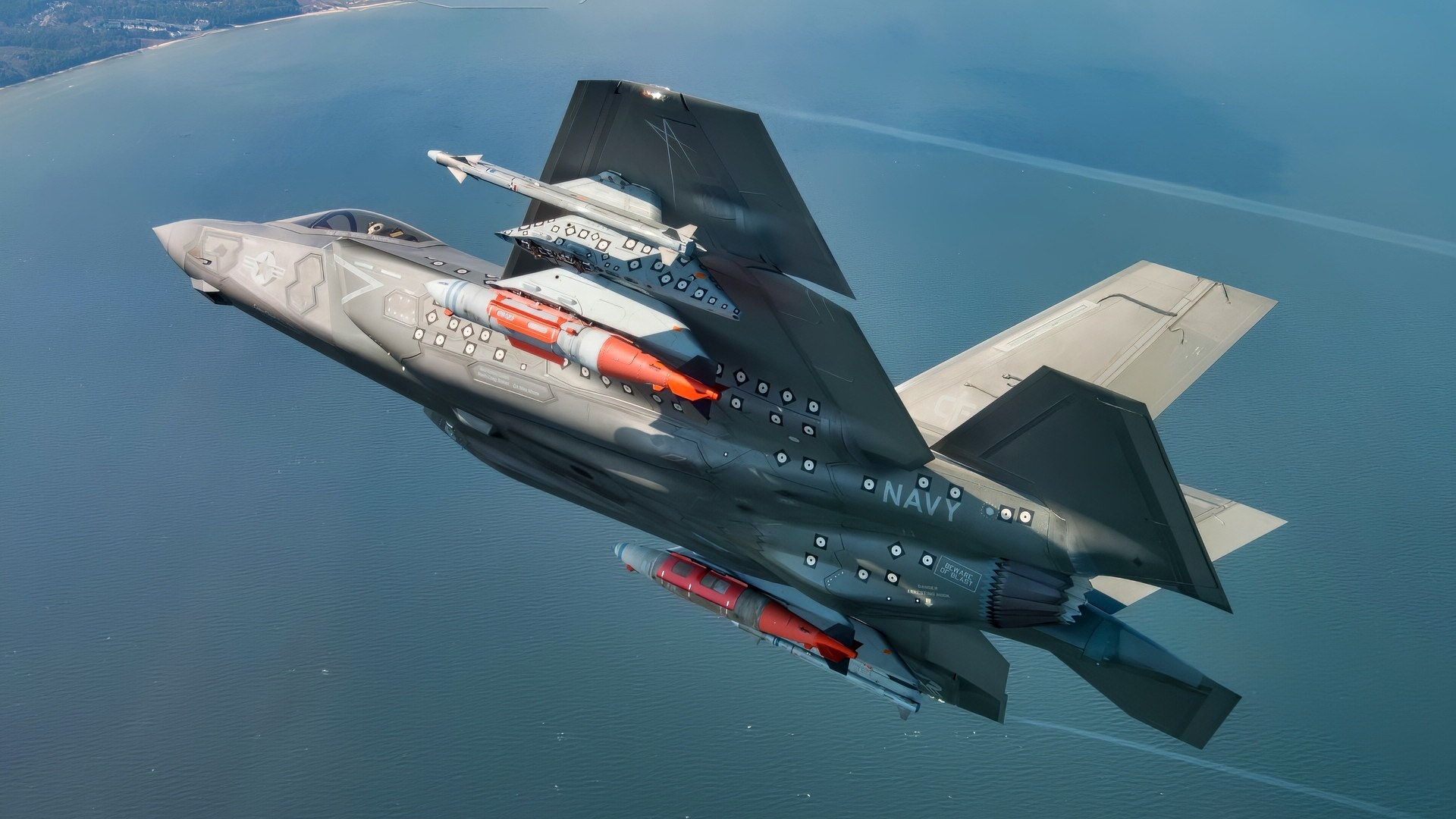
Article Summary – Unlike the Air Force’s F-35A, the Navy’s F-35C and Marine Corps F-35B don’t carry an internal cannon – and that’s by design, not mistake.
-Structural demands for STOVL operations, carrier landings, larger wings, and extra reinforcement left little internal volume for a gun without sacrificing fuel, sensors, or stealth.

Maj. Kristin Wolfe, F-35A Lightning II Demonstration Team pilot and commander, performs the “high speed pass” maneuver at the California International Air Show, Salinas, Calif., Oct. 30, 2021. The F-35A Demo Team performed alongside the U.S. Navy’s F-35C Demonstration Team, showcasing two different variants of the 5th-generation fighter aircraft. (U.S. Air Force photo by Capt. Kip Sumner)
-Instead, both variants lean on long-range missile engagements, sensor fusion, and networked operations as their primary combat tools, with an external gun pod available when missions demand close-in fire.
-The result is a calculated tradeoff: maximize survivability and long-range lethality, while accepting that dogfights are now the exception, not the rule.
Wait – the F-35B and F-35C Have No Internal Guns?
When the U.S. Navy and Marine Corps field their flagship stealth fighters – the F-35C (carrier-based) and the F-35B (short take-off) variants – there’s a surprising feature that really stands out.
And it’s a shocker: unlike the Air Force’s F-35A, neither the B nor C has an internal 25 mm cannon built into the airframe.
That’s right. Two of America’s flagship stealth fighters don’t have internal guns.
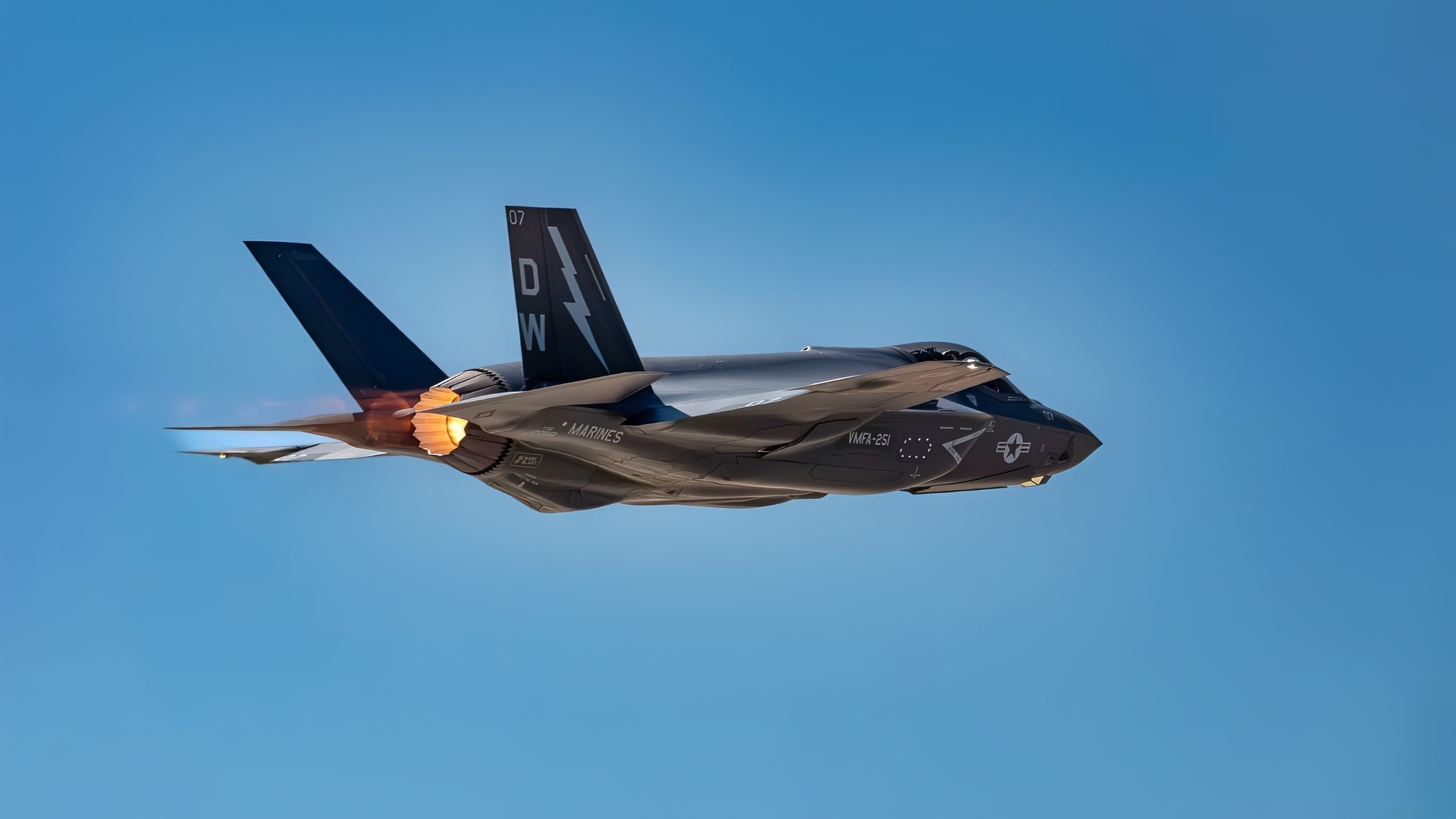
A U.S. Marine Corps F-35C Lightning II assigned to Marine Fighter Attack Squadron 251 (VMFA-251), Marine Corps Air Station Cherry Point, North Carolina, takes off for a mission in support of Red Flag-Nellis Marine Fighter Attack Squadron 251 (VMFA-251), 2nd Marine Aircraft Wing, Marine Corps Air Station Cherry Point, North Carolina 25-3 from Nellis Air Force Base, Nevada, July 22, 2025. Red Flag, strengthens join-force readiness through integration in realistic combat scenarios, enhancing interoperability and rapid-response capabilities. (U.S. Air Force photo by William R. Lewis)
The fact has raised questions for some time. How, exactly, does a multibillion-dollar fifth-generation combat aircraft forego what has been traditionally considered a basic fighter capability?
As the Navy and Marine Corps steer their air wings toward a potential high-end Indo-Pacific conflict and contested carrier operations, the absence of a built-in gun is particularly curious. But there’s a reason why.
Why Two F-35 Variants Have No Internal Gun
Before we get to the matter of the internal gun, let’s go over the basics.
The F-35 family shares a standard airframe and avionics suite, but the F-35B and F-35C differ significantly from the F-35A in terms of mission environment and various structural constraints.
The F-35A is the conventional-takeoff variant operated by the U.S. Air Force and is the only variant to carry a built-in 25 mm rotary cannon mounted internally.
The F-35B and C, by contrast, omit that internal gun due to several engineering, aerodynamic, and mission-profile trade-offs.
In other words, these aircraft are specifically designed to meet specific requirements. While the gun is obviously helpful, there are benefits to removing it that those two variants need. Chief among them? Stealth.

Two F-35C Lightning II carrier variant joint strike fighters conduct the first catapult launches aboard the aircraft carrier USS Nimitz (CVN 68). The F-35 Lightning II Pax River Integrated Test Force from Air Test and Evaluation Squadron (VX) 23 is conducting initial at-sea trials aboard Nimitz. (U.S. Navy photo courtesy of Lockheed Martin by Dane Wiedmann/Released)
The F-35 design incorporates stealth requirements into its internal weapons bay. It is designed to minimize radar cross-section and maintain low observability. Internal sensors, weapons, and fuel all contribute to stealth by reducing external protrusions. An internal gun, however, still requires openings, ammunition-feed systems, and other structural reinforcements that can compromise stealth shape.
Then there are variant-specific components, such as the F-35 B’s swivelling nozzle, which enables short take-off and vertical landing (STOVL). These systems all consume internal space, increase the aircraft’s weight, and reduce the volume of internal fuel or weapons bays. The B variant has a smaller internal weapons bay than the A and C.
And as for the F-35C, it’s designed for carrier operations. That means it needs to function on catapult launches and work with arrested recovery gear, which means it needs reinforced landing gear and larger wings for low-speed handling. These kinds of structural changes all require trade-offs, as they consume weight and internal space. The victim? Guns.
But remember this: the Navy and the Marine Corps place a higher premium on missile engagements (beyond visual range) and strike capability over cannon-based dogfighting, so a lack of cannons isn’t necessarily a big problem.
And, the B and C variants are both equipped to accept an external gun pod for when the mission requires it -meaning they aren’t unarmed.
Does It Matter In Combat?
The operational relevance of the F-35B and F-35C’s missing internal gun really depends on the mission, as well as the threat environment. In high-end air supremacy fights, naval planners expect the jet to be used more effectively as a stealthy forward sensor node, launching missiles long before an adversary can even detect it.
In a scenario like that, the aircraft’s most significant advantage is its stealth, and a built-in gun would be secondary to long-range weapons, electronic warfare equipment, and its overall ability to pass targeting data across the carrier strike groups. It’s hard to envision, in these scenarios, the aircraft needing an internal cannon.
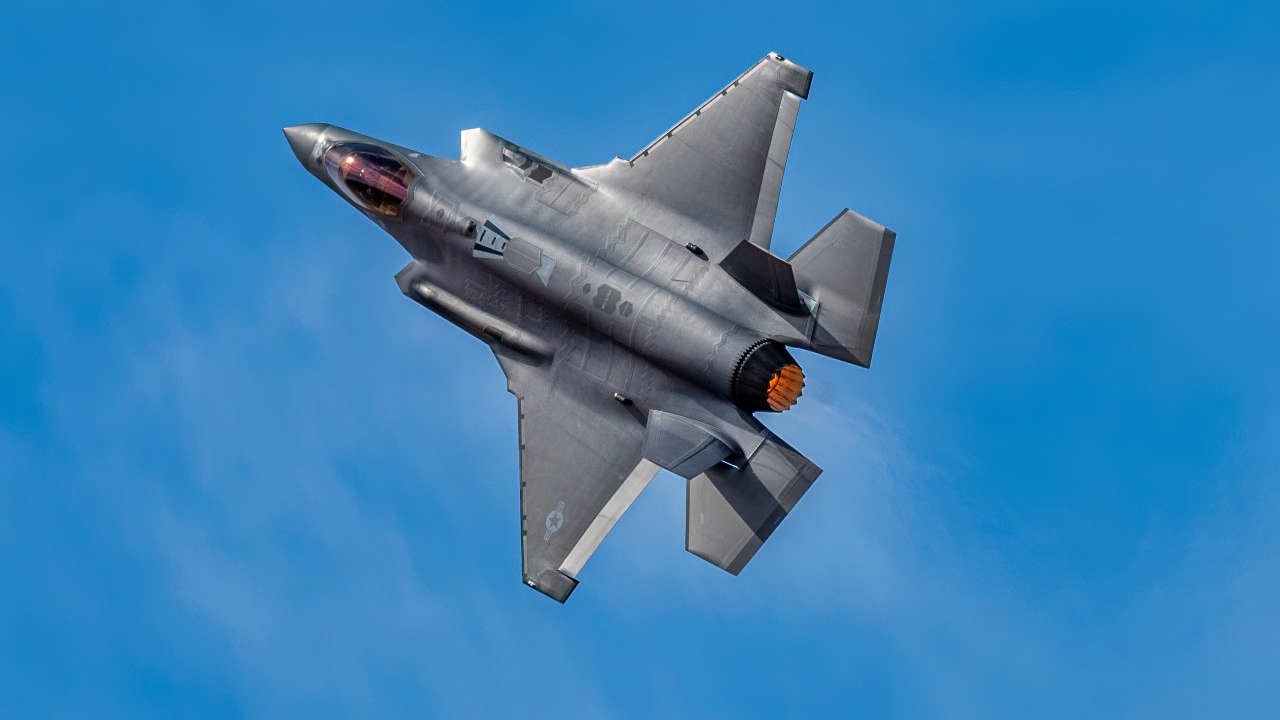
A U.S. Air Force F-35A Lightning II aircraft flies during the Heritage Flight Training Course at Davis-Monthan Air Force Base, Arizona, Feb. 28, 2025. The F-35 is designed to provide the pilot with unsurpassed situational awareness, positive target identification and precision strike in all weather conditions. (U.S. Air Force photo by Senior Airman Jasmyne Bridgers-Matos)
But, of course, naval aviation cannot expect that scenarios will always unfold most conveniently. Close-in engagements are not uncommon, but they’re also not entirely theoretical.
Carrier air wings have routinely operated in complex environments where visual-range fire is still required, and in those circumstances, an internal gun may be necessary.
Missile inventories can, after all, be exhausted – and rules of engagement often change depending on visual confirmation. Engagements can collapse into short-range fights – but even so, the lack of an internal gun still isn’t a fatal flaw. It’s a calculated decision that needed to be made.
Mission planners can still mitigate the gap by loading the external gun pod for sorties where close-in engagements are more likely, pairing both the F-35B and C with aircraft that carry internal guns, or even shaping strike packages so that missile-heavy aircraft can remain protected by fighters configured for visual-range contingencies.
Naval aviation has battled these predicaments for many years.
The lack of an internal cannon may be surprising, but it’s nothing new. It’s a feature.
About the Author:
Jack Buckby is a British author, counter-extremism researcher, and journalist based in New York. Reporting on the U.K., Europe, and the U.S., he works to analyze and understand left-wing and right-wing radicalization, and reports on Western governments’ approaches to the pressing issues of today. His books and research papers explore these themes and propose pragmatic solutions to our increasingly polarized society. His latest book is The Truth Teller: RFK Jr. and the Case for a Post-Partisan Presidency.
More Military
The U.S. Military Is In ‘Crisis’
Canada’s F-35 Stealth Fighter Mistake Is Just Around the Corner
The Mach 2.23 F-4G Wild Weasel Has a Message for the U.S. Air Force


