

Key Points and Summary: In March 1984, the Soviet Victor I-class nuclear-powered attack submarine K-314 collided with the US aircraft carrier USS Kitty Hawk in the Sea of Japan during a tense period of Cold War “cat and mouse” games.
-The submarine, which was shadowing the US carrier group, surfaced directly in the path of the Kitty Hawk, allegedly without its navigation lights on, resulting in a collision.
-While the carrier sustained minor damage, the K-314 was left dead in the water.
-The incident provided an intelligence windfall for the US, which recovered pieces of the submarine’s sonar-absorbing anechoic tiles from the carrier’s hull.
The Day a Soviet Sub Surfaced Directly in Front of a US Aircraft Carrier
Bad seamanship and failing to turn on sea lights at night are blamed for what could have been an avoidable collision.
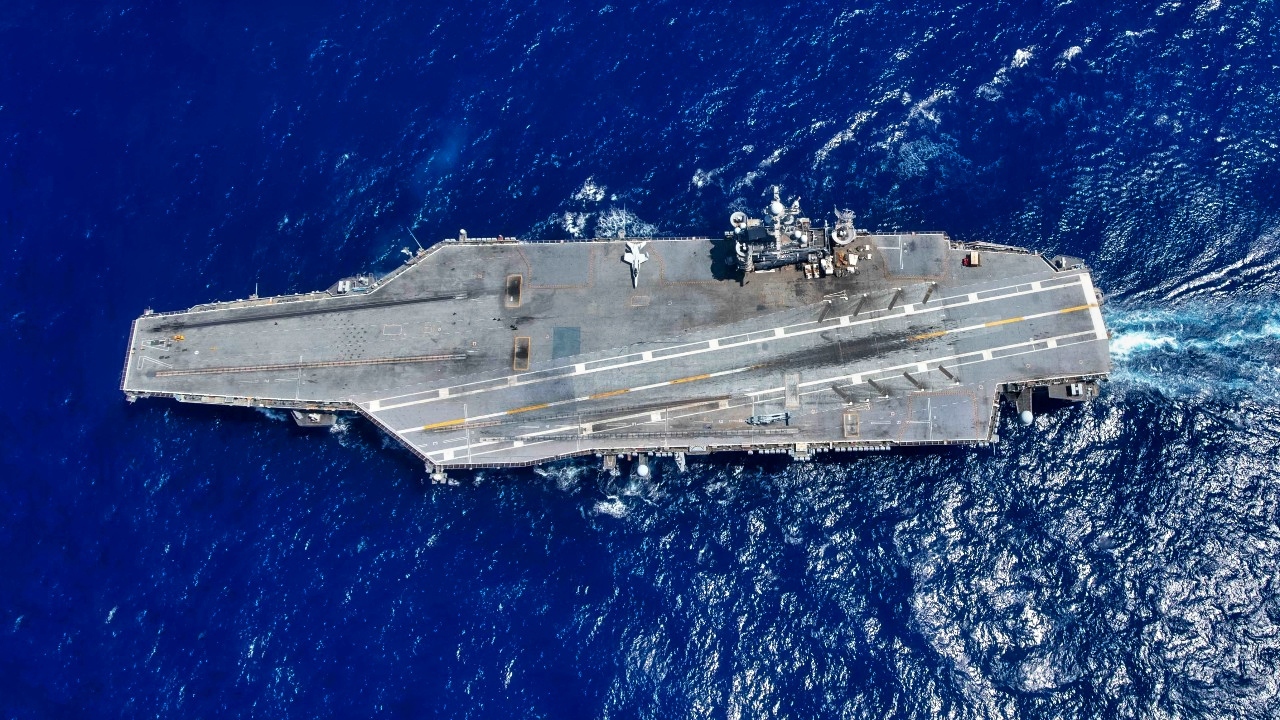
In 1984, a Soviet Navy submarine, the Victor-class K-314, collided with the USS Kitty Hawk, a United States Navy aircraft carrier sailing in the Sea of Japan during exercises there. The totally unexpected collision happened at night, just after 10 p.m.
It was one of the more dramatic incidents at sea of the Cold War. According to reports, the K-314 surfaced just ahead of the American carrier, which was underway and could not avoid the collision.
A news article from 1984 covering the collision cited Pentagon officials, who said that the carrier “had suffered no damage in the collision, which occurred at 10:07 p.m. local time, but that the 5,200-ton submarine, of what the Western nations designate as the Victor class, was seen on the surface dead in the water with a cruiser standing by to assist. The Soviet ships ignored American offers of assistance, the officials said.”
“Naval officers said the Navy would conduct an inquiry. If the evidence showed that the submarine was at fault, a protest will probably be lodged with the Soviet Navy, the officers said,” according to the article.
“Under a 1972 accord governing incidents at sea, the two navies pledged not to interfere with operations of the other or to operate in ways that could be taken as threatening,” the article stated
The competition between the Soviet and American Navies was incredibly intense, even if the two sides never escalated to a full-blown shooting war. Both vessels would have liked to gain some knowledge about the other’s habits, hoping for insight into how their respective opponents operated while at sea. It was an intense, though mostly non-violent, confrontation.
“They play cat and mouse with us all the time,” said one officer. Others noted that Soviet submarines appear to test American antisubmarine devices,” the 1984 article said, quoting a United States Navy officer.
“Reports from the Kitty Hawk said sailors had felt a shudder, apparently as the submarine rose to the surface and struck a glancing blow.
Initial reports stated that the submarine was not operating with its navigation lights, as required by international regulations. A submarine must give way to a surface vessel when surfacing and is obliged to follow those rules when on the surface.
The naval officers said there was no evidence of nuclear leakage from the submarine.”
While the Soviet submarine suffered extensive damage, the USS Kitty Hawk suffered relatively minor damage—this despite both vessels being nuclear-armed and, in the Soviet submarine’s case, nuclear-powered.
Ultimately, the K-314 had to be towed back to the port to repair damage to the sail and the top part of its hull. The incident proved to be particularly insightful for the United States Navy.
Intelligence Scoop
Following the collision, US Navy officials inadvertently gleaned information about the submarine thanks to pieces of the Soviet submarine’s anechoic tiles, sonar-absorbing material, left behind by the vessels’ collision.
While the material was a surprise intelligence scoop for the United States, Navy officials firmly stated that the fault for the incident lay squarely with the Soviet Navy sailors, not the United States Navy.
While surfaced and during towing to home waters, the United States Navy also took a number of photographs of the submarine, providing peeks into its innards that helped confirm and explore aspects not visible to the naked eye.
“Responsibility for the collision lay with the Russians, who placed themselves “in a very hazardous position,” the US Navy said.
“The reason behind the Soviet submarine captain’s slip in judgment is the only mystery here,” reflected RADM James D. Watkins, CNO. “He showed uncharacteristically poor seamanship in not staying clear of Kitty Hawk. That should cause concern in Moscow.”
It Could Have Been Far Worse…
Despite the carrier’s checkered history, parts of the ship are on display. “Iconic elements” of the ship have found a home on display, despite large parts of the USS Kitty Hawk being broken up and sold for scrap. Ultimately, both the Soviets and Americans chose to downplay the incident rather than lodge protests.
And though the incident with the K-314 did not result in the loss of life on either side, it highlighted the dangers inherent in naval operations and the risks posed by accidents or miscalculations.
About the Author: Caleb Larson
Caleb Larson is an American multiformat journalist based in Berlin, Germany. His work covers the intersection of conflict and society, focusing on American foreign policy and European security. He has reported from Germany, Russia, and the United States. Most recently, he covered the war in Ukraine, reporting extensively on the war’s shifting battle lines from Donbas and writing on the war’s civilian and humanitarian toll. Previously, he worked as a Defense Reporter for POLITICO Europe. You can follow his latest work on X.
The Best Tanks on Earth
AbramsX: The Tank the US Army Wants


