
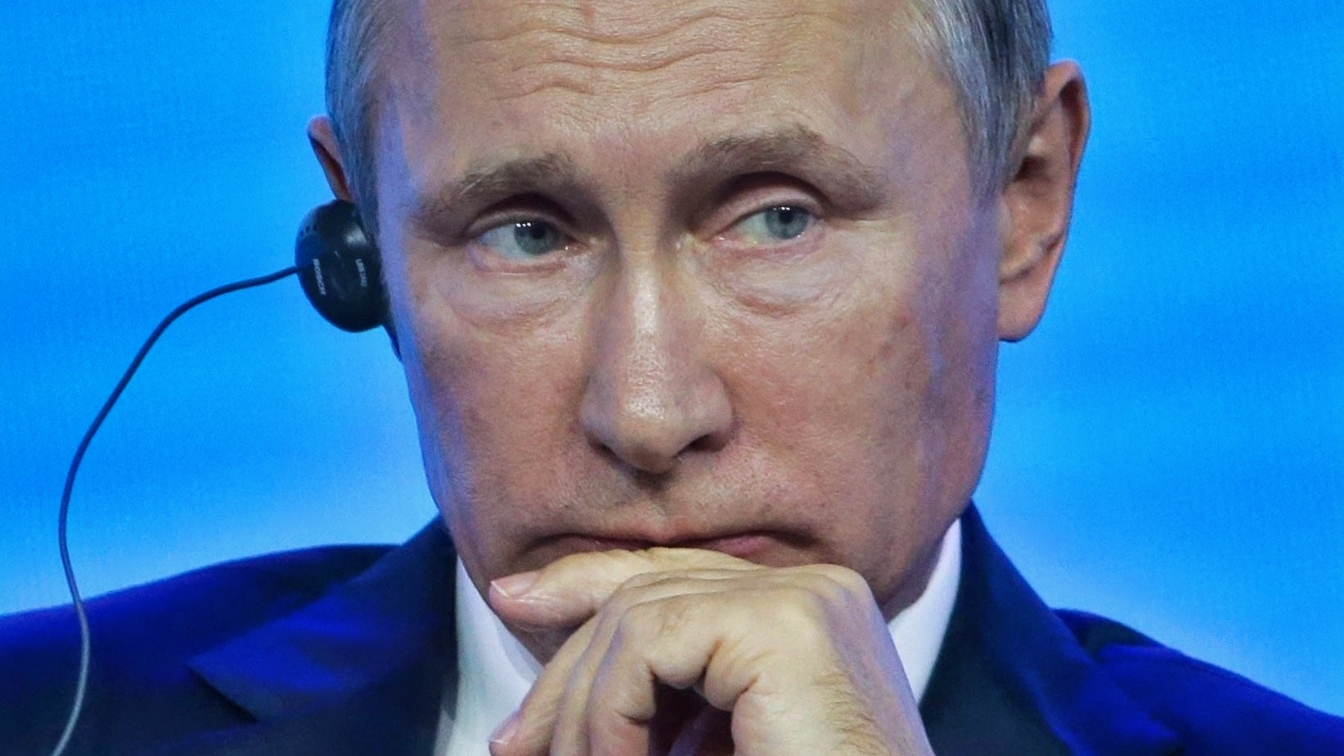
Putin Is Running Out of Soldiers for the Ukraine War – As Russia grapples with ongoing Ukrainian long-range strikes and diminishing returns on the front lines, its massive military recruitment machine appears to be grinding to a halt. This week, reports described how Russian President Vladimir Putin is struggling to replace soldiers being lost in the war, with Western officials now estimating that his army is losing roughly 6,000 more troops per month than it can recruit. And that’s despite Moscow continuing to bring around 1,000 new personnel into the military every day.
Putin in June 2016 Image Credit Russian Federation Photo
Putin Back in 2016 Image Credit Russian Federation
That imbalance has reportedly grown over the last two months, with Russian forces suffering heavy casualties in eastern Ukraine without achieving the kind of territorial breakthroughs that might justify the cost or fundamentally change the war.
That shocking new estimate, reported by The Guardian, cannot be independently verified— but it does fit the broader picture of mounting Russian manpower pressure as the Kremlin looks for ways to escalate and attract soldiers to sign up in the hopes of avoiding another politically dangerous mass mobilization.
Russia Still Recruits Around 1,000 Troops Per Day
Russia has a manpower problem, but the problem is the losses, not the sheer number of soldiers available. Moscow has built an enormous recruitment system since Putin’s September 2022 mobilization, using substantial signing bonuses, comparatively high military salaries and payments to the families of troops killed in Ukraine.
Roughly 1.3 million contract soldiers have been recruited since then, according to reports, but Western estimates cited by The Guardian suggest that Russia has recently been suffering more than 30,000 casualties per month. That means much of the new intake is replacing battlefield losses rather than providing new combat power to support new offensives.
The problem for Putin, then, is obvious.
If recruitment continues at around 1,000 troops per day but losses remain higher, the Kremlin either needs to reduce the intensity of its campaign on the ground — which seems unlikely — or find additional recruits by turning to mobilization again.
Another Mobilization Seems Plausible
For months, reports have indicated that Putin is considering launching another large-scale mobilization in Russia — a move that could cost him politically but would provide the manpower he needs in Ukraine. It would, however, come at a cost to the national economy, which is already struggling with its own labor shortage.
The Institute for the Study of War assessed earlier this summer that Russia’s spring-summer offensive had failed to achieve operationally significant gains despite heavy personnel and equipment losses.
“Russia’s spring-summer 2026 offensive has failed to achieve operationally significant gains thus far, and Russian forces’ rate of advance in June 2026 is a fraction of the rate of advance that Russian forces achieved in June 2025. ISW has observed evidence to assess that Russian forces seized or infiltrated 30.42 square kilometers in June 2026 and advanced or infiltrated at an average pace of 1.01 square kilometers per day. Russian forces comparatively seized 481.25 square kilometers in June 2025, advancing at an average pace of 16.04 square kilometers per day. Russia’s gains have been largely gradual and creeping for over a year, and even Russia’s faster average rate of advance in 2025 was at a foot pace,” analysts wrote.
More recently, Russian forces continued attacking around Pokrovsk, Dobropillya and Novopavlivka on August 27 and 28 without making confirmed advances in those sectors.
There are, however, still some areas where Moscow is gaining ground, including around Kostyantynivka. Russia also retains substantial offensive capabilities, and is successfully exploiting Ukraine’s shortage of Patriot interceptors to cause significant damage with regular ballistic missile strikes.
On Saturday, Ukraine said that Russian military planners have recently been ordered to prepare for possible operations toward Kyiv and Chernihiv, but that the large assault groupings that would be required to launch such an operation quickly have not been detected.
Russia Is Preparing
There are signs that Moscow is already preparing for mobilization.
Western intelligence recently identified mobilization readiness exercises taking place across Russia, including drills in Kaliningrad that test authorities’ ability to house, equip, and supply large numbers of newly mobilized personnel. And, on August 28, Russia’s Defense Ministry proposed expanding military officials’ access to citizens’ medical, employment, income, banking and other personal information. ISW said that the measure could allow Moscow to conduct a mobilization more rapidly in the near future.
But the political risks would be huge, with Russian officials having reportedly discussed imposing additional restrictions if the next mobilization triggers unrest, including partial or full martial law and tighter controls on Russians leaving the country.
A mobilization is not inevitable at this stage, as progress could be made in other ways. Recent concerns that Putin may test NATO’s resolve through asymmetric actions or a small incursion into NATO territory suggest that he is still looking to use any option at his disposal, and that if a mobilization can be avoided, it will be.
About the Author: Jack Buckby
Jack Buckby is a British researcher and analyst specializing in defense and national security, based in New York. His work focuses on military capability, procurement, and strategic competition, producing and editing analysis for policy and defense audiences. He brings extensive editorial experience, with a career output spanning over 1,000 articles at 19FortyFive and National Security Journal, and has previously authored books and papers on extremism and deradicalization.


