

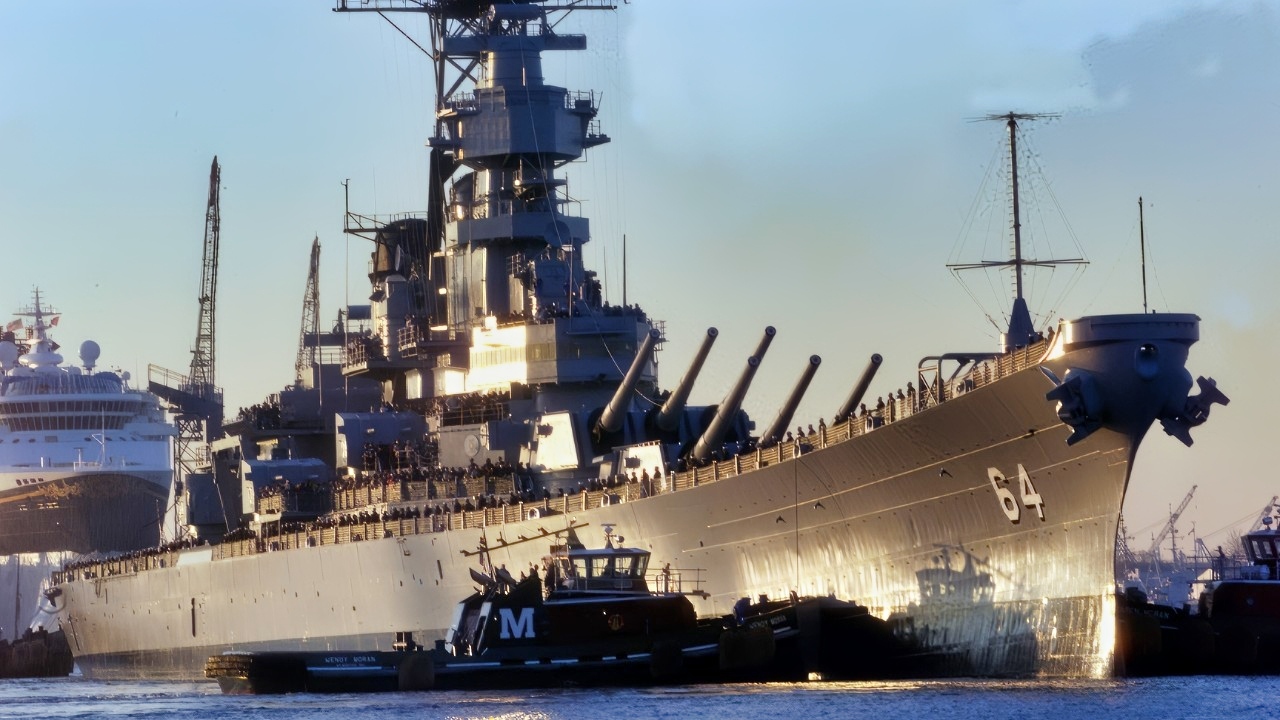
Key Points and Summary – A list details five of the worst battleships in history.
-The Austro-Hungarian Tegetthoff-class makes the list for its paper-thin underwater armor, which led to two ships being easily sunk by torpedoes and mines.
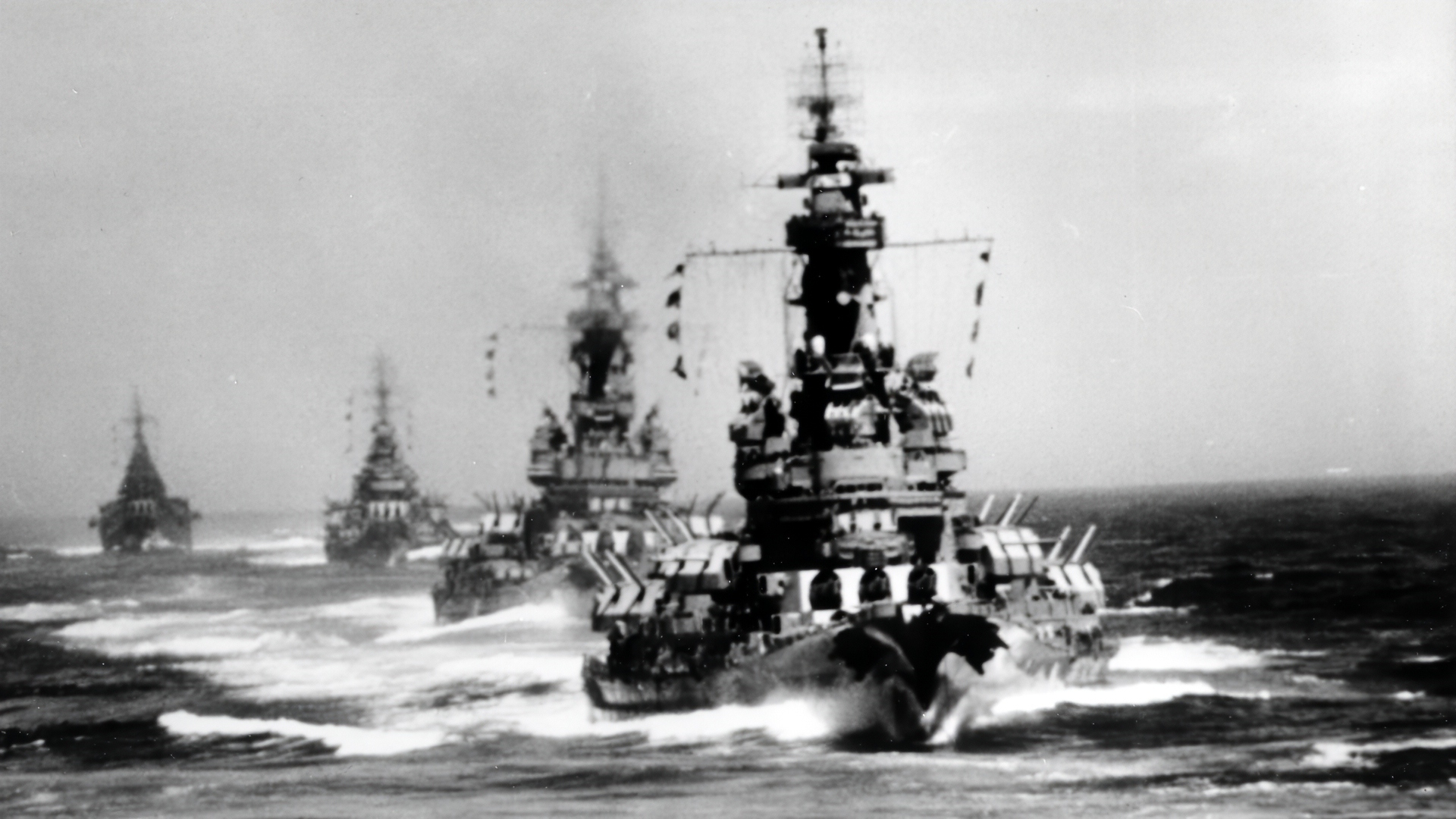
Indiana leading Massachusetts and the heavy cruisers Chicago and Quincy shortly before the bombardment of Kamaishi on 14 July 1945. This photo was taken from South Dakota.
-France’s Courbet-class is cited for being both under-armored and too slow (21 knots), with one ship sinking after hitting a reef.
-The U.S. Navy’s USS Massachusetts (BB-2), a pre-dreadnought, was an “embarrassment” that listed so badly its guns would dip underwater.
-Japan’s Fusō was a flawed “super-dreadnought” with poor armor that was quickly sunk at the Battle of Surigao Strait.
-Finally, the HMS Vanguard makes the list for being a ship cursed by bad timing—it was the last battleship ever built, commissioned in 1946 when aircraft carriers had already made it obsolete.
These Are Surely the 5 Worst Battleships
Battleships were the primary instruments of naval power projection until World War II. But the battleships of the U.S. Navy continued to play a vital, if smaller, role in naval warfare throughout the Cold War era— including during the Korean War, the Vietnam War, and the 1991 Persian Gulf War.
The decades of the dreadnoughts were glorious while they lasted, but not all battlewagons were created equal. Accordingly, National Security Journal now makes a case for the five worst battleships of all time.
Though this is admittedly a subjective list, we will apply some objective criteria, such as inherent design flaws, crew competence, and combat record. Without further ado, and in no particular order, let’s begin.
#1: The Tegetthoff Class (Austro-Hungarian Navy)
This class makes the bottom-five lists of at least two naval history writers, namely Brad Hill of SlashGear and Peter Suciu of The National Interest.
There were four ships in the class, built between 1910 and 1914: the SMS Tegetthoff, Szent Istvan, Viribus Unitis, and Prinz Eugen (not to be confused with the Nazi German Kriegsmarine heavy cruiser bearing the same name). These ships were quite innovative in some ways—for example, they were the first to bear triple-gun turrets.
So, what made the Tegethoffs so bad?
Mr. Hill elaborates: “Focusing too much on the class’s guns, the Navy failed to construct the ships with reliable armor, specifically underwater. The Tegetthoff-class’s defense under the waves consisted of a 1.9-inch anti-torpedo bulkhead, which really only kept vital machinery safe.
“There was a brief skirmish in the Austro-Hungarian port of Pola in which Italian torpedo boats took advantage of this weakness and sank the Szent Istvan in 1918. Later in the same year, Italian frogmen snuck into Pola’s harbor to place a portable mine on the Viribus Unitis’ hull. This capsized the battleship, leaving only two in its class. Italy received the Tegetthof after the war only to scrap it in 1922, while the Prinz Eugen went to France, where it was used for target practice.”
#2: The Courbet Class (French Navy)
This one makes Hill’s list, as well as another written by Brandon Weichert for 19FortyFive. Coincidentally, just like with the Tegetthoff class, the four ships of this class were built between 1910 and 1914: the Courbet, Jean Bart, France, and Paris.
On the plus side, the Courbets made history as France’s first dreadnoughts.
On the minus side, they were under-armored, just like the Tegetthoff class. To make matters worse, they were also way too slow, with a top speed of a mere 21 knots. Hence the ignominious histories of these four dreadnoughts:
-The Jean Bart was damaged by a submarine-launched torpedo at the end of 1914 (though the damage was eventually repaired).
-The France crashed into a reef and sank in August 1922.
-The three surviving vessels ended up undergoing some modernization, but that wasn’t enough to keep them viable.
They were relegated to training-vessel duties by the time World War II broke out in 1939, and the life of the class came to an inauspicious end when the Courbet was sold for scrap in 1947.
#3: The USS Massachusetts (BB-2) (U.S. Navy)
This one makes both Hill’s list as well as Suciu’s. The former describes her as “an embarrassment of epic proportions that deserves its own ‘The Office’-style sitcom.” (To add further insult to insult, one could say that this battleship’s travails put a whole new meaning on the slang term “Masshole.”)
BB-2 was an Indiana-class pre-dreadnought battleship commissioned in 1896. Alas, the Massachusetts couldn’t withstand high waves. When her 13-inch main guns turned, their weight (four such guns weighed a combined 272 tons) forced the vessel to list in that direction, with the deck and other cannons sinking below the water line. This vessel also ran aground on two separate occasions, and nine seamen lost their lives during a training exercise when one of the 8-inch guns exploded.
The Navy decommissioned the Massachusetts in 1919. At least she accomplished something useful thereafter, as she was converted to an artificial reef off the shores of Pensacola, Florida.
#4: The Fusō (Imperial Japanese Navy [IJN])
The IJN fielded some impressive battleships during World War II, particularly the Yamato and Musashi. However, the Fusō, though billed as a “super-dreadnought” when she was designed in 1915, turned out to be not so super.
For one thing, she had a very low freeboard, which caused her to take on water in choppy seas. Her armor was also unevenly distributed.
Fusō met her fate during the Battle of Surigao Strait on Oct. 24-25, 1944, which proved to be history’s last battleship vs. battleship engagement. She was sunk along with her fellow IJN battleship Yamashiro. A mere 10 crewmen out of a crew complement of 1,600 survived her sinking.
#5: The HMS Vanguard (Pennant No. 23) (UK Royal Navy)
As Hill and Suciu alike concede, the Vanguard wasn’t necessarily a bad battleship from a technical standpoint, but she was cursed by bad timing. She was “late to the party,” as Hill puts it. She was the last battleship ever built—commissioned in 1946—as well as the largest and fastest battleship the British ever built, with a displacement of 52,250 tons, a hull length of 814 feet 4 inches, and a max speed of 30 knots.

HMS Vanguard. Image Credit: Creative Commons.
Alas, by the time of her commissioning, the ascendancy of aircraft carriers had already rendered her moot. She was scrapped in 1960 after a mere 14-year service life.
About the Author: Christian D. Orr, Defense Expert
Christian D. Orr is a Senior Defense Editor. He is a former Air Force Security Forces officer, Federal law enforcement officer, and private military contractor (with assignments worked in Iraq, the United Arab Emirates, Kosovo, Japan, Germany, and the Pentagon). Chris holds a B.A. in International Relations from the University of Southern California (USC) and an M.A. in Intelligence Studies (concentration in Terrorism Studies) from American Military University (AMU). He is also the author of the newly published book “Five Decades of a Fabulous Firearm: Celebrating the 50th Anniversary of the Beretta 92 Pistol Series.”
More Military
The Army’s AbramsX Tank Boils Down to 1 Word
China’s Big Plan To Sink U.S. Navy Aircraft Carriers Comes Down to 4 Words
The New Air Force B-21 Raider Isn’t Just a Stealth Bomber
The F-22 ‘Super’ Stealth Fighter Is Coming
The Real Reason U.S. Air Force Recruiting Numbers Are Surging


