


Key Points and Summary – The Soviet Kirov-class battlecruiser was conceived as a nuclear-powered, prestige flagship built to stalk U.S. carrier groups and survive brutal surface combat.
-Bristling with Granit “carrier-killer” missiles, heavy armor, and robust anti-submarine capability, the massive Project 1144 Orlan ships embodied Moscow’s bid to challenge U.S. sea power in the late Cold War.

Kirov-Class from the Russian Navy. Image Credit: Creative Commons.
-Yet post-Soviet reality was unkind: staggering operating costs, decaying shipyards, and Russia’s shrinking navy left the class largely pier-bound and never tested in combat.
-Some even say these were Russia’s battleships in the respect that they were obsolete and not worth building, some of the arguments made about later U.S. Navy battleships.
-With Pyotr Velikiy decommissioned and Admiral Nakhimov’s future uncertain, the Kirov-class survives more as a symbol of lost Soviet ambition than a living threat.
Was History Kind to the Mighty Kirov-class Battlecruiser? Maybe We Can Call Them Russia’s Battleships
The Soviet Union-era Kirov-class battlecruiser was one impressive beast.
The Russians called it the Project 1144 Orlan (Sea Eagle), and it was a powerful hybrid ship. Known for being one of the Soviet Union’s early nuclear-powered surface fleet vessels, the Kirov-class could bring the noise.
This was a guided-missile battlecruiser that could engage in ship-versus-ship combat and support troops landing during an amphibious attack.
This was the largest and most powerful surface ship, aside from aircraft carriers, in the Soviet naval fleet.
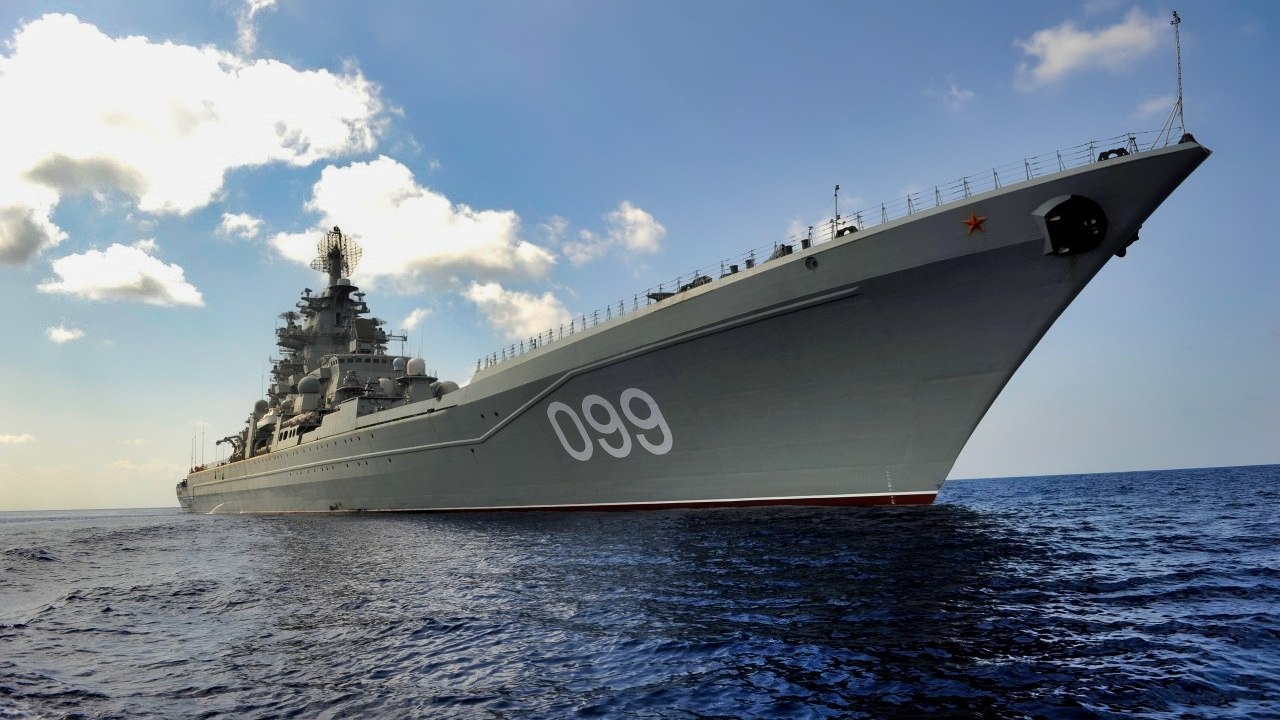
Kirov-Class Battlecruiser Russian Navy. Image Credit: Creative Commons.
One could compare the size of the Kirov-class to that of a World War I or World War II battleship, and the Soviets viewed it as a prestige ship that could carry the flag and project power around the world.
This was the kind of vessel that could make for rousing propaganda reels.
The Soviets proudly described the Kirov-class as a “heavy nuclear-powered guided-missile cruiser.”
One of the reasons that the United States recalled the Iowa-class battleships back to duty was because of the Kirov-class.
The Kirov-class was adorned with guns, missiles, torpedoes, and rockets.
This was undoubtedly a heavily armed ship.
The armor was powerful, able to withstand direct hits from naval gunfire or missiles from aircraft.
When Did the Kirov-class Program Begin?
The Kirov-class goes back to the 1960s when the Soviet Union’s navy was in transition. The Russians wanted a more powerful fleet that could take advantage of ballistic missile developments to punish the Americans.
The Soviets were also worried about U.S. submarines and aircraft carriers.
Why not build a hybrid ship with the versatility for modern warfare that could survive a gunfight or an airplane strike against friendly ships?
Nuclear Power Enabled the Powerful Ships to Challenge the U.S Navy
The Soviets had seen how battleships could also shell enemy positions in land warfare, and with the advent of nuclear power, could send the new battle cruiser around the world looking for a fight with the ability to take on the U.S. Navy on its own terms.
Perhaps the Soviets could eliminate a few American aircraft carriers while the nuclear power was still fresh and an innovative outgrowth of Russian engineering prowess.
While the Soviets developed more precise missiles, designers knew that the United States and NATO navies would perfect counter-measures like surface-to-air missiles, chaff to spoof incoming projectiles, and close-in weapons systems that could protect aircraft carriers from any missile that got through the protective umbrella.
Adept at Anti-Submarine Warfare Too
The Soviets were also adapting tactics to take on American carrier strike groups.
The Kirov-class was designed to lead their own attack convoys with faster-moving cruisers, frigates, and destroyers ,along with a strong presence of submarines.
The Russians were also aware that they needed a better defense against U.S. Navy ballistic missile “boomer” SSBNs that could sneak closer to the shores of the Motherland.
The Kirov-class could be a flagship and control a contingent of hunter-killer escorts. They would operate in pairs against enemy submarines.
One would guard the Kirov-class and the other would hunt submarines.

Russian Navy Kirov-class Battlecruiser. Image Credit: Creative Commons.
The Kirov-class was about missile delivery against enemy shipping. The idea was to take 16 missiles and fire them at eight targets simultaneously.
This is why the Russians were so excited about the battlecruiser.
More About the Nuclear Power On Board
The Kirov-class would have four KN-3 nuclear reactors, capable of pushing 32 knots at 120,000 horsepower, using three shafts.
This would be a power plant akin to those that allowed aircraft carriers to steam ahead.
“The ships were functional yet relatively pleasing to the eye, with a raised, sharp bow, long clipper style forecastle with bulwarks, long straight middle section, forming a perfect rectangle, and ending in a lower stern deck and rounded semi-transom stern, almost as large as the hull mid-beam,” according to NavalEncyclopedia.com.
These Ships Could Kill Carriers and Boomers
The Kirov-class also featured the advanced Granit anti-ship supersonic cruise missile.
This was considered a “carrier-killer,” and the Soviets were confident it could make a difference in combat.
The Kirov-class also had room for two anti-submarine warfare helicopters.
The lead ship of the class, the Kirov, was laid down in 1974. It was launched in 1977 and commissioned in 1980.
The second battlecruiser, the Frunze, was commissioned in 1984. This alerted the Ronald Reagan administration that the Soviets were getting serious about threatening a carrier strike group.
The Kalinin, the third Kirov, arrived on the scene in 1988, toward the end of the Reagan era.
The fourth battlecruiser, the Yuriy Andropov, was not constructed until 1998. After the Cold War, the Russians wanted to reinstate the Kirov-class. But there were ample problems in the Navy due to resource constraints and limitations brought on by the end of the Cold War. A fifth Kirov-class was planned but never built.
The Future Was Not Kind to the Kirov-class
Moscow later believed the Kirov-class to be too expensive to maintain and keep afloat on active duty.
Plans for modernization of the Kirov-class were mostly cancelled and one, renamed the Pyotr Velikiy, had been decommissioned as of 2025. The Kirov-class Admiral Nakhimov was “re-floated” in July of this year. It could enter active duty after sea trials someday, but its fate is still not inevitable.
The Kirov-class was never used in combat, but the ships were definitely prepared to bring maximum firepower to the fight.
They were hurt by the end of the Cold War and the lack of functioning shipyards that could have modernized them for the 21st century. The Kirov-class was a symbol of a navy that is no more.
But they were the epitome of a maritime doctrine that could have challenged a U.S. carrier strike group had they been called to a battle.
The Soviets believed that the Kirov-class could have “aced” the Americans, and it was probably good for the United States and NATO that they never fired a shot in anger.
About the Author: Brent M. Eastwood
Author of now over 3,000 articles on defense issues, Brent M. Eastwood, PhD is the author of Don’t Turn Your Back On the World: a Conservative Foreign Policy and Humans, Machines, and Data: Future Trends in Warfare plus two other books. Brent was the founder and CEO of a tech firm that predicted world events using artificial intelligence. He served as a legislative fellow for US Senator Tim Scott and advised the senator on defense and foreign policy issues. He has taught at American University, George Washington University, and George Mason University. Brent is a former US Army Infantry officer. He can be followed on X @BMEastwood.


