


F-35 program leader Lieutenant General Greg Masiello delivered something of a lite-beer testimony to the Senate Armed Services Committee last week, with many questions deferred to a closed session. But the discussion (transcript here) pointed to a big and little-discussed change to air warfare technology – fighter radars so powerful that they can act as high-power microwave (HPM) weapons. And this involves not just the Lockheed Martin F-35 Lightning but also British Eurofighter Typhoons and the multinational Global Combat Aircraft Program (GCAP).
HPM is not just a type of jamming. A form of directed energy, it is the targeting of an adversary’s radio-frequency (RF) devices, such as radars, communications radios and passive receivers, with pulses of energy so intense that the system is forced offline or even physically damaged. The technology is being widely offered for use against battlefield drones, but those are RF-susceptible targets at distances of a few kilometres at most.
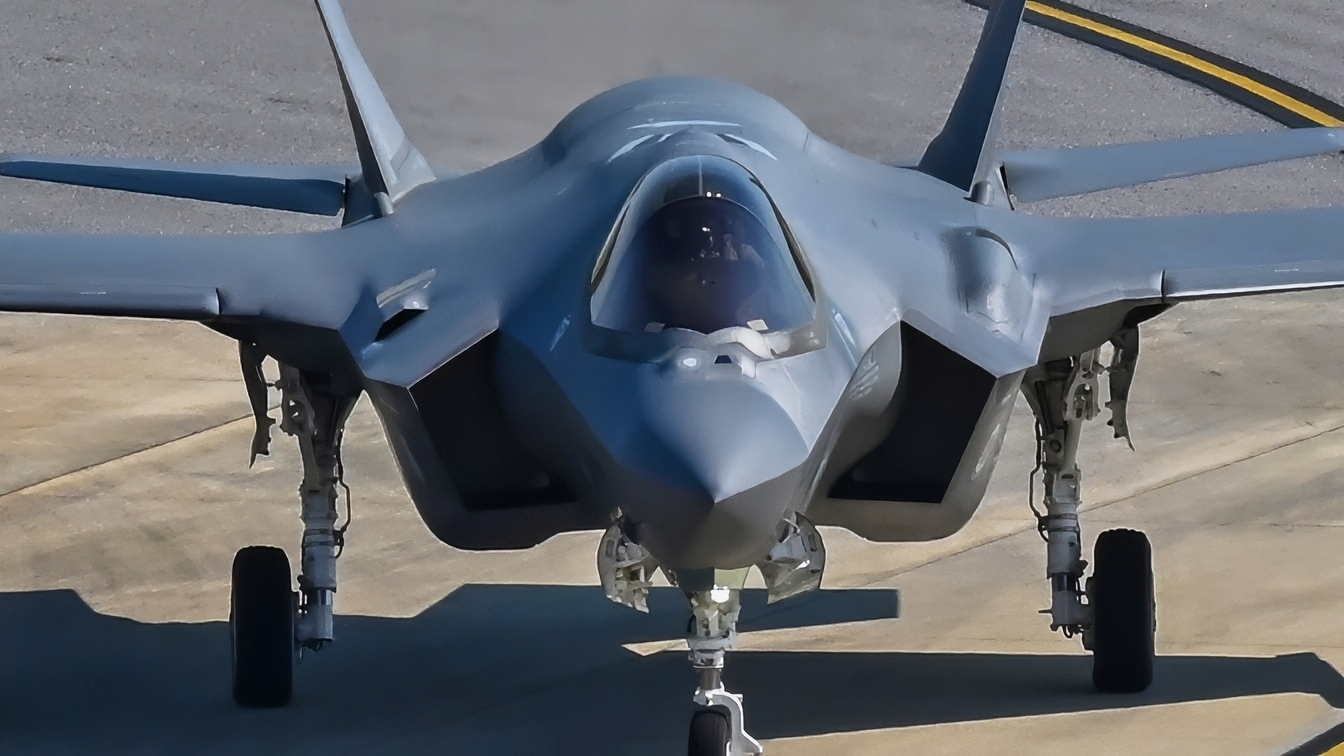
A U.S. Air Force F-35A Lightning II assigned to the 33rd Fighter Wing taxis down the runway at Eglin Air Force Base, Florida, August 1, 2023. The F-35A is a high-performance, multirole fighter jet that combines stealth, sensor fusion and unprecedented situational awareness. (U.S. Air Force photo by Airman 1st Class Abigail Duell)
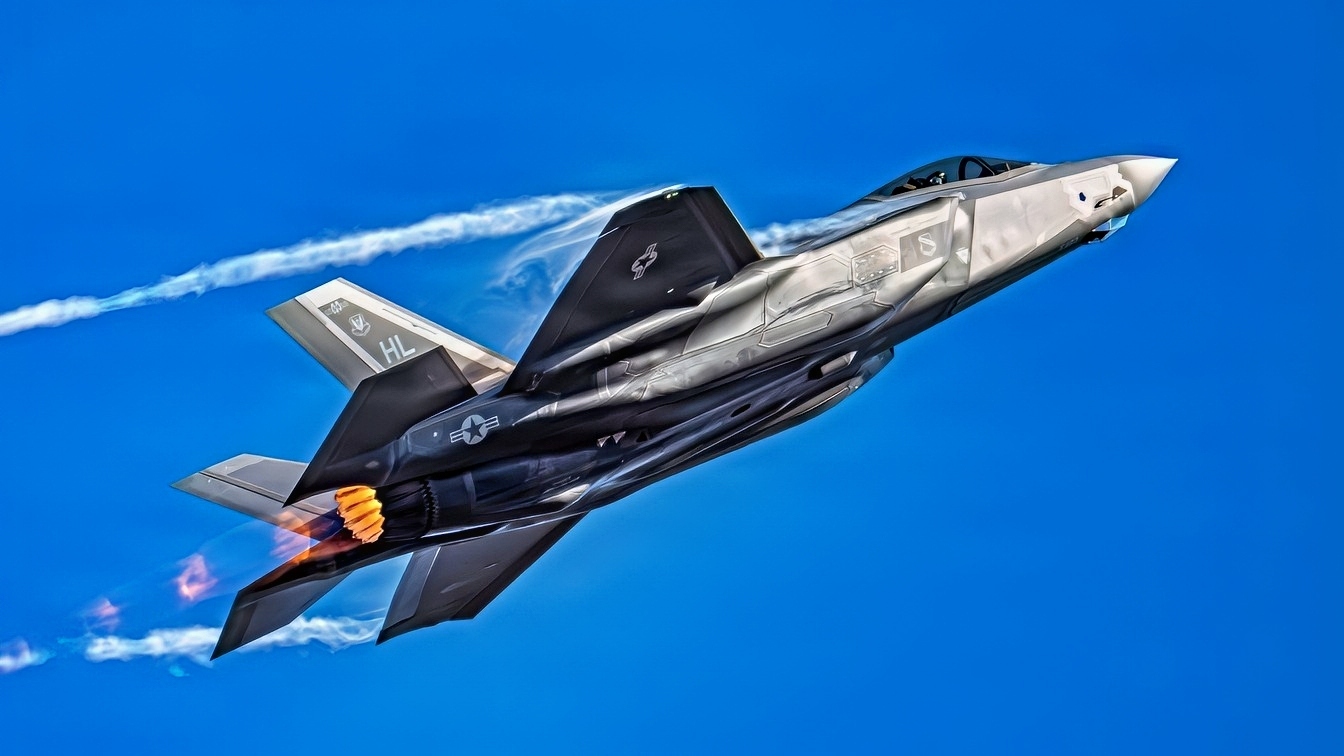
U.S. Air Force Maj. Sean “Rambo” Loughlin, pilot for the F-35A Lightning II Demonstration Team, performs aerial maneuvers during a practice flight at Hill Air Force Base, Utah, Jan. 6, 2026. The flight supported Loughlin’s training as the team’s new demonstration pilot as he prepares for the upcoming air show season. (U.S. Air Force photo by Staff Sgt. Nicholas Rupiper)
Masiello was talking about something that could give Godzilla a round of electroshock therapy at 200 km range.
The story emerged as Senator Mark Kelly questioned Masiello about the new Northrop Grumman APG-85 radar that’s going into US F-35s. There have been a few revelations about that radar in the past year or so: no other country will get it, it is not interchangeable with the current APG-81 sensor, and deliveries of it have been running late. Masiello disclosed that F-35Bs have been delivered to the US Marine Corps without radars.
Masiello also said that the ‘full capability’ of the APG-85 could not be exploited without the forthcoming upgrades to the fighter’s engine and complex cooling system. The program expects to deliver upgraded engines in 2031, but the cooling system will be ‘a few years later’ – raising cooling capacity from the current 30 kW to the future requirement, a startling 62 kW to 80 kW. Running the APG-85 more than doubles the cooling needed for the entire aircraft.
Now that’s revealing, because if a radar needs remarkably more cooling, it must be pumping remarkably greater energy out through its antenna.
Normally, a stealth aircraft wants to emit the smallest amount of radar energy needed to defeat jamming and track targets, so this power points to HPM.
The US Air Force’s interest in HPM as an anti-radar weapon has been a decades-long quest. The Counter-electronics HPM Advanced Missile Project (CHAMP), carried out by Boeing for the Air Force Research Laboratory, demonstrated a missile in 2012 that could disable multiple electronic targets in a single sortie.
CHAMP became a congressional favourite after the 2012 demo, but a senior Air Combat Command leader noted at a 2015 conference that it ‘cost way too much’. A chart from the same event mapped a path from a more compact CHAMP with more accurate beam-steering, through the development of more efficient power sources, to a ‘smart waveform’ weapon mounted on an uncrewed aircraft.
I attended a US air power conference in May where several speakers referred to a topic that one summarised as ‘what electronic warfare and nonkinetic payloads can I bring to the fight?’ (The speakers cannot be identified because the event was held under the Chatham House rule.)
The discussion of nonkinetic payloads revolved around uncrewed aircraft. If HPM systems can be made small and efficient, they can alleviate a problem with concepts for collaborative combat aircraft (CCAs). These are fighter-like drones, such as the Boeing MQ-28 Ghost Bat, that are too small to carry more than a pair of the weapons used on manned aircraft, such as air-to-air missiles. Smaller weapons could be developed for them, but doing so would require time and cost and bring risk. HPM could give CCAs, and the force as a whole, a magazine depth limited only by onboard energy supply, meaning fuel.
CCA-carried HPM weapons may be specialised devices, but there have been consistent reports that the F-35’s initial standard APG-81 radar has an HPM-like mode. A fighter can generate a lot of power, and the radar antenna is large, generating a narrow beam. Gallium-nitride technology in the APG-85 is more efficient than the APG-81’s older gallium-arsenide – more energy on target for the same input power – and it lends itself to working in a wider band of frequencies, as would be needed for attacking a variety of HPM targets.
The United States is not alone. Researchers from the British government and industry (Leonardo, the former Ferranti) have been working with HPMs since the 1990s. British defence technology company QinetiQ commissioned a powerful HPM test facility called Orion in 2002. There were reports of a proposal in 2006 to test a reusable HPM generator on a Northrop Grumman BQM-145 drone.
In 2007 an Advanced Radar Targeting System (ARTS) was tested on a Tornado, and some of that hardware was used in an experimental radar system known as Bright Adder. The last did not fly, but led to the ECRS Mk 2 radar for upgraded Royal Air Force Typhoons. ECRS Mk 2 is unique to the RAF and costly, testimony to the perceived importance of its hinted-at electronic-attack modes.
The sensor suite for the in-development GCAP fighter is named ISANKE (Integrated Sensing and Non-Kinetic Effects), and the big fighter’s key features include two megawatt-class integrated generators on both engines and an emphasis on cooling. The Excalibur flying test bed for the program, a modified Boeing 757, carries not only a radome but some impressively large electronic warfare apertures.
The idea of compromising hostile emitters at light-speed is attractive, but the time that it has taken to field systems shows that it’s not simple. You need the flexibility to hit the target in its own operating band, even if the antenna is protected. Breaking in through other parts of the system takes raw power, as well as bespoke waveforms and even code: HPM can be a delivery system for cyber effects.
Speakers at the May conference noted other issues. Some nonkinetic effects, one speaker said, are ‘fragile’ – suggesting that they could be countered if revealed.
Testing some of these capabilities is difficult because of ‘wide-ranging effects … it’s hard to get approval to operate in (continental US), because we really don’t know how it’s going to spill out.’ The speaker alluded to interference with GPS satellites. Even a signal bouncing off the ground may be enough to fry a satellite’s ultra-sensitive receivers. ‘The burden is on us to prove the negative,’ the speaker said.
HPM shares a persistent limitation with cyber, also classified as a nonkinetic capability. ‘We don’t know how to do BDA (bomb damage assessment)’, a speaker admitted. Particularly if an attack mechanism has been compromised, an adversary system can be programmed to feign damage and restart as soon as the attacker ceases to transmit.
Many aspects of long-reach HPM weapons are likely to remain in the shadows – but it seems that, after a long time, confidence is growing.
About the Author: Bill Sweetman
Bill Sweetman is a veteran, award-winning journalist and aerospace industry executive. This first appeared in ASPI’s The Strategist.


