


Key Takeaways: The USS George Washington (CVN-73) has returned to Yokosuka, Japan, reclaiming its title as the U.S. Navy’s sole forward-deployed aircraft carrier.
-The Asset: A 99,000-ton Nimitz-class supercarrier powered by two Westinghouse nuclear reactors, carrying 90 aircraft including F-35C Lightning IIs.
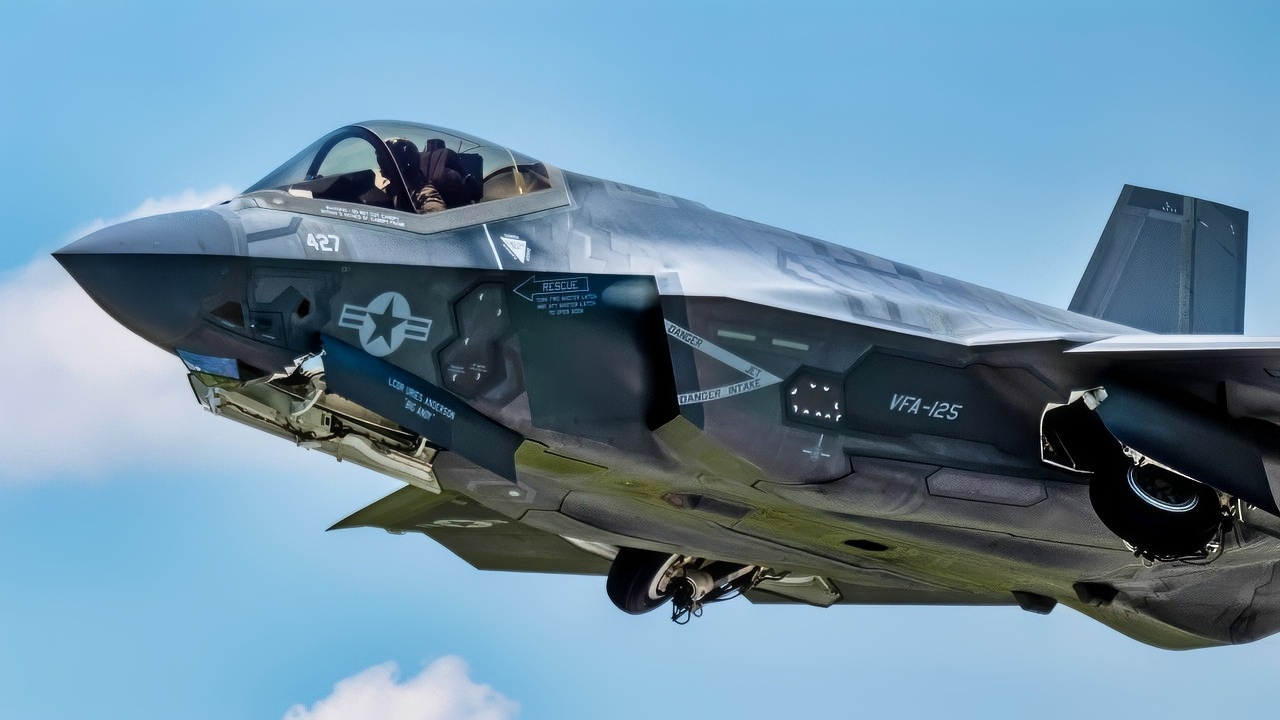
U.S. Navy Lt. Dave Hinkle, F-35C Lightning II Demonstration Pilot, performs during the 2021 Atlanta Air Show, Atlanta Regional Airport-Falcon Field, Ga., May 23, 2021. The U.S. Navy and Marine Corps’ carrier variant has larger wings and more robust landing gear than the other F-35 variants, making it suitable for catapult launches and fly-in arrestments aboard naval aircraft carriers. (U.S. Air Force photo by Staff Sergeant Thomas Barley)
-The Tragedy: The ship’s return follows a grueling $2.8 billion Refueling and Complex Overhaul (RCOH) that dragged on for 2,117 days—two years over schedule. The delay and poor living conditions contributed to a tragic cluster of 11 sailor suicides.
-The Mission: Now operational, the “GW” resumes its critical role projecting power in the Indo-Pacific with the U.S. 7th Fleet.
USS George Washington Navy Aircraft Carrier, Explained
The USS George Washington (CVN-73) is a Nimitz-class nuclear-powered aircraft carrier, the sixth in its class, and the fourth US Navy vessel named after the first U.S. president.
As the U.S. Navy’s sole forward-deployed aircraft carrier, based in Yokosuka, Japan, it serves a critical role in the Indo-Pacific region, operating with the U.S. 7th Fleet.
Aircraft carriers are the centerpiece of America’s Naval forces and are invaluable as the nation’s power projection symbols. On any given day, aircraft carriers exercise the Chief of Naval Operations (CNO) Navigation Directions of Warfighting First, Being Ready, and Operating Forward.
The largest warships in the world (until the Ford-class arrived), Nimitz-class aircraft carriers, support and operate aircraft that engage in attacks on airborne, afloat, and ashore targets that threaten the unrestricted use of the sea, and conduct sustained power projection operations in support of U.S. and coalition forces.
The aircraft carrier strike groups also engage in maritime security operations to interdict threats to merchant shipping and prevent the use of the seas for terrorism and piracy. Aircraft carriers also provide unique capabilities for disaster response and humanitarian assistance.
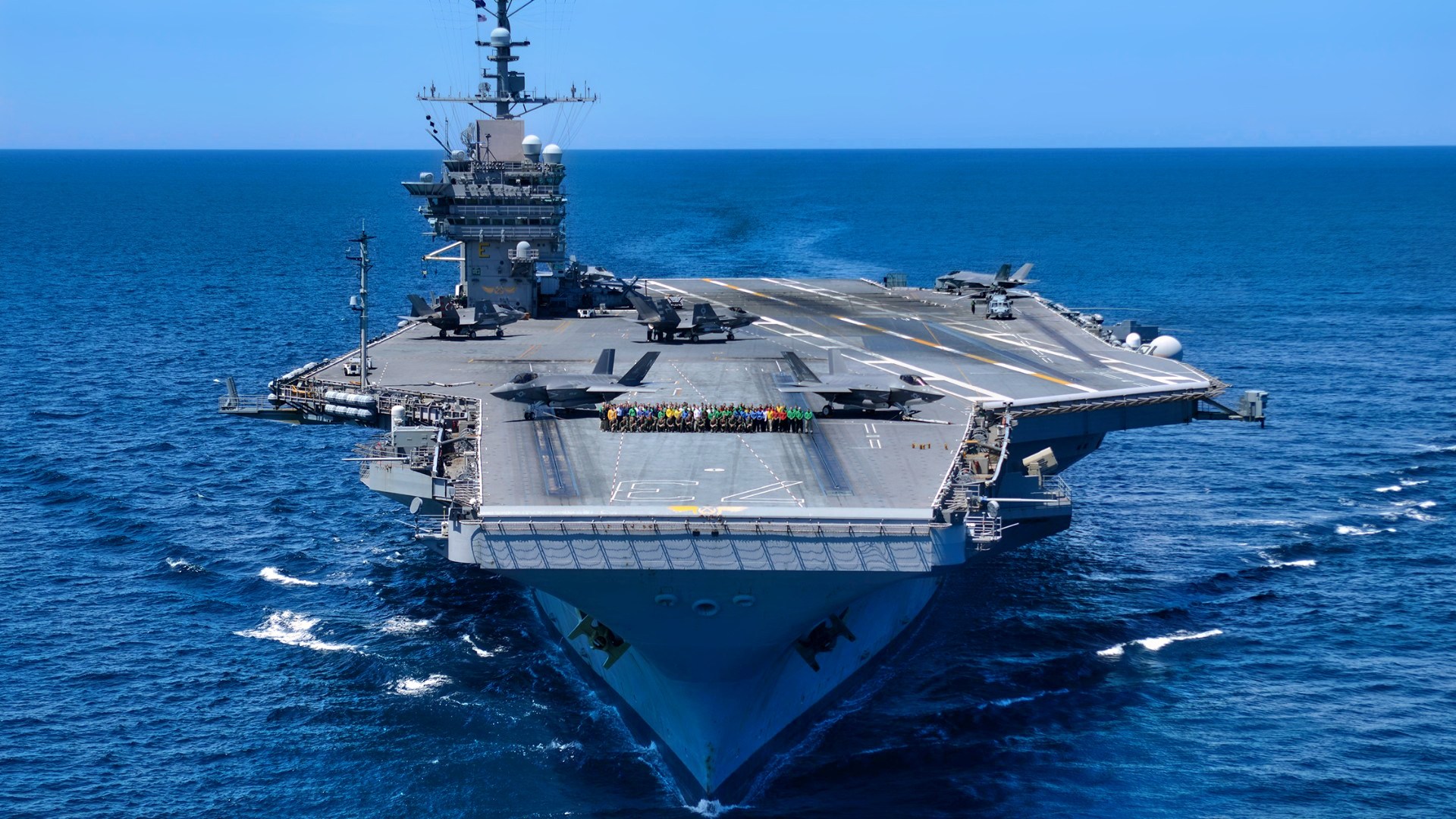
ATLANTIC OCEAN (Aug. 16, 2016) Sailors assigned to the Grim Reapers of Strike Fighter Squadron (VFA) 101, the Navy’s F-35C Fleet replacement squadron, pose on the flight deck of the aircraft carrier USS George Washington (CVN 73) during an aerial photo exercise. VFA-101 aircraft and pilots are conducting initial qualifications aboard George Washington in the Atlantic Ocean. The F-35C is expected to be Fleet operational in 2018. (U.S. Navy photo by Mass Communication Specialist Seaman Apprentice Krystofer Belknap)
Meet the “GW”
The USS George Washington (commonly known to its crew as GW) is 1,092 feet (333 m) long, 257 ft (78 m) wide, and 244 ft (74 m) high.
The super carrier can accommodate approximately 90 aircraft and has a flight deck of 4.5 acres (18,000 m²) in size, utilizing four elevators that are each 3,880 square feet (360 m²) in size to move planes between the flight deck and the hangar bay.
The GW displaces almost 99,000 tons with a combat load and can accommodate 6,250 crewmembers. Her four distilling units can produce 400,000 U.S. gallons (1,500,000 L) of potable water per day; the food service divisions serve 18,000 meals daily.
There are over 2,500 compartments on board requiring 2,520 refrigeration tons (8.6 MW) of air conditioning capacity (enough to cool over 2,000 homes).
The warship utilizes two Mark II stockless anchors, each weighing 30 tons, with each link of the anchor chain weighing 360 pounds (160 kg).
USS George Washington Armaments
It is currently equipped with two 20 mm Phalanx CIWS mounts and two Sea Sparrow SAM launchers.
One CIWS and one Sea Sparrow mount were removed to make way for two RIM-116 Rolling Airframe Missile launchers, installed during the 2005 Drydocking Planned Incremental Availability (DPIA).
The George Washington also carries 90 fixed-wing and rotary-wing aircraft, including fighter jets such as the F-35C Lightning II and F/A-18 Super Hornets, as well as surveillance aircraft like the E-2D Hawkeye, and helicopters.

Maj. Kristin Wolfe, F-35A Lightning II Demonstration Team pilot and commander, performs the “high speed pass” maneuver at the California International Air Show, Salinas, Calif., Oct. 30, 2021. The F-35A Demo Team performed alongside the U.S. Navy’s F-35C Demonstration Team, showcasing two different variants of the 5th-generation fighter aircraft. (U.S. Air Force photo by Capt. Kip Sumner)
A specific Carrier Air Wing (CVW) is assigned for each deployment, but the carrier’s capacity allows for a variety of aircraft types essential for naval operations.
Nuclear Propulsion
The ship can reach speeds of over 30 knots (56 km/h; 35 mph) and is powered by two Westinghouse A4W nuclear reactors.
It has four 5-bladed propellers, each weighing 66,220 pounds (30,040 kg). The George Washington can travel more than 3,000,000 nautical miles (5,600,000 km; 3,500,000 mi) before needing refueling.
USS George Washington History
The GW was deployed to New York City for air defense after the 9/11 attacks.
She participated in numerous operations in the Mediterranean Sea and the Persian Gulf. In 2008, became the first nuclear-powered aircraft carrier to be forward-deployed to Yokosuka, Japan.
The GW provided disaster relief in Japan after the 2011 earthquake and tsunami and in the Philippines after Typhoon Haiyan.
She suffered severe damage during a fire in 2008 that injured 37 sailors, but thankfully, there were no fatalities.
RCOH Drags Out Two Years Over Schedule
The GW completed an extensive Refueling and Complex Overhaul (RCOH) in May 2023, which extended nearly two years beyond schedule.
Typical RCOHs take four years, but the Washington was stuck in HII’s Newport News Shipbuilding for so long that the crew turned over three times while she was stuck in the shipyard. When they finally left port in May 2023, 85 percent of the crew had never been to sea.
Poor Living Conditions Lead To Several Suicides
The long, grueling RCOH that lasted for 2,117 days cost taxpayers $2.8 billion. But it cost the crew much more. Living conditions on board the aircraft carrier were so bad, with the area around the shipyard offering little in the way of food or mental healthcare, that the crew grew depressed.
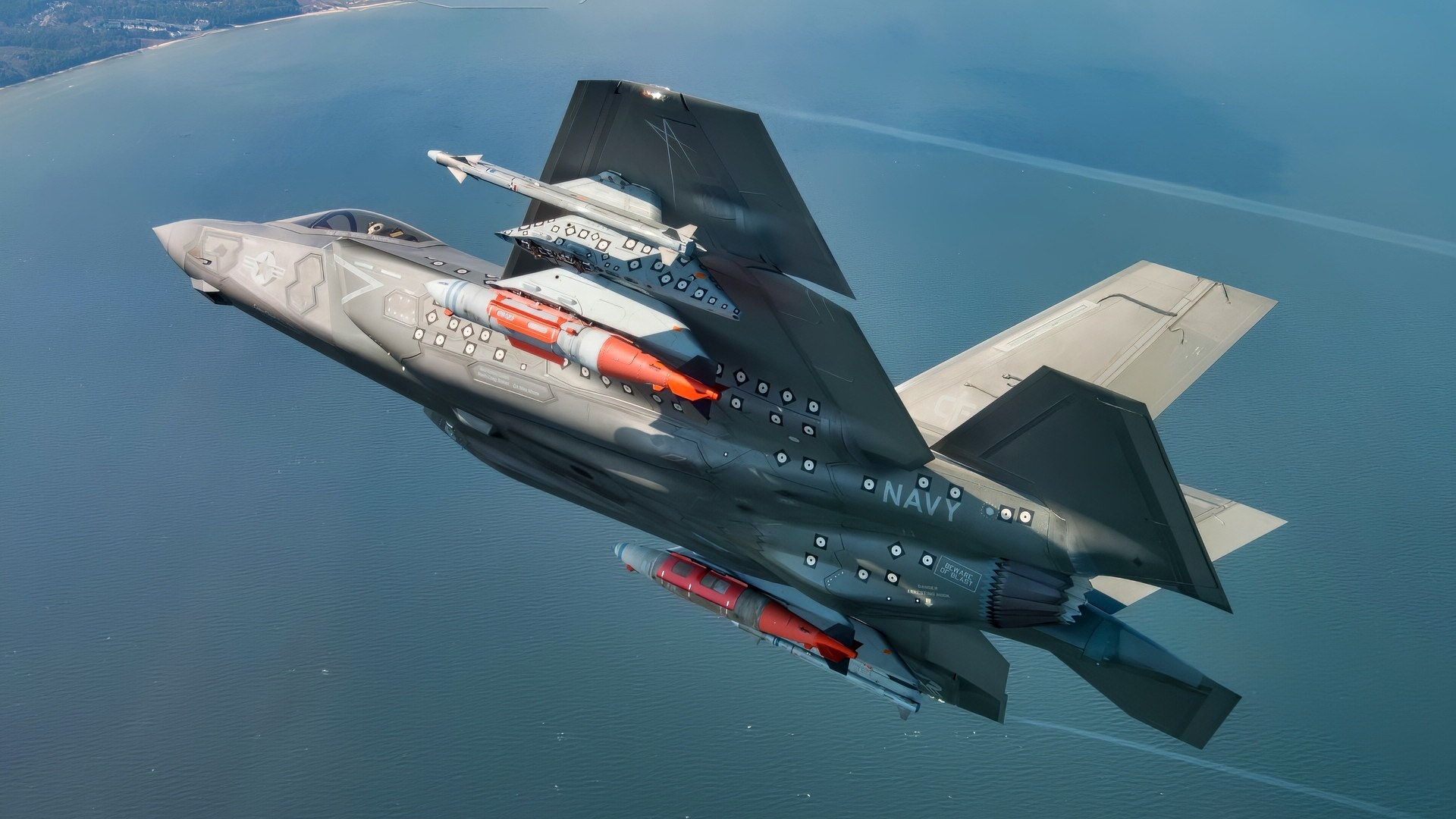
The final SDD Test flight CF-2 Flt 596 was piloted by BAE Test pilot Peter Wilson, April 11, 2018, from the F-35 Pax River Integrated Test Force. The F-35C completed a mission to collect loads data while carrying external 2,000-pound GBU-31 Joint Direct Attack Munitions (JDAM) and AIM-9X Sidewinder heat-seeking missiles. (Photo courtesy of Lockheed Martin)
The Naval Criminal Investigative Service confirmed that from the time the carrier went into the yard in 2017 to the time it left in May 2023, 11 sailors died by suicide, and nine of the 11 sailors died by gunshot wounds to the head.
The Navy’s report on the suicides recommended limiting the time young sailors spend in the yard.
The GW is now back in Japan, home-based at Yokosuka.
About the Author: Steve Balestrieri
Steve Balestrieri is a National Security Columnist. He served as a US Army Special Forces NCO and Warrant Officer. In addition to writing on defense, he covers the NFL for PatsFans.com and is a member of the Pro Football Writers of America (PFWA). His work was regularly featured in many military publications.


Christopher Wood
September 25, 2025 at 8:34 pm
…and one Russian nuclear bomb can take it out. Also, we have an imbecile and coward in charge of the U.S.
Jordan
September 28, 2025 at 6:52 pm
Hey at least they try what’s ur excuae
Prof. Mustafa Leake
September 28, 2025 at 8:08 pm
“and one russian nuclear bomb can take it out” – and how’s your beloved russia going to DELIVER said nuclear bomb, Ivan?
Any country that doesn’t have even a single carrier isn’t a naval power – FACT!
K Mcmaugh
December 1, 2025 at 9:26 am
USA needs a dozen of new GW, at least. Maybe 20. The Nimitz are getting too old. The production will create 1000s of jobs.
Ron C
December 2, 2025 at 9:10 pm
WTF … 11 suicides
Looks like we need to screen the applicants alot better