

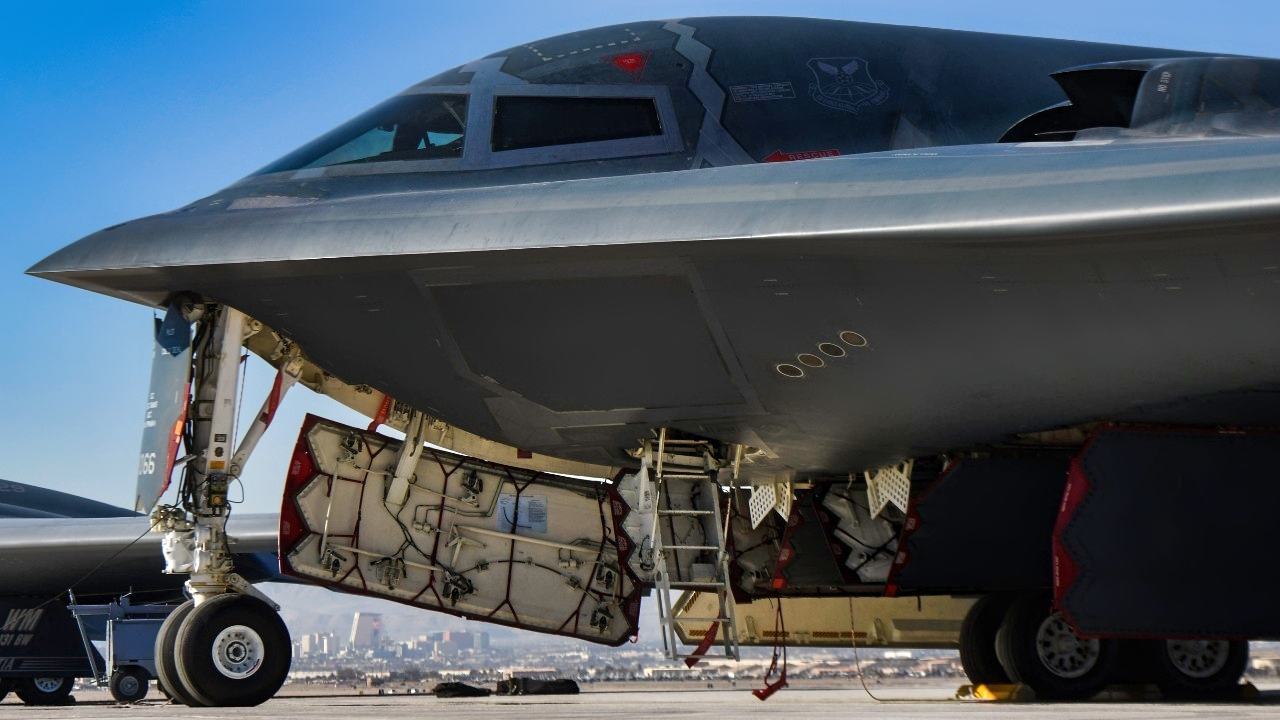
Key Points and Summary on B-2 Stealth Bomber – The B-2 Spirit stealth bomber’s massive and versatile payload is a critical component of its strategic value, as demonstrated in the recent “Operation Midnight Hammer” strike against Iran.
-The B-2 can carry over 20 tons of ordnance, including up to 80 conventional 500-pound bombs, 16 nuclear B-61 bombs, or, most notably, two 30,000-pound GBU-57 “bunker buster” bombs.
-This unique capability to deliver the GBU-57, America’s largest non-nuclear weapon, allowed the US to successfully target Iran’s most deeply buried nuclear facilities, a mission no other aircraft in the US arsenal could have accomplished.
Major B-2 Bombing Payload Is a Difference Maker in Modern Warfare
The B-2 Spirit bomber has been in the news since it dropped bunker-busting bombs on Iranian nuclear infrastructure recently. The stealth airplane has been a sturdy asset with a heavy payload throughout its service career. The B-2 is nuclear-capable with the ability to carry 800 percent more bombing payload than the F-117 Nighthawk. The B-2 can deliver more than 20 tons of ordnance.
The Spirit can deploy 80 MK-82 general-purpose, free-fall 500-pound bombs. These are highly versatile and have been utilized in numerous combat missions over the years. The B-2 can drop several nuclear B-61 bombs, which weigh 825 pounds each. The maximum nuclear payload would be 16 B-61s. The B-2 can also deploy B83 nuclear gravity bombs.
Massive Bunker Buster Taught Iran a Lesson
However, when custom outfitted, the bomber can increase its payload for a heavier delivery. The Spirit can sometimes carry two GBU-57 Massive Ordnance Penetrator bombs, which weigh 30,000 pounds (15 tons) each. These were pivotal performers against the Iranian nuclear sites.
JDAMs Pack a Punch
The B-2s also carry the Joint Direct Attack Munition (JDAM) for a total of 16 2,000-pound JDAMs. This transforms a traditional bomb into a precision-guided weapon that is highly accurate. The Israelis have made good use of JDAMs against Hamas, Hezbollah, and Iran. The U.S. B-2s used JDAMs effectively during Operation Allied Force in the Kosovo War of 1999. The B-2 bomber dropped more than 600 JDAMs during the NATO conflict against Serbia.
B-2s are effective at bombing because of their long range of 6,000 miles. When the B-2s carried the bunker busters against Iran, they needed to be refueled frequently in the air. The B-2 is not a fast MACH-rated airplane, but it does have a high subsonic speed.
B-2 Missions Can Last More Than 24 Hours
The stealth bombers can stay in the air for longer than a day. The Iranian mission lasted 36 hours. After 9/11 in 2001, the B-2 had an operation that lasted 44 hours against the Taliban and al-Qaeda in Afghanistan.
Don’t Forget the New B-21 Raider
B-2s are 30 years old, but still relevant after the successful mission against Iranian nuclear sites. The B-21 Raider will supplement them. The Raider’s payload is 30,000 pounds, and it can also deploy the B-61 nuclear bomb, the Long-range Stand Off Missile, and the Joint Air-to-Surface Standoff Missile (JASSM) or JASSM-ER.
Combining the B-2 with the B-21 will be hugely effective for the United States. The nuclear deterrent will be considerable. The B-21’s ability to fire stand-off missiles is a welcome addition to the U.S. Air Force bombing fleet.
B-2 Bomb Payload Matters Greatly
Seven B-2s were used against Iran during Operation Midnight Hammer. This was one of the longest missions the B-2 has flown in decades. It took 18 hours to reach the targets from Whiteman Air Force Base. Six stealth bombers were sent to Guam as a decoy to fool the Iranians. Fourteen bunker busters were dropped on Natanz and Fordow. Massive Ordnance Penetrators are 20 feet long and can penetrate up to 200 feet before exploding.
Tomahawk cruise missiles were fired from a U.S. Navy submarine at the Isfahan nuclear site after the bombers dropped the bunker busters.
The B-2s carried out this mission with audacity, maximizing the shock value. Their massive payload will make the airplane valuable for many years. They will eventually be paired with the B-21 Raider. This will provide the Air Force with a 1-2 punch that can overawe the enemy. The nuclear capability forms an essential leg of the American nuclear triad.
The B-2s are not done. There could always be another strike against Iranian nuclear sites. Thus, Operation Midnight Hammer may not be the last you hear of B-2s. The Americans will have to produce more bunker busters before another mission can happen.
Thus, the bomber is relevant, and its large bomb payload matters in future wars. The bunker-busting bomb capacity enabled the historic raid on Iran. The B-21 has a large payload as well, and if at least 100 Raiders are produced, the Air Force will be able to maintain pressure on the enemy for decades to come.
The B-2’s heavy bombing payload is a difference maker in modern warfare. Their stealth capability made them blind to the Iranians. The feint to Guam was a master stroke by the Air Force, and the Iranians never saw the main effort coming.
Pairing the older stealth bomber with the new B-21 will only strengthen the U.S. deterrence mission and make the bombers a key asset for the coming decades.
About the Author: Dr. Brent M. Eastwood
Brent M. Eastwood, PhD is the author of Don’t Turn Your Back On the World: a Conservative Foreign Policy and Humans, Machines, and Data: Future Trends in Warfare plus two other books. Brent was the founder and CEO of a tech firm that predicted world events using artificial intelligence. He served as a legislative fellow for U.S. Senator Tim Scott and advised the senator on defense and foreign policy issues. He has taught at American University, George Washington University, and George Mason University. Brent is a former U.S. Army Infantry officer. He can be followed on X @BMEastwood.
More Military
The U.S. Navy’s Submarine Crisis Is Real


