

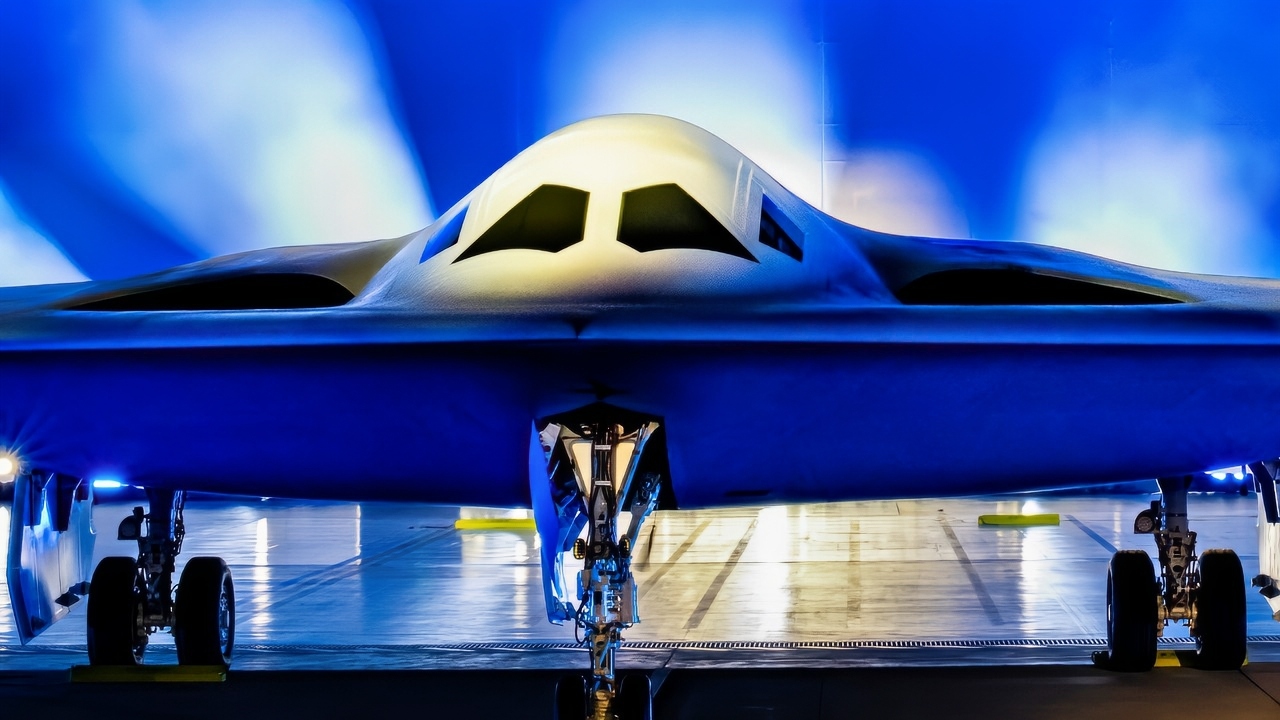
PUBLISHED on August 13, 2025, 7:57 PM EDT – Key Points and Summary: The B-21 Raider is poised to be a dramatic success in military procurement, costing just a third of its B-2 Spirit predecessor at an estimated $700 million per aircraft.
-This significant cost reduction is attributed to advanced digital engineering, which slashed design changes, and a much larger planned production run of at least 100 units.

The B-21 Raider program is on track and continues flight testing at Northrop Grumman’s manufacturing facility on Edwards Air Force Base, California. The B-21 will have an open architecture to integrate new technologies and respond to future threats across the spectrum of operations. The B-21 Long Range Strike Family of Systems will greatly enhance mission effectiveness and Joint interoperability in advanced threat environments, strengthening U.S. deterrence and strategic advantage. (U.S. Air Force photo)
-In a strategic move, manufacturer Northrop Grumman is accepting a loss on the initial production lots to secure a faster ramp-up, betting on future orders for a larger fleet that top military leaders are now demanding.
The B-21 Raider Stealth Bomber Will Be Cheaper Than The B-2
The B-21 Raider is a sixth-generation stealth bomber soon to be introduced into service with the U.S. Air Force. The aircraft will be significantly more capable than the B-2 Spirit, especially as concerns stealth and operational flexibility. It will also improve on the B-2 in manufacturing cost and efficiency.
The B-21 is estimated to cost around $700 million per aircraft, while the B-2 cost more than $2 billion per unit. This lower cost is a major factor in the B-21’s planned production of around 100 units initially, compared to the B-2’s limited production run of just 21.
That is good news, but even better news is that the aircraft program appears to be on schedule – perhaps even ahead of schedule – and $2 billion under budget. This is a rare achievement today.
B-21’s Costs Are Much Less Than Those of The B-2. Why?
So the B-21 Raider’s per-unit cost is just one-third of the B-2 Spirit’s. In 2022, the Air Force estimated that developing, purchasing, and operating a fleet of at least 100 B-21 Raiders would cost about $203 billion over 30 years. How did the cost come down for the B-21, compared to the B-2 Spirit?
One major reason is that the B-2 Spirit was a new and revolutionary design, the only stealth bomber in existence. (It still is.) The B-21 is an evolution of the Spirit.
Northrop Grumman points out that the company’s “fully digital engineering ecosystem reduces engineering rework, accelerates schedule, and saves costs for customers on future aircraft programs.”
My friend Alex Hollings from Sandboxx News, who is among the best aviation analysts out there, reported that Northrop Grumman claims to have reduced the changes that are needed to bring a project from a design on a sheet of paper to an actual flyable aircraft. These have fallen from the typical 15-20 percent of design elements, to just 1 percent now. This has sped up development of their aircraft and allowed Northrop Grumman to lower costs.
B-2 Production Numbers Cut After Just A Few Bombers
A key factor in the high cost of the B-2 was the aircraft’s short production run. The Air Force initially wanted 132 B-2s. However, with the end of the Cold War approaching, the Air Force cut that number to 75. After the Soviet Union collapsed, additional cuts restricted the program to just 21 bombers.
We now know that the strategy was very short-sighted – but it was also very expensive. The high costs of designing, developing, and building a new, revolutionary machine were now spread across 21 aircraft, instead of 132.
“B-21 remains on track to meet its key performance parameter for Average Procurement Unit Cost (APUC) of $550 million in Base Year 2010 dollars,” said Northrup Grumman in a press release.
Northrop Grumman Took A Loss On The First Few B-21s:
The War Zone reported that “Northrop Grumman had already said it expected to make a loss on each of the first five low-rate initial production (LRIP) lots. Under the terms of the fixed-price contract it signed in 2015, the company has to cover costs over a certain threshold on LRIP aircraft.”
Kathy Warden, Northrop Grumman’s chairwoman, chief executive officer, and president, explained in a conference call that the higher manufacturing costs had resulted from the company’s efforts to ramp up production of the stealth bomber.
Warden added that the company would have the capacity to ramp up production “beyond the quantity in the program of record, which is something that we and the government decided was important for the optionality to support the scenarios that they’ve been looking at, to increase the current build rate.”
In other words, the company took a hit now to gain back those losses later. It may gain even more before the program is over: The Air Force has said that the needs of the service may go beyond 100 aircraft, reaching as many as 145 in the future.
“I, as a customer, want to see increased rates” of B-21 production, Gen. Anthony J. Cotton, head of U.S. Strategic Command, said, noting that the production rate currently envisaged was scheduled “when the geopolitical environment was a little bit different than what we face today.”
Any increased numbers will ultimately decrease the cost of each bomber, adding to the profit that Northrop Grumman will see.
About the Author: Steve Balestrieri
Steve Balestrieri is a National Security Columnist. He served as a US Army Special Forces NCO and Warrant Officer. In addition to writing on defense, he covers the NFL for PatsFans.com and is a member of the Pro Football Writers of America (PFWA). His work was regularly featured in many military publications.
Military Matters
The F-22 Raptor Just Keeps Getting Better


bis-biss
October 13, 2025 at 8:53 am
B-21 is useless.
Why.
B-21 not useless if employed against places like Afghanistan, iran, Iraq, syria and Venezuela.
But against peer adversaries, it’s useless.
All the peer adversary or adversaries need to do is to keep an eye on all the known B-21 bases. They aren’t many of them.
Aim ICBMs at their bases, kapow, and they won’t ever return home. Thus b-21 effectively a one-shot wonder.
The b-1 is far more dangerous than the b-21 could ever be to peer adversaries. But it’s no longer in production, which is a pleasant outcome or result.
A fast bomber like the b-1 armed with hypersonic warheads is harder to confront than slow-flying bombers like the b-21 which can be handily intercepted by long-range subsonic combat UAVs loitering in ambush.