

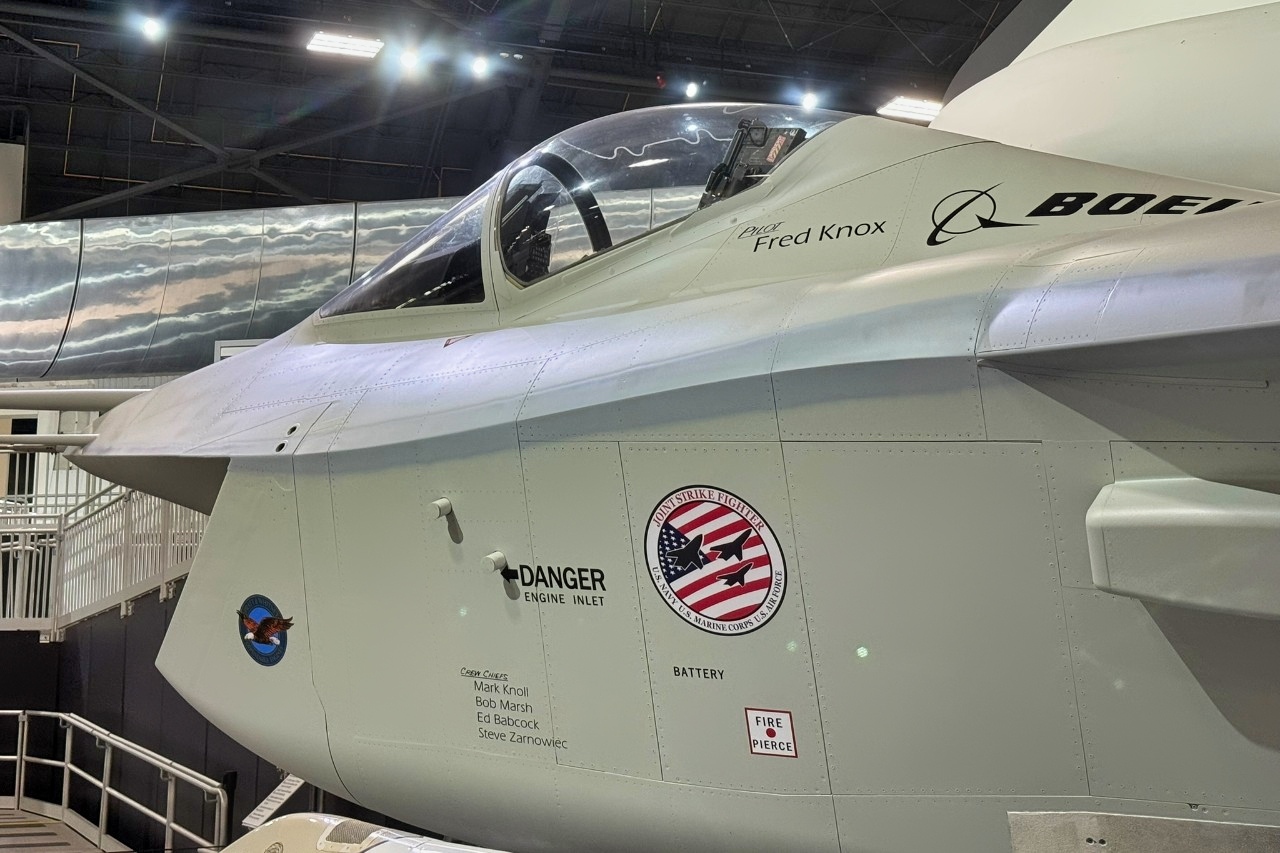
Key Points and Summary – While the F-35 won the Joint Strike Fighter competition, its rival, the Boeing X-32, was a surprisingly capable aircraft despite its cartoonish looks.
-Test pilots lauded its “superb handling qualities,” comparing it favorably to the legendary F/A-18.
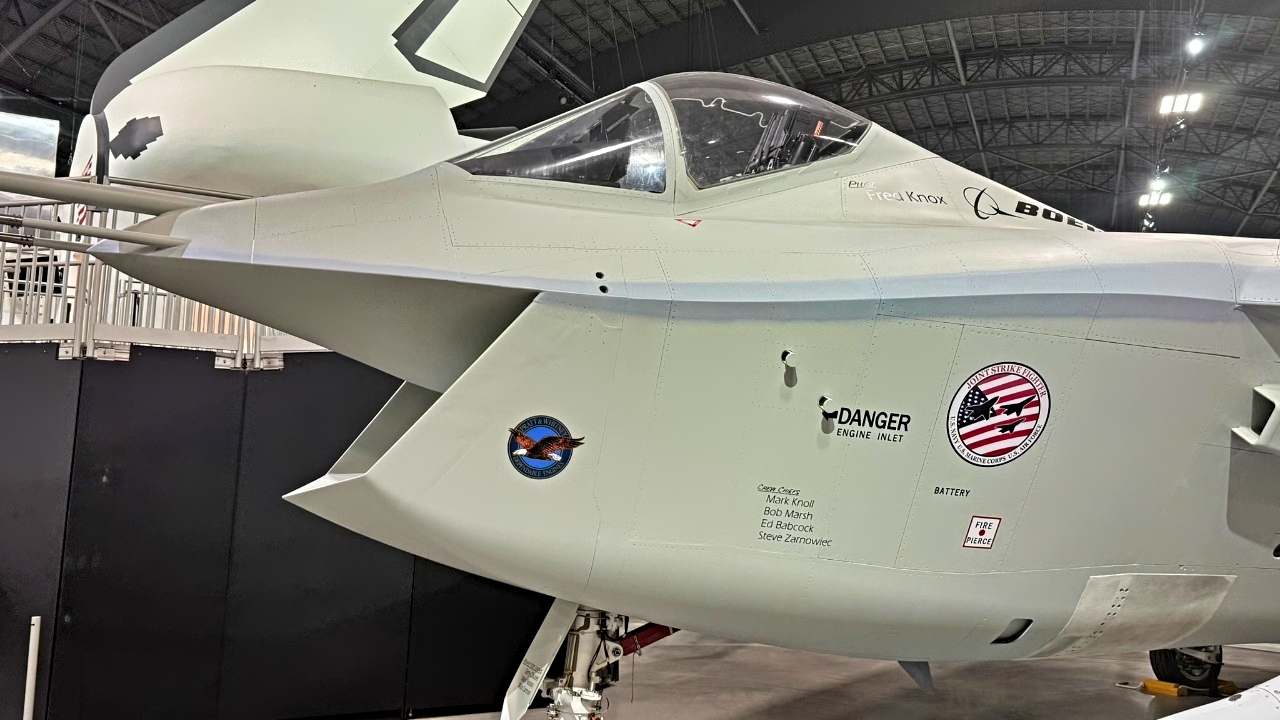
Boeing X-32 Near Space Shuttle. Image Credit: National Security Journal.
-The X-32 was also faster and had a better thrust-to-weight ratio than its competitor.
-Ultimately, however, the “Ugly Duckling” was doomed by a single fatal flaw: its complex vertical landing (STOVL) design caused the engine to ingest its own hot exhaust, leading to overheating and sealing its fate, ultimately handing victory to the F-35.
How Close Were The F-35 And Boeing X-32 In Performance?
We recently examined the X-32 and X-35, the platforms that competed in the 1990s to become the Joint Strike Fighter. We know, of course, that Lockheed Martin won the competition and has since built more than 1,200 F-35s.
The Lightning II is in use with the United States and 20 other countries. It is the most advanced fighter aircraft in the world. However, the Boeing X-32 was a worthy candidate for the JSF competition. Despite its cartoonish appearance (akin to Tow Mater from Cars), it had superb handling qualities that one test pilot compared to those of an F/A-18, a Boeing-produced aircraft.
The X-32 lost the competition because of its flawed and complex short take-off and vertical landing (STOVL) design. The design caused hot air from the plane’s exhaust to be recirculated into its modified intake, weakening the thrust it could produce and leading the engine to overheat.

A Sideview of the Boeing X-32 JSF. Image Credit: Harry J. Kazianis/National Security Journal.
The F-35, despite initial worries, has turned into a superb stealth aircraft. So, how close were the F-35 and the X-32 in performance?
Could the X-32 have actually outperformed the Lightning II?
A Brief Look At The Boeing X-32
The Department of Defense created the Joint Strike Fighter program to bring the Navy, Air Force, and Marine Corps together to reduce the costs of future strike warfare concepts.
First flying in September 2000, the X-32 made 66 flights during its four-month testing period. These flights demonstrated the aircraft’s handling qualities for inflight refueling, its weapons bay operations, and its ability to achieve supersonic flight.
U.S. Navy Comm. Phillip “Rowdy” Yates, a former Naval aviator who served as the test pilot for the Boeing team, said he was thrilled to fly it.
Yates said the X-32 was the high point of his career as a test pilot. “Dream come true,” he said. “You can use all those trite phrases. Many of my peers and contemporaries were likely envious of what I was able to accomplish with the X-32. I don’t know how to say it any better than just that it was the highlight of my career.
“When I entered the program, they were pretty far along in the design process,” Yates said, adding that the initial X-32 design was a derivative of a secret, stealthy aircraft concept from a “black program” Boeing had in their portfolio and that the company “made the decision to leverage that design for their X-32.”
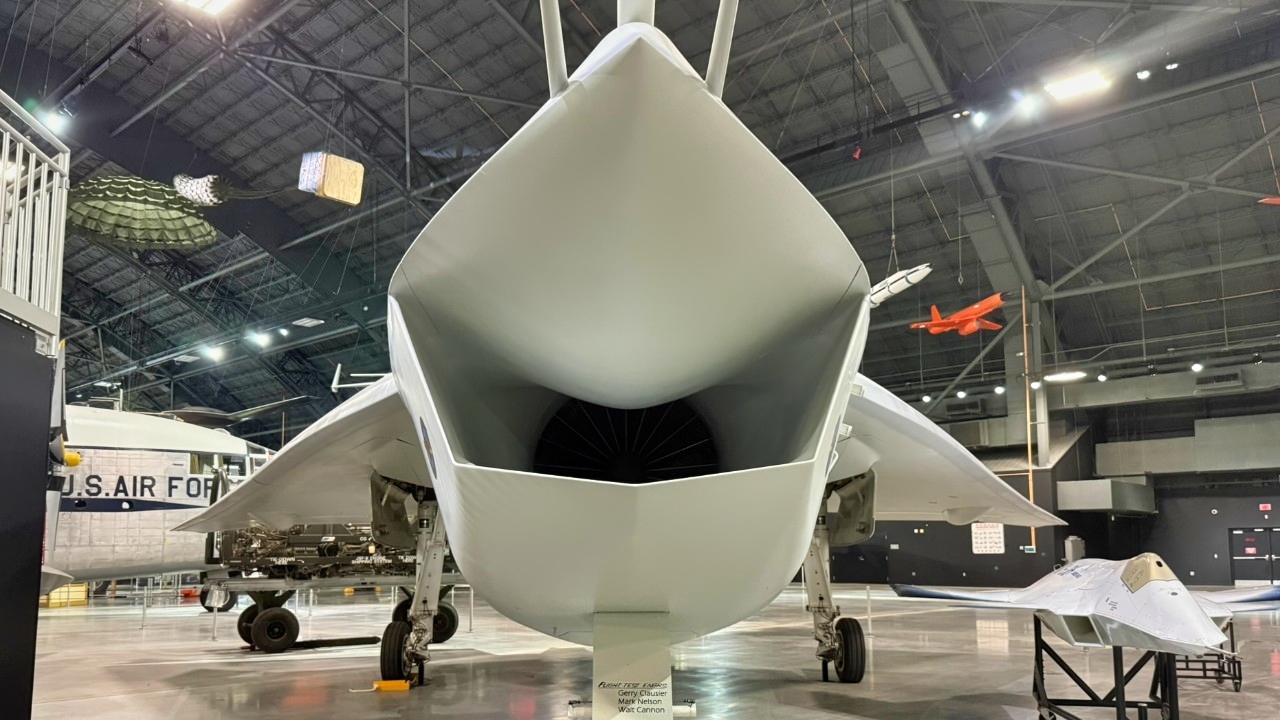
Head On Boeing X-32 Fighter. Image Credit: National Security Journal.
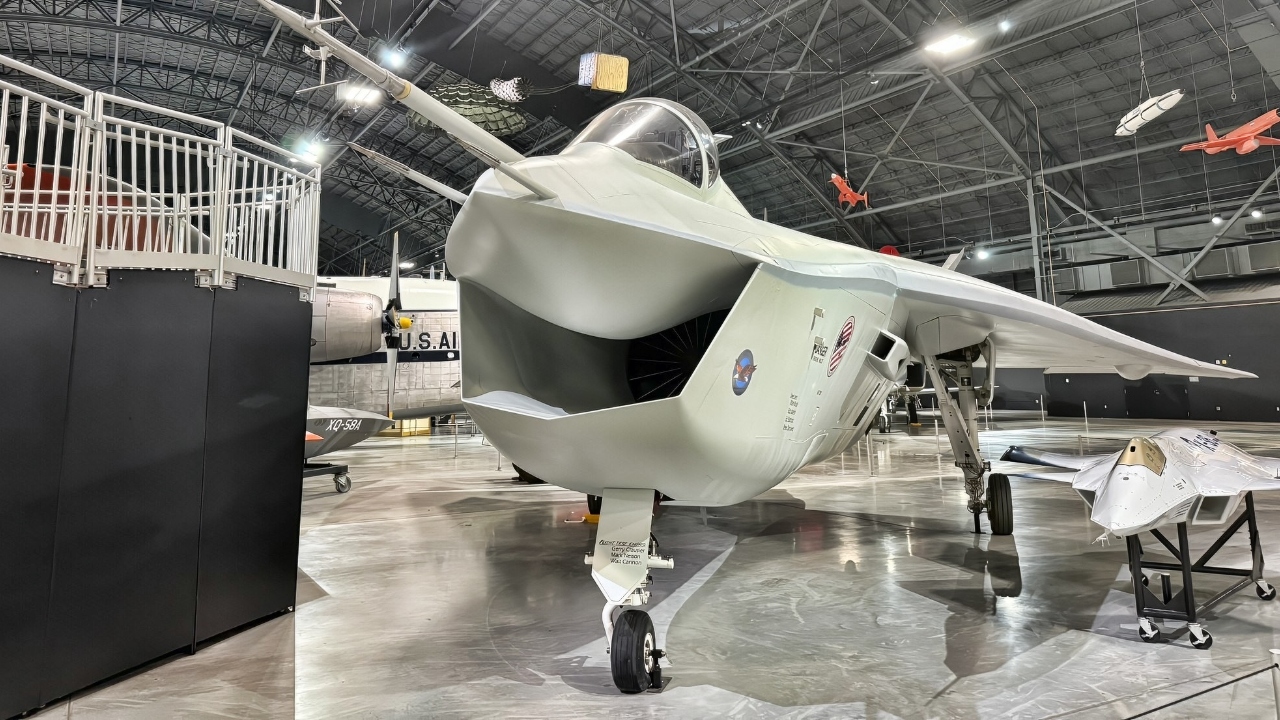
Boeing X-32 Bright Image 2025. Credit: National Security Journal.
Yates was most closely involved with testing how the aircraft responded during carrier approaches and evaluating the aircraft’s handling properties. The X-32B, which featured the STOVL design, was to be the carrier version.
“Did it feel like an airplane you’d want to take to the boat?” Yates was asked.
“That’s exactly the comment I made,” Yates answered.
However, Yates was then asked specifically about the STOVL tests conducted with both aircraft. “That was a big deal,” Yates said. “That was probably the one where we kicked the dirt a little bit and said ‘damn.’”

X-32 and YF-23 Together at U.S. Air Force Museum. Image: National Security Journal.
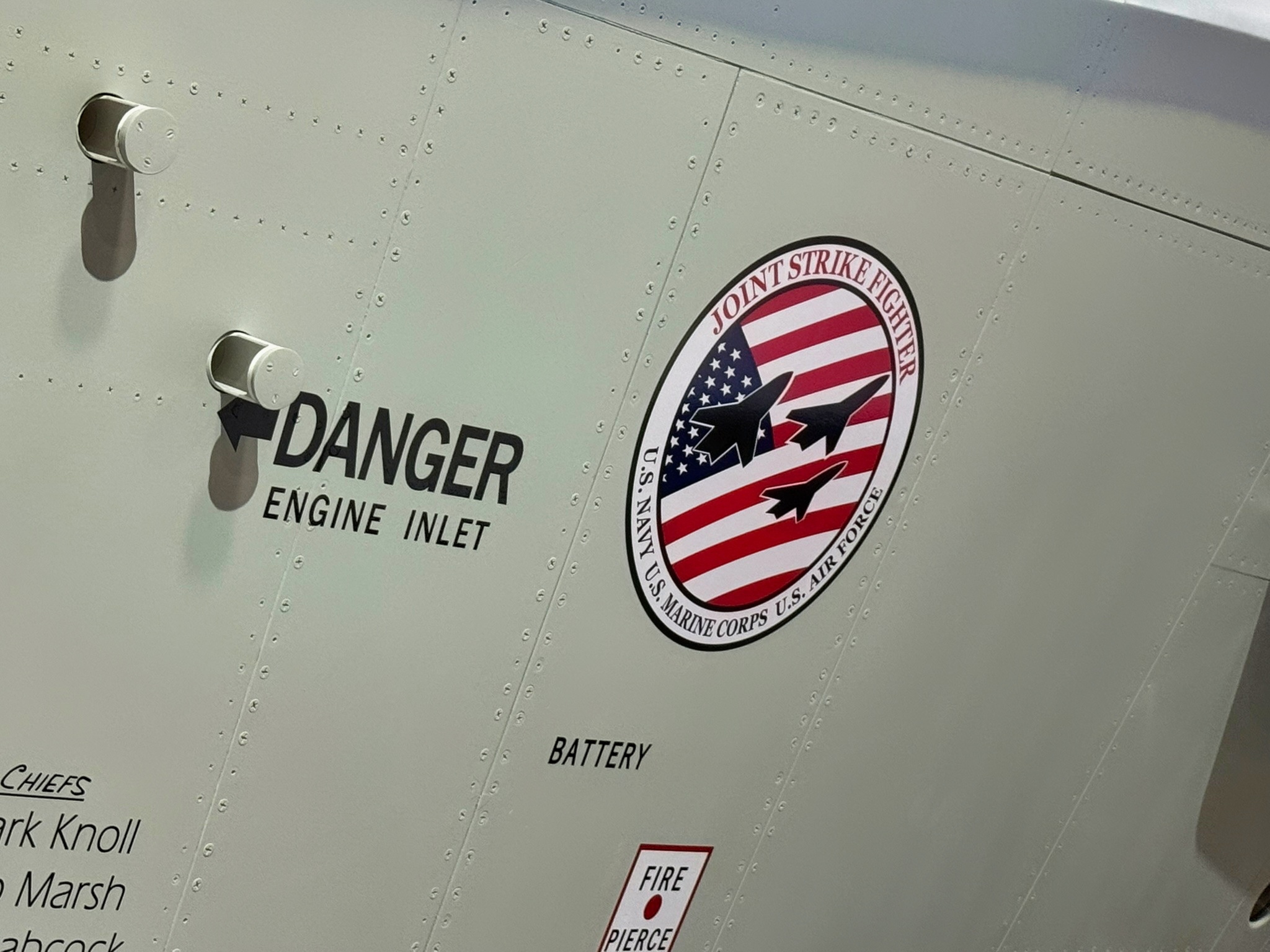
Boeing X-32 Side Shot. Image by National Security Journal.
Comparison Of the X-32 And the F-35
The most important comparison is between the fighters’ specifications and capabilities.
First, the F-35:
Power Plant: One Pratt & Whitney F135-PW-100 turbofan engine
Thrust: 43,000 pounds
Wingspan: 35 feet (10.7 meters)
Length: 51 feet (15.7 meters)
Height: 14 feet (4.38 meters)
Maximum Takeoff Weight: 70,000 pounds
Fuel Capacity: Internal: 18,498 pounds
Payload: 18,000 pounds (8,160 kilograms)
Speed: Mach 1.6 (1,200 mph)
Range: More than 1,350 miles with internal fuel (1,200+ nautical miles), unlimited with aerial refueling
Ceiling: Above 50,000 feet (15 kilometers)
Armament: Internal and external capability. Munitions carried vary based on mission requirements.
Crew: One pilot
The X-32:
Crew: One pilot
Length: 45 ft 0.1 in (13.72 m)
Wingspan: 36 ft 0 in (10.97 m)
Height: 17 ft 3.8 in (5.28 m)
Max takeoff weight: 50,000 lb (17,200 kg)
Powerplant: 1 × Pratt & Whitney YF119-PW-614 afterburning turbofan
Thrust: 28,000 lbf (120 kN) thrust dry, 43,000 lbf (190 kN) with afterburner
Maximum speed: 1,200 mph (1,931 km/h, Mach 1.6) at altitude
Range: 850 nautical miles (1,111 miles) unlimited with aerial refueling
Guns: 20 mm M61A2 cannon, 27 mm Mauser BK-27 cannon
Missiles: 6 AMRAAM air-air missiles, 2 AIM-9 air-air missiles
Bombs: 2 x 2,000 lb (900 kg) class guided bombs
External hardpoints: 15,000 lb (6,800 kg) of a full range of external stores
The F-35 can carry more ordnance, and it is just a tad longer. Its takeoff weight is much heavier. The X-32 had a better thrust-to-weight ratio. Both aircraft had the same top speed, and both handled exceptionally well.
(We were able to tour the Boeing X-32 at the U.S. Air Force Museum. See the video above.)
Yates mentioned how well the X-32 flew and handled. “They had leveraged F-18 handling qualities and control laws extensively for the X-32. Having flown the F-18 at the ship, that was the comment I made after just a couple of FCLP [Field Carrier Landing Practice], what we could call bounce periods, that I would take that aircraft to the ship tomorrow.
“It was handling that smoothly and precisely. I could make fine corrections, I could make gross corrections back to the centerline, back to the glide path. There were no issues with the handling qualities of the X-32 that I flew.”
However, in the end, the STOVL capability deeply harmed Boeing’s chances – well, that and its aesthetic qualities. The X-32 was not a prom queen. All things being equal, the Air Force would have still chosen the F-35. That’s the vanity piece of the puzzle.
But wouldn’t it have been cool to see “Tow Mater” bomb the Houthis or Iran?
About the Author: Steve Balestrieri
Steve Balestrieri is a National Security Columnist. He served as a US Army Special Forces NCO and Warrant Officer. In addition to writing on defense, he covers the NFL for PatsFans.com and is a member of the Pro Football Writers of America (PFWA). His work was regularly featured in many military publications.
More Military
We Almost Touched the F-117 Stealth Fighter


