

Key Points and Summary – The F-15EX Eagle II shows why an aging design can still be indispensable in a high-end fight.
-Built on the classic F-15 airframe but packed with modern sensors, an APG-82 AESA radar, EPAWSS electronic warfare, and fly-by-wire controls, the Eagle II is optimized to haul weapons, not sneak past radars.
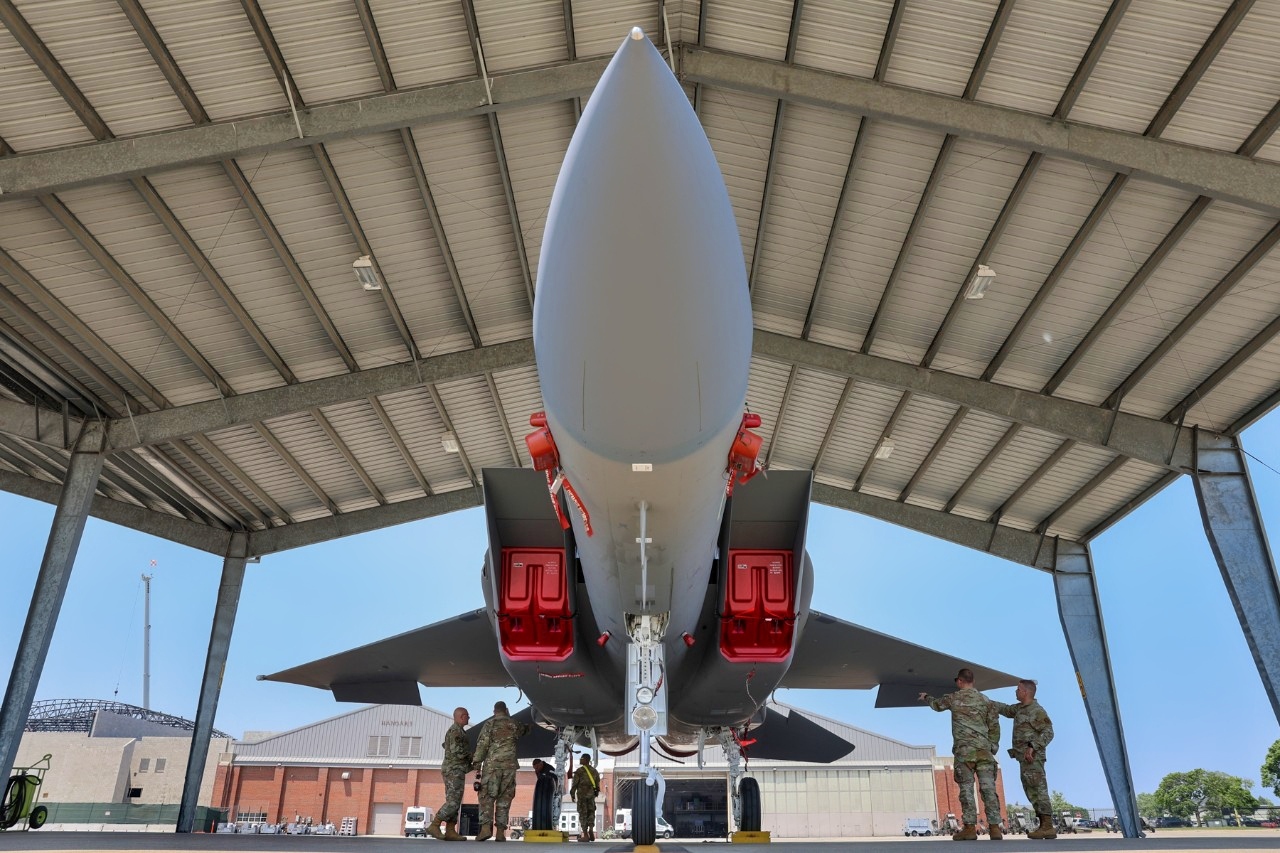
An F-15EX Eagle II from the Defense Contracting Management Agency Boeing St. Louis, sits on the flight line at Selfridge Air National Guard Base, Michigan, June 11, 2025. The aircraft visited the base as part of a site activation task force, an initial step to prepare the 127th Wing with the right infrastructure, personnel, and support the incoming F-15EX and KC-46 Pegasus missions . (U.S. Air National Guard photo by 1st Lt. Elise Wahlstrom)
-With nearly 30,000 pounds of payload and the ability to launch large salvos of long-range stand-off missiles, it gives the Air Force something stealth aircraft cannot: volume. In any drawn-out conflict against a peer like China, that magazine depth could be the difference between deterrence and defeat.
F-15EX Eagle II: The 1970s Fighter America Still Can’t Live Without
When the newest F-15EX Eagle II began operations with the U.S. Air National Guard in Oregon this month, it arrived with an obvious purpose: to field a large-payload strike and weapons-carrying platform.
Equipped with the AN/APG-82 AESA radar, the EPAWSS electronic warfare suite, and a payload capacity of roughly 29,500 pounds, the F-15EX is being positioned for missions that require a long-range strike platform more than a highly maneuverable craft. In practical terms, the F-15EX was delivered to carry and launch multiple stand-off weapons while operating as a high-capacity missile carrier in support of stealth aircraft and bomber platforms.
That role is becoming more relevant as the U.S. focuses on high-end conflict scenarios where sustaining firepower matters as much as penetrating air defenses.
The F-15EX is the newest evolution of a platform first introduced in the 1970s as an air-superiority fighter and later developed into the Strike Eagle multirole variant.
The Eagle II retains the range, twin-engine power, and payload of the F-15E, but adds modern sensors and equipment that make it serviceable today.

A U.S. Air Force F-15EX Eagle II, assigned to 85th Test and Evaluation Squadron, Eglin Air Force Base, Florida, lands at Kadena Air Base, Japan, July 16, 2025. During the transition to the F-15EX, the U.S. Air Force will sustain a steady-state presence at Kadena through a combination of 4th and 5th generation aircraft. (U.S. Air Force photo by Airman Nathaniel Jackson)
It is the long-range and high-capacity branch of the Eagle family. And despite its age, it remains an essential asset to the U.S. Air Force today.
From Air-Superiority Icon to Global Strike Eagle
The lineage of the Strike Eagle traces back to the Cold War-era F-15 air-superiority fighter. As threats evolved, the platform adapted: the two-seat F-15E Strike Eagle added deep-strike capability, making the Eagle a true multirole workhouse.
But the F-15EX goes even further than the F-15E Strike Eagle – and marks the most dramatic variation of that Cold War-era platform yet.
Built on the Advanced Eagle airframe, the F-15EX features a modern avionics suite that includes an active electronically scanned-array radar (AN/APG-82), infrared search and track sensors, and a new electronic warfare package (EPAWSS).
The aircraft also features a redesigned structure as well as fly-by-wire flight controls.
Those upgrades were essential, effectively turning a half-century-old into a capable, modern fighter.

A F-15EX assigned to the 85th Test and Evaluation Squadron, Eglin Air Force Base, Florida, flies behind a KC-135 assigned to the 465th Air Refueling Squadron, Tinker AFB, Oklahoma, Oct. 15, 2021. In-air refueling allows fighter aircraft to stay airborne for longer periods of time without having to land to refuel. (U.S. Air Force photo by 2nd Lt. Mary Begy)
But the transformation goes beyond its upgraded internals: the F-15EX Eagle II also boasts a substantial maximum payload capacity of around 29,500 pounds.
And, it has already demonstrated its ability to carry multiple long-range, air-to-ground stand-off missiles in a single sortie.
It’s for these reasons (and others) that the F-15EX remains a useful, albeit aging, asset for the U.S. Air Force. It’s relevant in an age where volume matters.
An Old Solution for a Modern Problem?
Despite its age, the F-15EX may be the solution to a problem facing both the U.S. Air Force and Navy – at least, for now.
In a global environment where adversaries are rapidly expanding their surface fleets and missile arsenals, the U.S. faces an arithmetic problem.
Its long-range strike capacity, meaning the number of platforms capable of launching stand-off weapons at extended ranges, remains limited.
And the gap is only growing. The F-15EX Eagle II addresses that shortfall, trading stealth for sheer firepower volume.
Unlike low-observable aircraft that carry smaller internal magazines, the F-15EX can carry large numbers of long-range weapons externally while still benefiting from advanced sensors and modern defensive systems.
Its huge payload capacity gives it more internal and external carriage room than any other fighter in the U.S. inventory, and it has repeatedly demonstrated its ability to release air-to-air missiles under test conditions. It is even slated to integrate long-range air-to-surface missiles like the AGM-158C LRASM.
Upgrades like that will mean its utility for stand-off strikes against ships and surface targets only improves further.

The F-15EX, the Air Force’s newest fighter aircraft, arrives to Eglin Air Force Base, Florida March 11. The aircraft will be the first Air Force aircraft to be tested and fielded from beginning to end through combined developmental and operational tests. The 40th Flight Test Squadron and the 85th Test and Evaluation Squadron personnel are responsible for testing the aircraft. (U.S. Air Force photo/Samuel King Jr.)
That kind of firepower is truly indispensable. Recent defense budget requests have shown an increase in procurements of LRASM and similar long-range strike munitions, seemingly reflecting a growing focus on maritime and anti-surface strike capabilities – particularly in contested regions like the Indo-Pacific.
As U.S. strategic planners foresee potential conflict scenarios involving peer adversaries, the ability to launch large salvos of missiles quickly becomes more essential – and forms a deterrent, too.
At the same time, the U.S. presently lacks a sufficient number of stealth aircraft and isn’t building them fast enough to carry the number of long-range weapons required to sustain a large, drawn-out conflict against a peer military.
Production rates for stealth jets remain massively constrained by development, cost, and industrial-base bottlenecks, creating a lag between what the planners want and what is actually fieldable in any meaningful numbers.
Without platforms like the F-15EX Eagle II, the U.S. Air Force would risk entering a conflict with a firepower shortage.
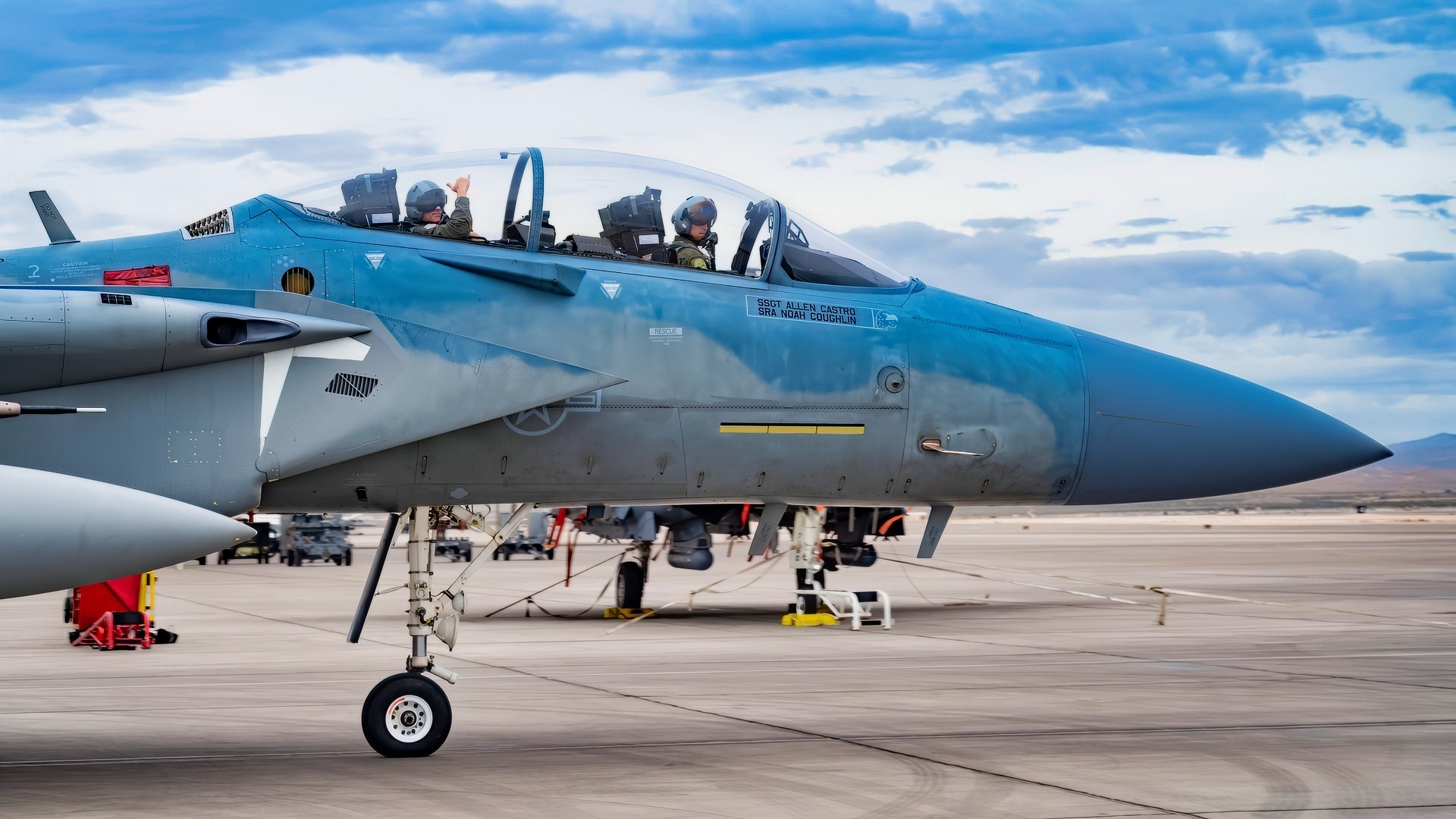
U.S. Air Force Maj. Michael Tope, right, and Brig. Gen. Michael Rawls, taxis to the runway in a F-15EX Eagle II for a training operation at Nellis Air Force Base, Nevada, Nov. 15, 2023. The EX is the most advanced variant of the F-15 aircraft family, with the capability to carry a great number of missiles in support of the F-35A Lightning II. (U.S. Air Force photo by Airman 1st Class Elizabeth Tan)
A modern war will demand volume as much as it will precision, and while the F-15EX Eagle II may not be truly new, it can deliver that volume.
And that’s why it’s here.
About the Author:
Jack Buckby is a British author, counter-extremism researcher, and journalist based in New York who writes frequently for National Security Journal. Reporting on the U.K., Europe, and the U.S., he analyzes and understands left-wing and right-wing radicalization and reports on Western governments’ approaches to the pressing issues of today. His books and research papers explore these themes and propose pragmatic solutions to our increasingly polarized society. His latest book is The Truth Teller: RFK Jr. and the Case for a Post-Partisan Presidency.


Oleg Olkha
December 10, 2025 at 11:37 am
In the Israeli concept, the carrier can be of the previous generation, and the striking elements of the next generation. And vice versa…Regards.