


The conflict between the U.S and Iran, after several weeks of relative calm, appears to have rekindled, with the U.S. firing on Iranian rocket launchers on Larak Island, and Iran in turn launching missiles at bases elsewhere in the Middle East, in Jordan and the United Arab Emirates, where U.S. troops are stationed.
However, the renewal of hostilities came as a Washington Post report said the Pentagon had been warned that further military action could overextend the military.
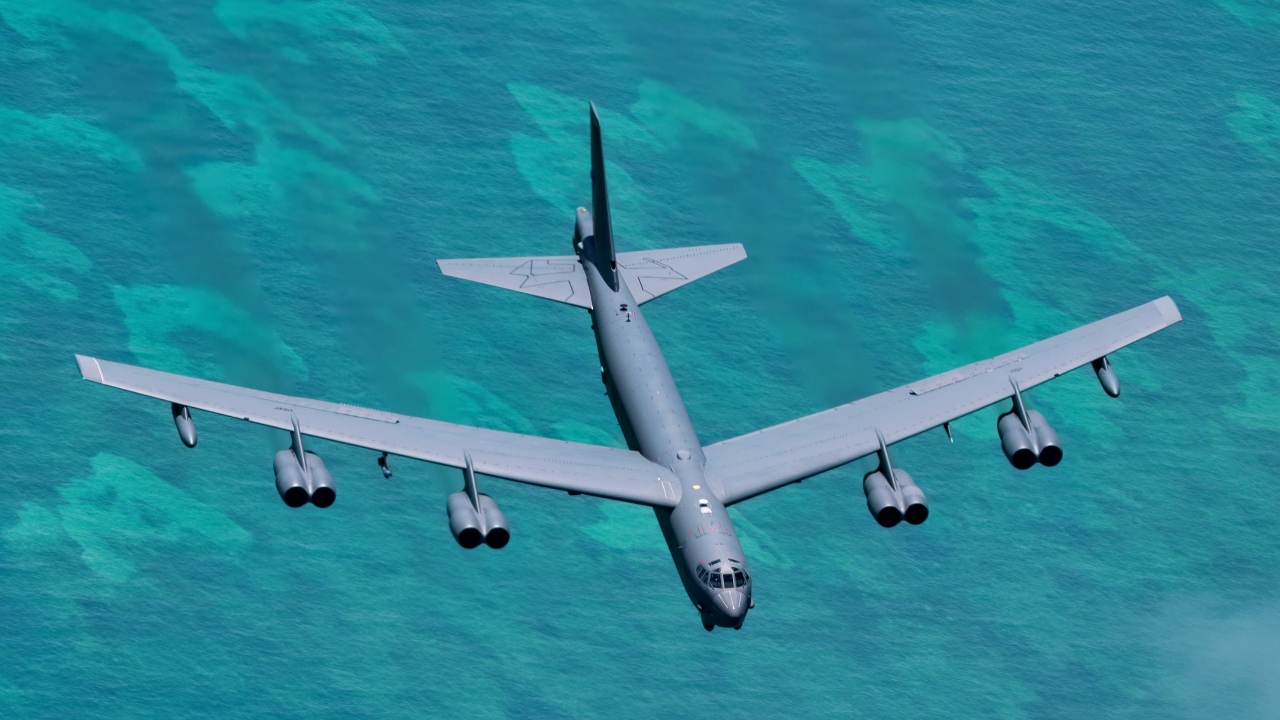
A U.S. Air Force B-52H Stratofortress aircraft flies in a seven-ship formation during the Hyundai Air and Sea Show at Miami Beach, Florida, May 24, 2025. The flyover represented the Air Force’s total force, integrating active duty, guard, and reserve pilots flying the B-1B Lancer, B-2 Spirit, F-22 Raptor, A-10 Thunderbolt II, B-52H Stratofortress, F-16C Fighting Falcon, and F-15C Eagle aircraft. (U.S. Air Force photo by Staff Sgt. Bailee A. Darbasie)
The report has not been well received within the Pentagon.
The Washington Post, in a report published Sunday, stated that Defense Secretary Pete Hegseth had been warned by multiple military leaders that “prolonging large-scale operations against Iran is unsustainable and risks weakening their ability to confront threats elsewhere, including the U.S. homeland.”
The Post’s report cited the August 14 Secretary of Defense Orders Book (SDOB), which stated that Hegseth had been warned by the heads of the US Army, Navy, and Air Force, as well as the four-star leaders of operations in Europe, Asia, and Latin America.
That order book, the Post reported, “directs some troops deployed in the Middle East to remain there through September and some others into 2027.” The report added that this was the topic that prompted the leaders’ concerns.
The leaders of the U.S. European Command, the U.S. Pacific Command and the U.S. Southern Command, the Post said, have issued a “non-concur,” which means they disagree with but will nevertheless carry out the secretary’s order for extensions.
The Post also reported that it was Adm. Daryl Caudle, the chief of Naval Operations, who provided Hegseth with “the dimmest picture.” The newspaper characterized Caudle’s position as “the Navy cannot sustain its current level of support for the Iran conflict because there is no anticipated end date.”

U.S. Air Force Major Lindsay “MAD” Johnson, A-10C Thunderbolt II Demonstration Team commander and pilot, flies during the National Cherry Festival Air Show in Traverse City, Mich., June 29, 2024. It took a team of highly skilled individuals to keep the A-10 flying and make Johson’s demonstrations possible. (U.S. Air Force photo by Senior Airman Devlin Bishop)
The Pentagon Responds
In the story, Sean Parnell, Hegseth’s spokesman, stated that “decisions regarding the scope and duration of specific force commitments to any Combatant Command are made based on the current threat assessment, strategic priorities established by the President, and the advice of the Chairman of the Joint Chiefs of Staff and Combatant Commanders,” and he added that the Pentagon would not discuss the contents of the Secretary of Defense Orders Book.
A subsequent story in The Hill, however, said the Pentagon “erupts” after the Post report and that the Defense Department was “seething” over the revelations.
Parnell, the spokesman, posted to X about his anger that classified material had been published in the newspaper, before calling it inaccurate.
“Publishing highly classified assessments from the Secretary’s orders book is a crime.
It’s a betrayal of the force,” Parnell said in the social media post. “And much of what they’re publishing is inaccurate.
Of course, we demand candid military advice. Non-concurs are standard. The Secretary sees them constantly. That’s how you run a real military.
We are in great shape around the world.”
The spokesman went on to accuse the Post of “TDS” (Trump Derangement Syndrome) and also “PDS,” a newer coinage in which it’s not clear if the “P” stands for “Pentagon” or for “Pete.”
“They hate President Trump and Secretary Hegseth more than they love America,” Parnell concluded.
A Community Note on X noted that under New York Times Co. v. United States, the 1971 Supreme Court ruling involving the publication of the Pentagon Papers, the First Amendment protects media outlets that publish classified information.
An “Army of Influencers”
Jennica Pounds, a social media personality known as “Data Republican,” who has been working for the Pentagon of late as a “special government employee,” posted to social media that the leak that made the story possible was “one of the most serious leaks I have ever seen, and you are using this to score partisan points against Hegseth.”
A separate Post story, also published over the weekend, stated that Pounds is part of a group of “military influencers” who have recently been installed in civilian roles at the Pentagon.
Some of the influencers, who have not always disclosed their status as government employees, have worked to “amplify Defense Secretary Pete Hegseth’s viewpoints and attack those who scrutinize the Trump administration.”
During the second Trump presidency, the Pentagon has limited some journalists’ access and fired three journalists from Stars and Stripes. Those three sued the Pentagon last week.
About the Author: Stephen Silver
Stephen Silver is an award-winning journalist, essayist, and film critic, and contributor to the Philadelphia Inquirer, the Jewish Telegraphic Agency, Broad Street Review, and Splice Today. The co-founder of the Philadelphia Film Critics Circle, Stephen lives in suburban Philadelphia with his wife and two sons. For over a decade, Stephen has authored thousands of articles that focus on politics, national security, technology, and the economy. Follow him on X (formerly Twitter) at @StephenSilver, and subscribe to his Substack newsletter.


