


Key Points and Summary – The latest M1A2 SEPv3 Abrams keeps its battlefield crown largely thanks to its 120mm gun firing depleted uranium (DU) “Silver Bullet” rounds like the M829A4.
-These APFSDS long-rod penetrators are denser than steel, self-sharpen on impact, shrug off explosive reactive armor, and ignite into firestorms inside enemy tanks, making them devastating at ranges out to 4,000 meters.
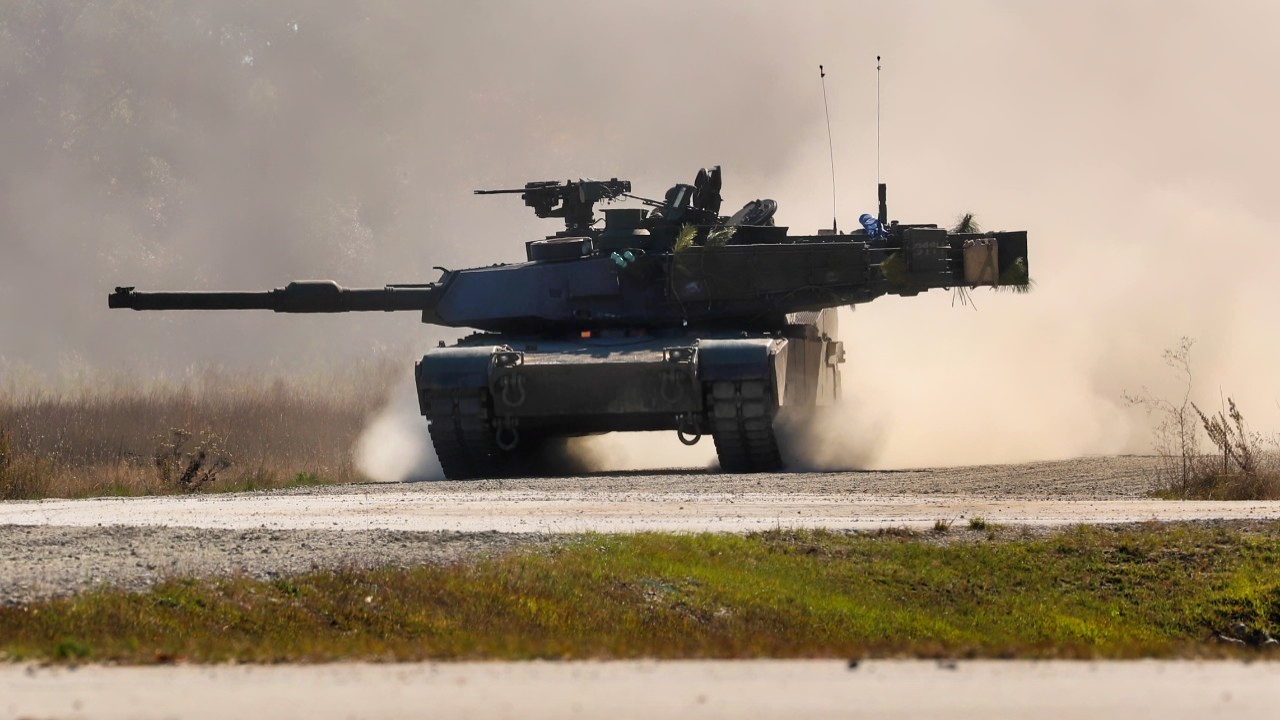
A M1A2 Abrams SEPv3 Main Battle Tank navigates a range during a Combined Arms Live Fire Exercise (CALFEX) at Fort Stewart, Georgia, Nov. 8th 2023. Tank crews honed their skills to ensure proficiency of eliminating targets while coordinating with other tank crews. (U.S. Army photo by Pfc. Luciano Alcala)
-Yet that same performance fuels debate: DU impacts create fine toxic and mildly radioactive dust that can contaminate soil and be inhaled or ingested over time.
-Militaries see unmatched lethality; critics warn of long-term health and environmental risks that won’t go away.
The M1 Abrams Tank’s Depleted Uranium Round, “The Silver Bullet”
The US and our allies know that tanks aren’t obsolete; only the current ones are. Meanwhile, the US has taken the best tank in the world and made it even better.
General Dynamics Land Systems (GDLS) has significantly upgraded the M1A2 Abrams, an outstanding tank. The SEP stands for the System Enhancement Program. The newest iteration of the Abrams is already a popular model with our allies, as both Australia and Poland have ordered more tanks to beef up their armored forces. Ukraine is clamoring for more tanks.
But what keeps the M1 Abrams the king of the battlefield is its main gun, a 120mm smoothbore that fires depleted uranium rounds. The rounds made from uranium, the densest, heaviest element on Earth, will defeat any known armor with ease.
DU Rounds Make For Incredible Firepower:
The SEPv3’s main gun is the M256 120mm smoothbore cannon. It can fire M829A4 advanced kinetic-energy and advanced multi-purpose rounds via an ammunition data link. This round is an Armor-Piercing, Fin-Stabilized, Discarding Sabot – Tracer (APFSDS-T) cartridge, consisting of a depleted uranium long-rod penetrator with a three-petal composite sabot.
These rounds will defeat third-generation explosive reactive armor (ERA) at extended ranges. ERA is designed for maximum penetration against heavily armored targets and has an effective range of 4,000 meters.

A tank crew with 1st Battalion, 64th Armor Regiment, 1st Armored Brigade Combat Team, 3rd Infantry Division, fires the main cannon of an M1A2 SEPv3 Main Battle Tank for the Live-fire Accuracy Screening Test (LFAST) of a tank gunnery training event at Fort Stewart, Georgia, Jan. 18, 2024. During LFAST crews ensure that their weapons are sighted and are accurate before continuing with the rest of the gunnery. (U.S. Army photo by Pfc. Luciano Alcala)
The crew compartment remains the same, with the driver in the middle of the hull and the commander, loader, and gunner in the well-armored turret. In addition to the main gun, the SEPv3 will have a .50-caliber M2 machine gun and a 7.62mm M240B coaxial machine gun.
The Depleted Uranium Round, The Silver Bullet
The M829A1 DU round, known as the “Silver Bullet,” made their appearance for the first time against Iraqi T-72s during the 1991 Persian Gulf War. They cut through the Soviet-made armor with ease.
The latest in the series, the M829E4 (or A4), continues this legacy with enhanced capabilities to penetrate modern tank armors and defeat active protection systems.
M1 Abrams depleted uranium (DU) rounds are highly effective armor-piercing projectiles, with advantages in density, self-sharpening properties, and pyrophoric ignition, making them superior to tungsten rounds.
However, their use raises concerns about potential health and environmental risks, as they create radioactive and toxic dust upon impact, which critics argue may outweigh the military benefits.
Performance and Effectiveness
Superior penetration of any known armor. DU rounds are significantly denser than steel, allowing them to retain more kinetic energy and penetrate thick armor more effectively than other rounds.

A M1A2 SEPV3 Abrams Tank fires at multiple range targets during a range warfighter exercise, April 11, 2021, Fort Hood, Texas. The visit with foreign allies allows the U.S. Army to boost interoperability of staff members and warfighting capabilities with the M1A2 SEPv3 Abrams Tank. (U.S. Army photo by Sgt. Melissa N. Lessard)
The M829A1 DU round has a flat, laser-like trajectory out to 3,600 meters, meaning it does not incur ballistic drop due to gravity over a distance of two miles. That is incredible power generated by the gun and the round. It will penetrate 570mm of armor at a range of two thousand meters.
Unlike tungsten rounds that can flatten upon impact, DU rounds fracture into a self-sharpening shape, maintaining their ability to penetrate armor all the way through their target.
The rounds are pyrophoric, meaning they ignite on contact with air, which helps destroy the inside of a tank by creating secondary fires, especially when combined with the ignition of fuel and ammunition.
Accelerated to extremely high speeds by using the sabot round, this allowed a depleted-uranium (DU) round to penetrate through an unprecedented amount of armor. The pyrophoric nature of uranium and steel would cause DU to catch fire upon penetration, resulting in catastrophic damage inside the tank.
DU rounds will easily withstand the shock of reactive armor better than many other metals, increasing the likelihood of defeating an armored target even when the armor is designed to counter threats.
Environmental Concerns
The DU rounds pose an environmental risk. Once a DU round hits an armored surface, it creates a fine, radioactive, and chemically toxic dust. Critics are concerned that this dust is harmful to both military personnel and civilians.
Depleted uranium (DU) rounds that miss their targets contaminate the environment by leaving behind fragments and dust that can corrode over time, releasing DU into the soil and groundwater.
This contamination can lead to long-term ingestion through drinking water or food, though studies generally show low levels except in “hot spots” near impact sites. While DU has both chemical and radioactive properties, the primary environmental risk is chemical, with the potential for migration and incorporation into the food chain over decades.

Soldiers with the Ohio National Guard’s 1st Combined Arms Battalion – 145th Armor Regiment conduct live fire training with the M1A2 SEPv3 Abrams Main Battle Tank at the Camp Ripley Training Center near Little Falls, Minnesota, on July 28th, 2025 (Minnesota National Guard Photo by Mr. Tony Housey).
While some argue that the radiological danger is low, others highlight that the chemical toxicity is the primary concern, similar to other heavy metals like lead, and the risk of inhaling the dust is a serious health hazard.
Some experts argue that the potential long-term health and environmental risks of using DU ammunition outweigh the military advantages.
The International Atomic Energy Authority (IAEA) says depleted uranium has “chemical and radioactive toxicity“, but is considerably less radioactive than naturally-occurring uranium.
“The fear is that if depleted uranium shells land on the ground, they may contaminate the soil,” says Dr Marina Miron, from Kings College London. “That is why the US and its Nato allies sparked controversy when they used them in Kosovo.”
In 2016, the UN’s Scientific Committee on the Effects of Atomic Radiation (UNSCEAR) found no significant poisoning was caused by exposure to depleted uranium.
Retired Colonel Hamish de Bretton-Gordon, who previously commanded U.K. and NATO chemical, biological, radiologica,l and nuclear defense (CBRN) forces, told Newsweek that the “radiation is incredibly low.”
“If you’re in a vehicle that’s hit by a depleted uranium round, the radiation is the least of your worries,” he added.
However, the IAEA warns there could be a risk to individuals who handle fragments of depleted uranium rounds.
It is accepted that the United States, the UK, Russia, and other militaries will continue to use depleted uranium ammunition for the foreseeable future.
About the Author: Steve Balestrieri
Steve Balestrieri is a National Security Columnist. He served as a US Army Special Forces NCO and Warrant Officer. In addition to writing on defense, he covers the NFL for PatsFans.com and is a member of the Pro Football Writers of America (PFWA). His work was regularly featured in many military publications.
More Military
The Navy Wanted 29 Stealth Seawolf-Class Nuclear Attack Submarines. It Got Only 3


