

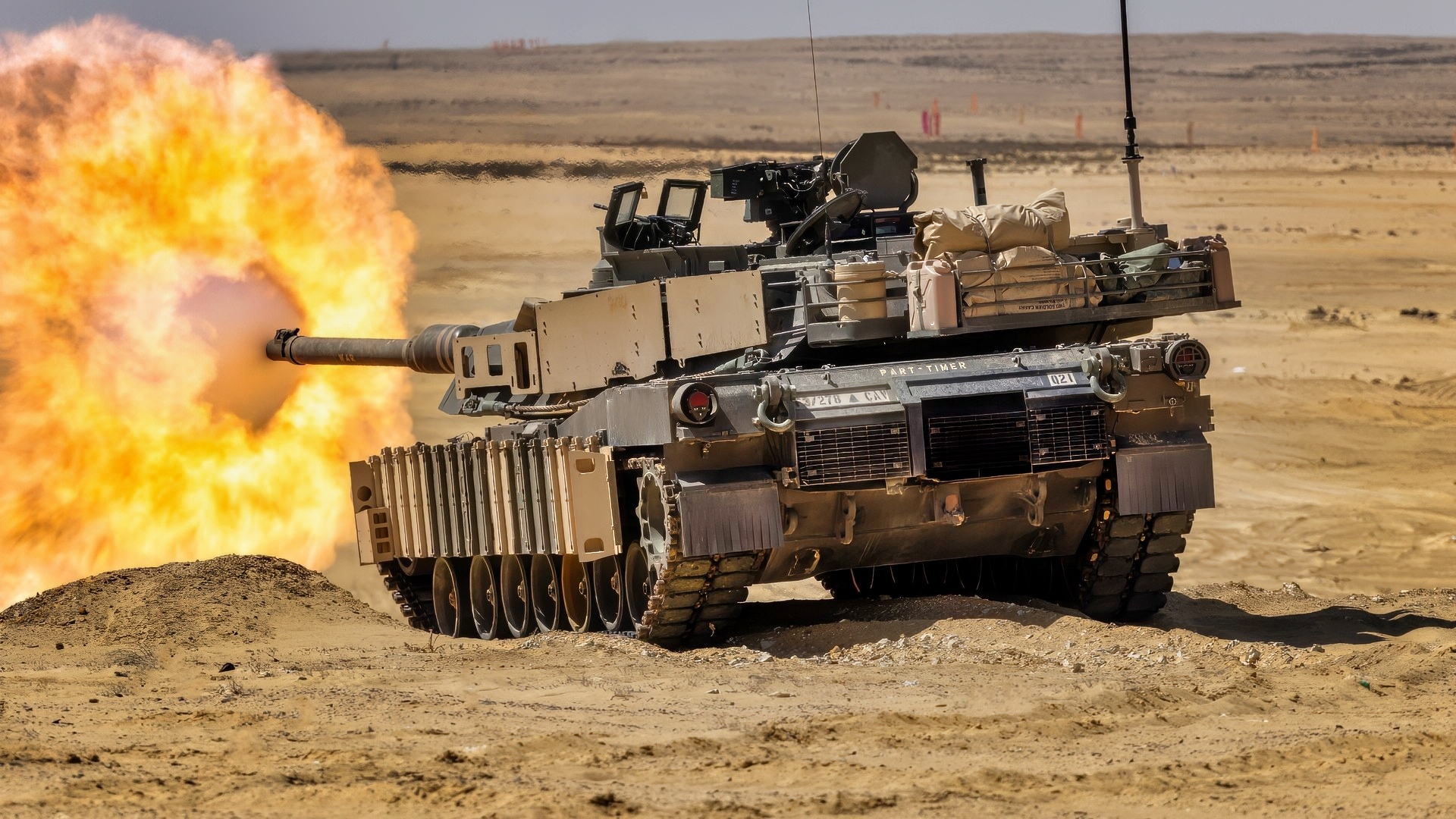
Key Points and Summary – The M1A2 SEPv4 aimed to keep Abrams on top by overhauling the commander’s and gunner’s sights, adding third-gen thermal imaging, tighter ranging, and digital links to program smarter rounds—speeding the see-decide-shoot cycle.
-As testing advanced, newer threats and hard logistics math intervened: a 73-ton-class tank with more bolt-ons struggled with bridges, power, and survivability against drones and top-attack weapons.

A U.S. Army M1A2 SEPv2 Abrams assigned to Alpha Company, 1st Battalion, 67th Armor Regiment, 3rd Brigade Combat Team, 1st Armored Division prepares to move off the live fire range after completing the day portion of Table VI Tank Gunnery conducted at McGregor Range, New Mexico, Sept. 29, 2023. Gunnery Table VI evaluates crews on engaging stationary and moving targets while utilizing all weapons systems in offensive and defensive positions, ensuring our crews are trained and ready for any mission. (U.S. Army photo by Spc. David Poleski)
-In 2023, the Army closed out SEPv4 and pivoted to M1E3, a lighter, modular, open-architecture Abrams that will carry SEPv4’s sensor and fire-control gains on a cleaner, more survivable baseline. SEPv4 wasn’t wasted; it became the spec sheet for what comes next.
M1 Abrams SEPv4: The Upgrade That Pointed The Way To M1E3
A few years back, I was a big fan of what would have been the new M1 Abrams SEPv4. But it seems the Army had good reasons to end this program and move on to the future.
By the mid-2010s, the M1 Abrams was still lethal, but its edge depended on seeing first and shooting first, and peer rivals were closing the sensor gap.
Armor and horsepower can’t help if a tank can’t positively identify threats in dust, smoke, darkness, or bad weather; nor can they defeat drones or teams hiding behind masonry with next-gen anti-armor weapons. The System Enhancement Package version 4 (SEPv4) set out to fix that.
SEPv4’s north star was simple: give crews more certainty at longer ranges. It focused on a wholesale refresh of the commander’s and gunner’s sights, a new generation of thermal imaging, better ranging and target handoff, and a digital backbone that could program smarter ammunition and fuse offboard cues faster.
In plain English: make the Abrams see clearer, decide faster, and kill more precisely—day or night—without changing the gun or silhouette.

A M1A2 SEPV3 Abrams Tank fires at multiple range targets during a range warfighter exercise, April 11, 2021, Fort Hood, Texas. The visit with foreign allies allows the U.S. Army to boost interoperability of staff members and warfighting capabilities with the M1A2 SEPv3 Abrams Tank. (U.S. Army photo by Sgt. Melissa N. Lessard)
What SEPv4 Actually Promised
SEPv4 was less about “more steel” and more about better eyes and brains.
Among its headline aims:
Third-generation thermal imaging for both the commander and gunner, paired with upgraded laser rangefinders and color cameras, to spot, classify, and track targets in clutter and through obscurants.
Improved fire-control and data links so the tank could digitally talk to its ammunition, enabling airburst and smart-fused effects from the main gun and smoothing the jump from one target type to another.
Refined commander’s optics and pointer/marker functions, tightening the “you see it / I kill it” loop between crew stations and reducing time-to-fire when seconds matter.
Back-end computing and architecture updates to ingest more sensors over time—electronic warfare, counter-UAS aids, and defensive suites—without ripping apart the turret each time.
None of this reinvented the M1 Abrams. It made a proven gun platform much better at finding and finishing.

A U.S. Army driver assigned to Alpha Company, 1st Battalion, 67th Armor Regiment, 3rd Brigade Combat Team, 1st Armored Division standbys in the drivers hull of an M1A2 SEPv2 Abrams waiting for further guidance prior to the start of Table VI Tank Gunnery at McGregor Range, New Mexico, Sept. 29, 2023. Gunnery Table VI evaluates crews on engaging stationary and moving targets while utilizing all weapons systems in offensive and defensive positions, ensuring our crews are trained and ready for any mission. (U.S. Army photo by Spc. David Poleski)
The Development Arc: From Testing To A Moving Finish Line
The Army pursued SEPv4 after fielding the SEPv3 (the M1A2C), expecting an operational test window in the mid-2020s.
Prototypes rolled, range testing began, and the sights and fire-control software matured. On paper, the schedule tracked: finish developmental testing, prove out survivability/lethality, and push a block upgrade into production for units already living with SEPv3.
But even as the tech progressed, the problem set changed. Battlefield videos and combat data from recent wars underlined that tanks now live under a constant drone and top-attack threat; that weight growth was eroding mobility over real bridges and rail; and that power and cooling margins were being eaten by every new black box bolted on.
SEPv4 still improved the view and the shot—but it couldn’t change the fact that the Abrams baseline had grown very heavy, and bolting more onto it was pushing into diminishing returns.
Why SEPv4 Was Closed Out
Three converging realities drove the decision to stop SEPv4 and pivot.
1) Weight And Mobility. The Abrams has put on decades of armor, electronics, and protection—necessary, but costly in tonnage.
A SEPv4-equipped turret atop the existing hull still left the Army with a 73-ton-class vehicle in many configurations.
That weight limits bridge choices, complicates rail and road movement, and reduces tactical agility in real terrain. An upgrade that keeps the tank heavy solves the shot but not the maneuver.
2) Survivability Against Modern Kill Chains. Today’s threats are not just gun duels across fields. They are networked sensors, top-attack munitions, loitering UAS, and long-range fires that punish any vehicle that lingers.

U.S. Soldiers assigned to the 2nd Armored Brigade Combat Team, 1st Cavalry Division supporting the 4th Infantry Division maneuver an M1A2 Abrams tank and M2 Bradley Fighting Vehicle past a simulated opposing force’s Leopard 2A6 tank during exercise Arrow 23 in Niinisalo, Finland, May 5, 2023. Exercise Arrow is an annual, multinational exercise involving armed forces from the U.S., U.K., Latvia, Lithuania and Estonia, who train with the Finnish Defense Forces in high-intensity, force-on-force engagements and live-fire exercises to increase military readiness and promote interoperability among partner nations. (U.S. Army National Guard photo by Sgt. John Schoebel)
Survivability now demands more than applique armor: signature control, integrated active protection, better EW/soft-kill, and power for all of it—all without more weight.
That called for re-architecting the tank, not another turret refresh.
3) Sustainability And Open Architecture. Each Abrams enhancement round added bespoke wiring, boxes, and cooling. Units could keep up—barely. But the Army wants a modular, open-systems backbone so future sensors and effectors drop in like phone apps, not depot-level surgeries.
SEPv4 moved in that direction, but the base vehicle’s space/weight/power/cooling realities argued for a cleaner start.
The service’s conclusion: close out SEPv4 as an upgrade line and carry its best tech forward into a new path—M1E3—built around weight discipline, survivability in a drone-rich fight, and a digital core designed for constant change.
What Happens To SEPv4’s Tech
Closing the program did not trash the work. The improved third-gen thermal sights, better ranging, target handoff, and digital ammunition interfaces remain exactly the kind of capabilities the next Abrams must have.
The Army’s plan is to harvest those pieces and embed them in a leaner hull and turret, with growth room for hard-kill APS, soft-kill and EW tools, and future counter-UAS aids—without driving the vehicle past mobility limits.
In other words, SEPv4’s sensors and fire-control are still the roadmap—just mounted to a chassis designed to carry them and everything else a 2040-era tank needs to live.
What The Cancellation Means For Units Now
M1 Abrams brigades will continue to field and operate SEPv3 (M1A2C) while the M1E3 design is finalized and tested.
That keeps frontline formations on a known, reliable configuration with excellent lethality while giving the Army time to build the right successor rather than another heavy interim. Expect ongoing software drops and incremental kit—counter-UAS aids, comms, displays—to keep SEPv3 relevant.
The big leaps (architecture and weight) arrive with M1E3.
The Strategic Logic: Aim At The Fight You Expect
SEPv4’s core assumption was that better sights and smarter rounds would push the Abrams’ overmatch another decade, and in pure gunnery terms that’s true. But the next war will not grade tanks on gunnery alone. It will grade them on how hard they are to find, how quickly they can move and hide, how they defeat drones, and how fast their software evolves. The Army is betting that a lighter, cleaner Abrams with SEPv4-class sensors, true modularity, and built-in power for protection suites will outlive a heavier tank with exquisite optics bolted to yesterday’s architecture.
Lessons From SEPv4—Banked For M1E3
Freeze The “Why,” Flex The “How.” The “why” (see first, shoot first) was right; the “how” (on an already maxed-out platform) wasn’t. M1E3 keeps the “why” and changes the base.
Design For Drones And Data. Counter-UAS, soft-kill, and signature discipline cannot be afterthoughts. They must be native features with power/cooling to match.
Open The Box. A modular open-systems backbone lets the Army spiral new sensors and effectors into brigades without tearing apart turrets every cycle.
Respect Bridges. Operational reach and tempo start with roads, rail, and bridging. If a tank can’t cross, it can’t fight.
What Success Looks Like Now
If the Army gets the follow-on right, crews will still see thermal images that make targets pop at long range, still lase and engage with airburst or delay as needed, and still fight at night like it’s noon.
The difference will be everything around those sights: a lighter vehicle that crosses more bridges and burns less fuel; native APS and soft-kill that confound top-attack threats; clean wiring and cooling so a new sensor is a weekend job, not a depot quarter; and a software pipeline that updates faster than the enemy adapts.
Verdict on M1 Abrams SEPv4
The M1 Abrams SEPv4 was a good upgrade aimed at a changing target. It doubled down on the Abrams’ superpower—find first, hit first—but it could not reverse the physics of a platform that had grown too heavy for the fight the Army sees coming.
Closing it out is not a retreat from what SEPv4 offered; it’s a decision to carry those gains into a tank designed from the start for weight discipline, modularity, and survivability in a world of drones and networked kill chains.
In that sense, SEPv4 did its job: it showed what the next Abrams must see and do—so the Army can build a machine that can carry those strengths farther.
About the Author: Harry J. Kazianis
Harry J. Kazianis (@Grecianformula) is Editor-In-Chief and President of National Security Journal. He was the former Senior Director of National Security Affairs at the Center for the National Interest (CFTNI), a foreign policy think tank founded by Richard Nixon based in Washington, DC. Harry has over a decade of experience in think tanks and national security publishing. His ideas have been published in the NY Times, The Washington Post, The Wall Street Journal, CNN, and many other outlets worldwide. He has held positions at CSIS, the Heritage Foundation, the University of Nottingham, and several other institutions related to national security research and studies. He is the former Executive Editor of the National Interest and the Diplomat. He holds a Master’s degree focusing on international affairs from Harvard University.
More Military
The F-22 Raptor’s Biggest Problem in 1 Word
The B-21 Raider Has a Weakness
Europe Has a Message for the F-35 Stealth Fighter
The Super Dassault Rafale: Can It Surpass the F-35?
Eurofighter Typhoon vs. F-47 NGAD 6th Generation Fighter: Who Wins in 4 Words


