


Key Points and Summary – The McDonnell-Douglas F-4 Phantom II is one of the most iconic aircraft of the early Cold War period.
-It was designed at a time when supersonic flight was still in its experimental period in the 1950s.

F-4 Phantom II Fighter National Security Journal Image Taken Onboard USS Intrepid.
-The F-4 was designed primarily for the U.S. Navy, but was later adopted by the Marine Corps and the Air Force.
-When it was introduced, the aircraft set several speed records, making it one of the fastest military aircraft in the world at the time.
-This achievement is due in large part to the innovative power plant that the F-4 utilizes.
The F-4’s Need for Speed
The F-4’s sheer speed set it apart from many other military aircraft at the time.
The aircraft could reach a maximum velocity of Mach 2.23, which translates to approximately 1,472 miles per hour (2,370 kilometers per hour) at altitude.
This made it one of the fastest fighters of its era, capable of intercepting enemy aircraft quickly and engaging or disengaging from combat with ease. Its cruising speed hovered around Mach 0.9, and it had a combat radius of roughly 680 miles, with a ferry range extending up to 1,750 miles when equipped with external fuel tanks.
Few other aircraft could come close to matching the speeds achieved by the F-4.
The Navy’s dedicated air superiority fighter, the F-8 Skyhawk, barely managed to exceed Mach 1.
A year after the F-4’s introduction, the Soviets started production on the MiG-21 Fishbed, which reached respectable speeds of Mach 2.03, still too slow to keep up with the F-4.
It wasn’t until the MiG-25 Foxbat, with a top speed of Mach 3.2, was released that the F-4 was thoroughly and decisively dethroned.
Powerplant and Design
The Phantom’s impressive speed and performance were made possible by its powerful propulsion system.
It was equipped with two General Electric J79-GE-17 turbojet engines, each capable of producing around 10,900 pounds of thrust in dry conditions and up to 17,900 pounds with afterburners engaged.
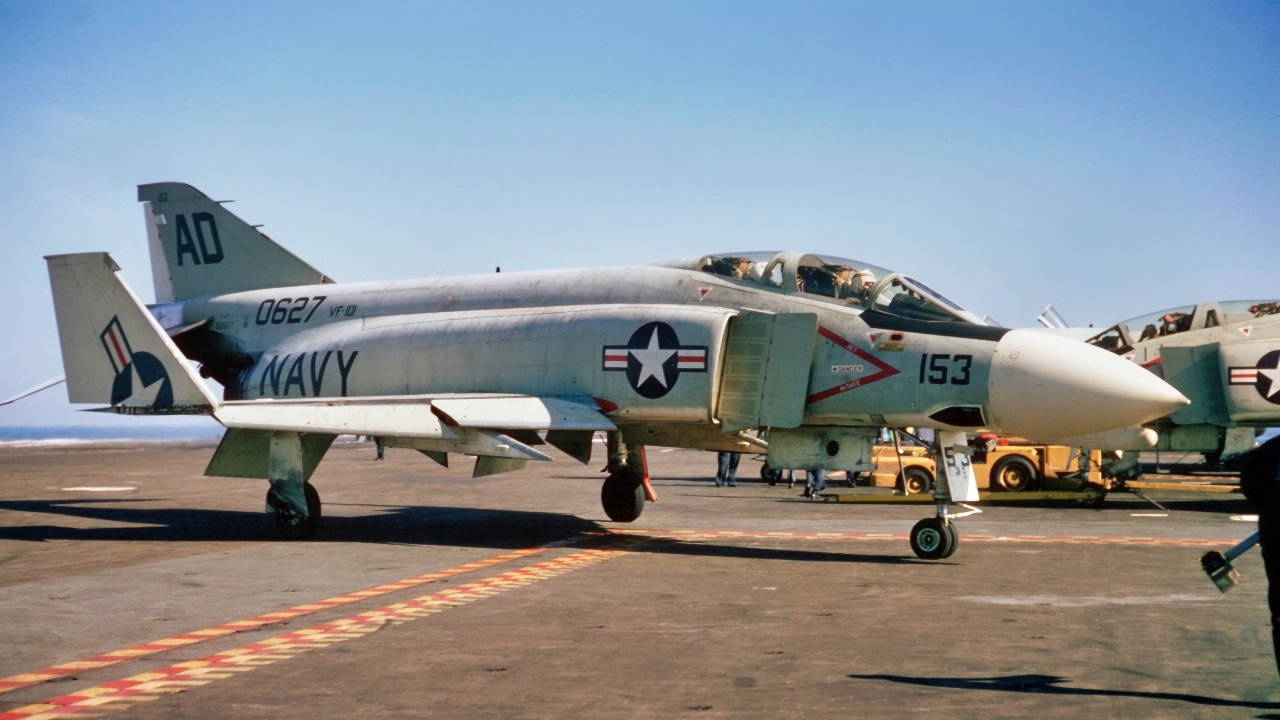
A Fighter Squadron 101 (VF-101) F-4J Phantom II aircraft taxis on the flight deck of the attack aircraft carrier USS AMERICA (CVA 66).
These engines were among the most advanced of their time and featured variable stator vanes to improve efficiency across different flight regimes.
The J79 engines were known for their smoky exhaust —a visual signature of the Phantom —but delivered reliable, robust performance that contributed to the aircraft’s high climb rate and acceleration.
In terms of design, the F-4 Phantom II featured a long fuselage, high-mounted swept wings, and anhedral tailplanes.
It had a two-seat configuration, with a pilot in the front and a radar intercept officer (RIO) in the rear. This arrangement allowed for better management of the aircraft’s sophisticated radar and weapons systems, especially during complex combat operations.
The aircraft was also equipped with a large radar housed in its nose, enabling long-range target detection and engagement. Its aerodynamic design was optimized for supersonic flight and weapons carriage, with multiple hardpoints allowing it to carry a wide array of ordnance.
Armament and Avionics
The Phantom could carry up to 18,650 pounds (8,480 kilograms) of weapons and equipment, including AIM-7 Sparrow radar-guided missiles, AIM-9 Sidewinder infrared-guided missiles, air-to-ground bombs, rockets, reconnaissance pods, and external fuel tanks.
Initially, the aircraft lacked an internal cannon and relied solely on missiles for air combat.
However, combat experience during the Vietnam War revealed the limitations of this approach, leading to the addition of an internal M61 Vulcan 20mm rotary cannon in the F-4E variant.
By today’s standards, the F-4 is outdated, but at the time, the Phantom’s avionics were pretty sophisticated.
Early models were equipped with the AN/APQ-72 radar, while later versions featured more advanced systems, such as the AN/APQ-120.
These radars allowed for beyond-visual-range engagements and improved situational awareness.
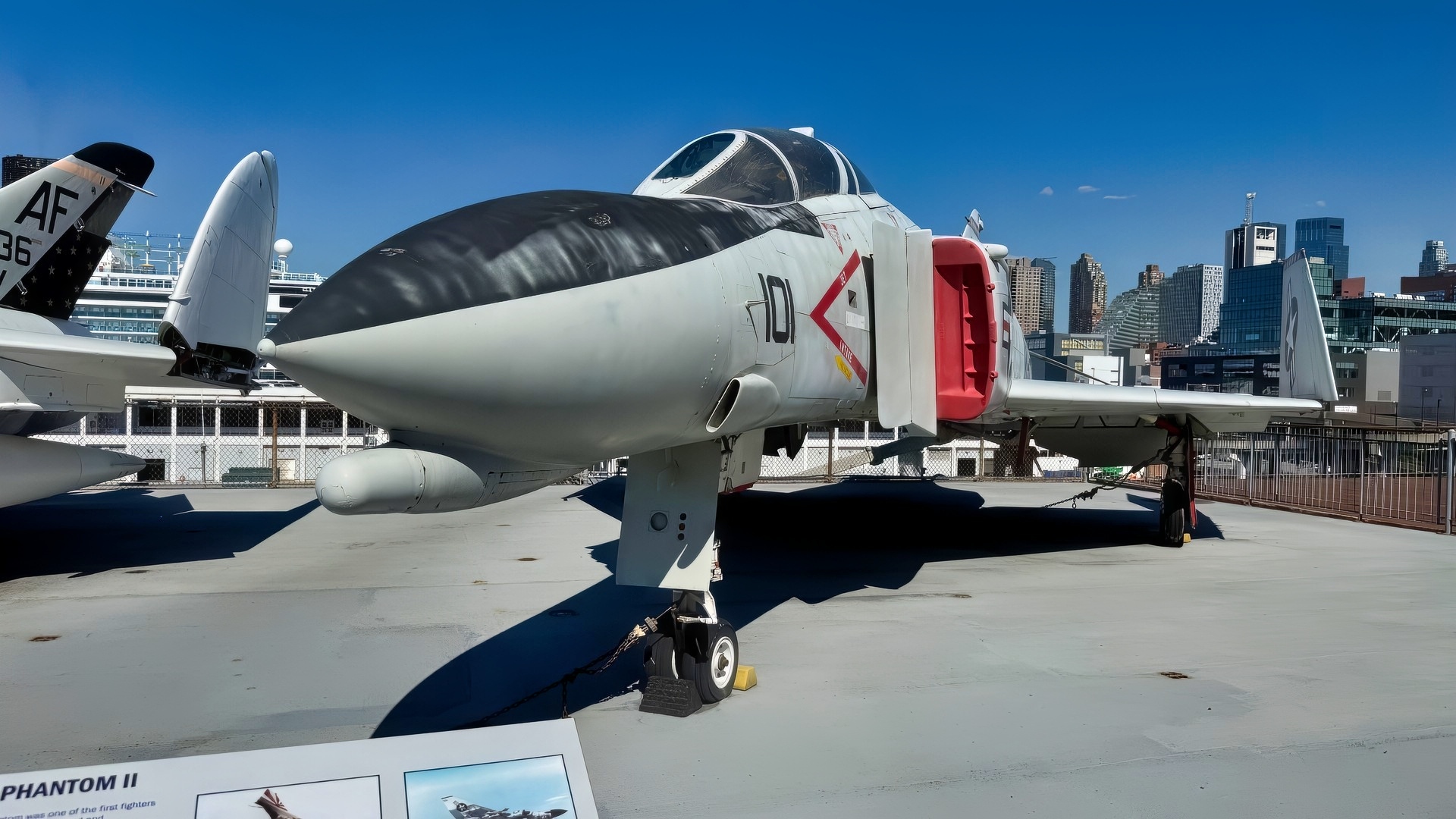
F-4 Phantom II Photo from National Security Journal. Taken on September 18, 2025.
The aircraft also incorporated evolving electronic countermeasures and targeting systems, making it a formidable platform in both air-to-air and air-to-ground roles.
One of the Most Widely Produced American Fighters Since WWII
Over its production run, more than 5,000 F-4 Phantom IIs were built, making it one of the most produced and widely used fighter aircraft in history.
Numerous variants were developed to fulfill different roles and requirements. The F-4B was the original Navy version, followed by the F-4C and F-4D for the Air Force, which featured improved avionics and systems.
The F-4E introduced the internal cannon and further radar upgrades. Reconnaissance versions like the RF-4C and RF-4E replaced the nose radar with camera systems, while the F-4G “Wild Weasel” variant specialized in electronic warfare and suppression of enemy air defenses.

An F/A-18 Super Hornet from Naval Air Station Oceana, Virginia, performs an aerial demonstration over Rickenbacker International Airport, Ohio, June 16, 2024, as part of the Columbus Air Show. This year’s event featured more than 20 military and civilian planes, including a KC-135 Stratotanker from the 121st Air Refueling Wing, which served as the base of operations for military aircraft participating in the show. (U.S. Air National Guard photo by Senior Airman Ivy Thomas)

An F/A-18C Hornet, assigned to the “Stingers” of Strike Fighter Squadron 113, transits over the haze of southern Afghanistan. VFA 113, part of Carrier Air Wing 14 aboard the aircraft carrier USS Ronald Reagan is supporting Operation Enduring Freedom. The mission of CVW 14 is to protect the people of Afghanistan and to support coalition forces. Ronald Reagan is currently deployed to the U.S. 5th Fleet area of operations. Operations in the U.S. 5th Fleet area of operations are focused on reassuring regional partners of the United States’ commitment to security, which promotes stability and global prosperity.

Aviation Boatswain’s Mate (Equipment) 3rd Class Mark Ruiz, assigned to Air Department aboard the world’s largest aircraft carrier, USS Gerald R. Ford (CVN 78), prepares a Carrier Air Wing 8 F/A-18E Super Hornet attached to Strike Fighter Squadron 37 for launch on the flight deck, Aug. 1, 2025. Gerald R. Ford, a first-in-class aircraft carrier and deployed flagship of Carrier Strike Group Twelve, is on a scheduled deployment in the U.S. 6th Fleet area of operations to support the warfighting effectiveness, lethality and readiness of U.S. Naval Forces Europe-Africa, and defend U.S., Allied and partner interests in the region. (U.S. Navy photo by Mass Communication Specialist 2nd Class Mariano Lopez)
The British operated their own versions, such as the FGR.2, which used Rolls-Royce Spey engines instead of the J79S.
The U.S. military began phasing out the Phantom in the 1980s and 1990s, replacing it with newer aircraft like the F-15 Eagle, F-16 Fighting Falcon, and F/A-18 Hornet. However, its legacy continued in various forms. Many retired Phantoms were converted into QF-4 target drones for missile testing and training purposes.

An F-15E Strike Eagle assigned to the 494th Fighter Squadron takes off for a training sortie at Royal Air Force Lakenheath, England, Oct. 26, 2018. The 494th trains regularly to ensure RAF Lakenheath brings unique air combat capabilities to the fight. (U.S. Air Force photo/ Tech. Sgt. Matthew Plew)
Others were preserved in museums or flown at airshows by private collectors and military demonstration teams.
The Phantom’s influence can be seen in the design philosophies of modern multi-role fighters, which strive to combine speed, firepower, and versatility in a single platform.
About the Author: Isaac Seitz
Isaac Seitz, a Defense Columnist, graduated from Patrick Henry College’s Strategic Intelligence and National Security program. He has also studied Russian at Middlebury Language Schools and has worked as an intelligence Analyst in the private sector.


Raymond Hollingsworth
November 1, 2025 at 1:10 am
Can you please come up with better headlines than has a message for “insert military”
If you get paid for this you should be ashamed for taking the money!
Be Original instead of using the same old headlines!
David Benedict
November 1, 2025 at 7:28 am
Please get your facts correct. The Skyhawk is designated the A4. The Skyhawk was a subsonic attack aircraft. The F 8 crusader was a supersonic fighter known as the “last gunfighter” with a top speed of Mach 1.2
Mark Prange
November 1, 2025 at 12:05 pm
F-8 Crusader
Christopher Townley
November 3, 2025 at 12:08 am
The F8, an interceptor for the US NAVY, was not the A4 Skyhawk, and attack bomber, that could carry more than it weighed, and used at Top Gun for its manoeuvring.