

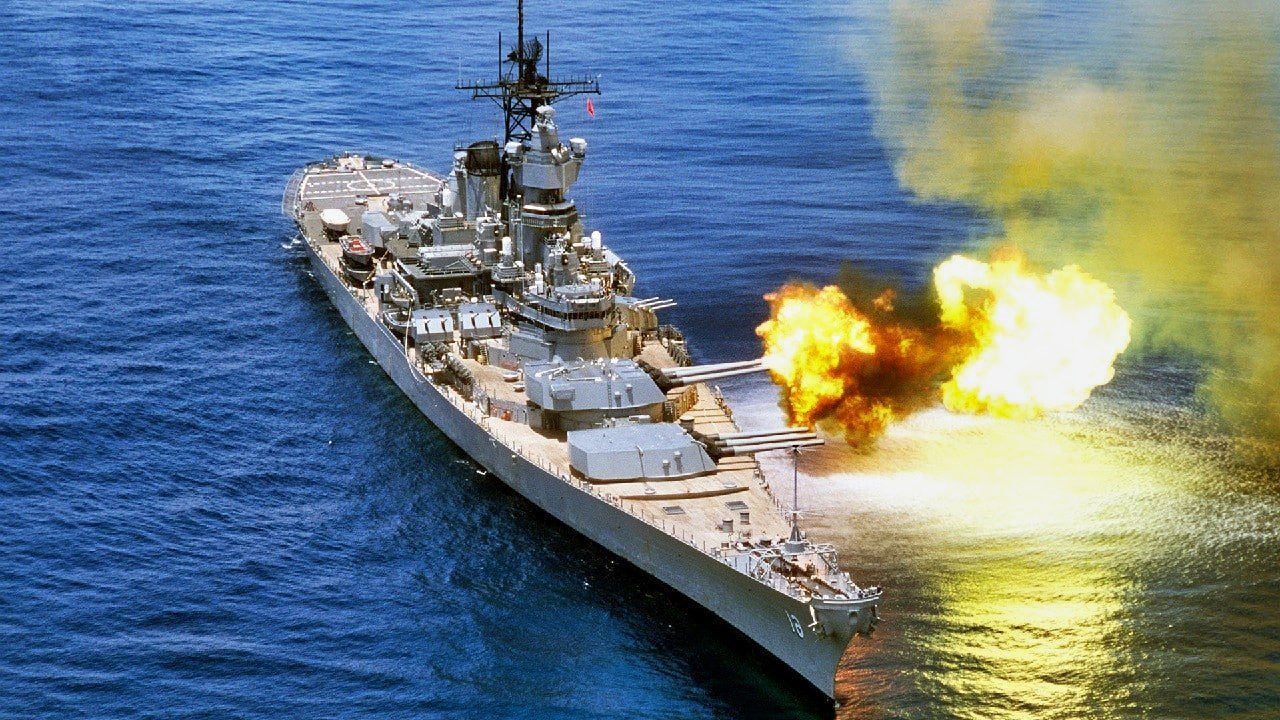
Key Points and Summary – The US Navy’s four Iowa-class battleships—Iowa, New Jersey, Missouri, and Wisconsin—were reactivated from reserve to play a crucial role in the Korean War, primarily providing devastating naval gunfire support.
-With their nine 16-inch guns, the battleships could shell enemy positions, infrastructure, and supply lines up to 20 miles inland, forcing North Korean forces to move critical assets away from the coast.
-This constant, heavy bombardment of targets up and down the peninsula was vital for supporting UN ground troops.
-Their powerful presence also acted as a significant deterrent, discouraging deeper involvement from the Soviet Union and China.
American Iowa-Class Battleships During the Korean War
Less than five years after the Japanese surrendered on board the battleship USS Missouri, the United States was involved in another war in Asia—and not far from Japan—when North Korea invaded the South.
Although this war featured none of the enormous sea battles that the US and Japan fought, it was in Korea that the Navy demonstrated its importance in a “limited” land war. This lesson would carry over to other conflicts the US was involved in during the 20th Century.
During the Korean War, US Navy battleships, specifically the Iowa-class battleships, played a significant role in providing naval gunfire support to United Nations forces.
These battleships, including the USS Iowa, USS New Jersey, USS Missouri, and USS Wisconsin, were reactivated from reserve and deployed to offer heavy coastal bombardment and strategic firepower.
The primary difference between the World War II battleships and their counterparts in the Korean War was the replacement of float planes off the ship’s fantail with helicopters.
Naval Gunfire Support: Battleships Rule
The primary role of the battleships was to provide shore bombardment support for UN forces, both in South Korea and when the war moved into North Korea.
The Iowa class relied on nine 16-inch 50-caliber Mark 7 naval guns, which were capable of firing high explosive and armor-piercing shells as far as 23.4 nautical miles.
The weapon is constructed of liner, A tube, jacket, three hoops, two locking rings, tube and liner locking ring, yoke ring and screw box liner.
As was typical of USN weapons built in the 1940s, the bore was chromium-plated for longer barrel life. It used a Smith-Asbury Welin breech block, which opens downwards. The screw box liner and breech plug are segmented with stepped screw threads arranged in fifteen sectors of 24 degrees each.
A manually operated lever is used to rotate and unlock the breech plug, which is then pulled open manually.
After loading, the breech plug is swung back up into the breech by a pneumatic system. The manually operated lever is then used to rotate and lock the breech closed.
When the plug is locked, the breech lever engages the salvo latch mechanism, which prevents the breech from being opened again until after the gun fires.
The battleships also carried twenty of the outstanding 5-inch/38 caliber Mark 12 guns as secondary armament.
Targeting
The Navy’s battleships would range along the coastline of South and later North Korea and shell enemy targets at will, sometimes as far inland as 20 miles.
They primarily targeted enemy positions along the coast, including cave systems, artillery, and command posts, as well as strategic and operational targets like railways, bridges, tunnels, and industrial areas.
Effectiveness
Despite the lack of significant North Korean naval forces, the battleships’ presence was crucial for supporting ground operations and maintaining control of the coastal areas.
This range forced North Korea to move military targets farther inland to escape the bombardment. However, the Navy, with its carriers, battleships, and other surface vessels, offered additional benefits.
The 7th Fleet maintained a presence off the Chinese coast to dissuade them from invading Taiwan. Chairman Mao thought twice before attempting to invade Taiwan with the vast naval presence nearby.
On May 25, 1951, the battleship Iowa arrived off the coast of Chongjin, a North Korean industrial center approximately 55 miles from the Russian border. Upon arrival, Iowa proceeded to shell the industrial and rail transportation centers in Chongjin, after which she moved south to support the Army’s X Corps.
This visible display of US naval might, throughout the war, also caused Soviet leader Joseph Stalin, who had endorsed the North Korean aggression, to think twice about militarily supporting the invasion.
He limited the extent of his country’s air support and warned his forces not to attack US and United Nations warships off Korea.
While the exact number of 16-inch shells that were fired in Korea is unknown, during a specific 120-day period on the gunline in the Korean War, 5,866 16-inch shells were fired by the USS New Jersey.
During the Korean War, the USS Missouri fired 3,861 rounds of 16-inch shells. That is a lot of steel downrange. And that doesn’t cover all of it, nor the 5-inch shells that the battleships carried.
The battleships provided tremendous shore bombardment during the war. In one action, the USS Wisconsin was peppering North Korean troops when it suffered a hit from a North Korean 152mm artillery position. The shell did no damage, and there were no casualties.
However, the “Big Wisky,” as the ship was called, located the position that the artillery had fired from, and trained all nine 16-inch guns on the position and fired, obliterating the entire artillery battery.
About the Author:
Steve Balestrieri is a National Security Columnist. He served as a US Army Special Forces NCO and Warrant Officer. In addition to writing on defense, he covers the NFL for PatsFans.com and is a member of the Pro Football Writers of America (PFWA). His work was regularly featured in many military publications.
More Fighters
China’s J-20 Stealth Fighter Looks Like a Powerhouse
China’s White Emperor Space Fighter Looks Fake
China’s Aircraft Carriers Have Arrived (Just Not Nuclear Carriers)


Pingback: Battlecarrier: The Navy Almost Merged an Aircraft Carrier and a Battleship - National Security Journal