


Key Points and Summary – The Virginia-class attack submarine program was supposed to deliver two boats a year. Instead, production is stuck around 1.2 annually, with Block V subs years behind schedule and billions over plan.
-GAO and CRS reports point to chronic shipyard workforce shortages, underfunded contracts, and a hollowed-out industrial base that can’t meet U.S. Navy and AUKUS demands at the same time.
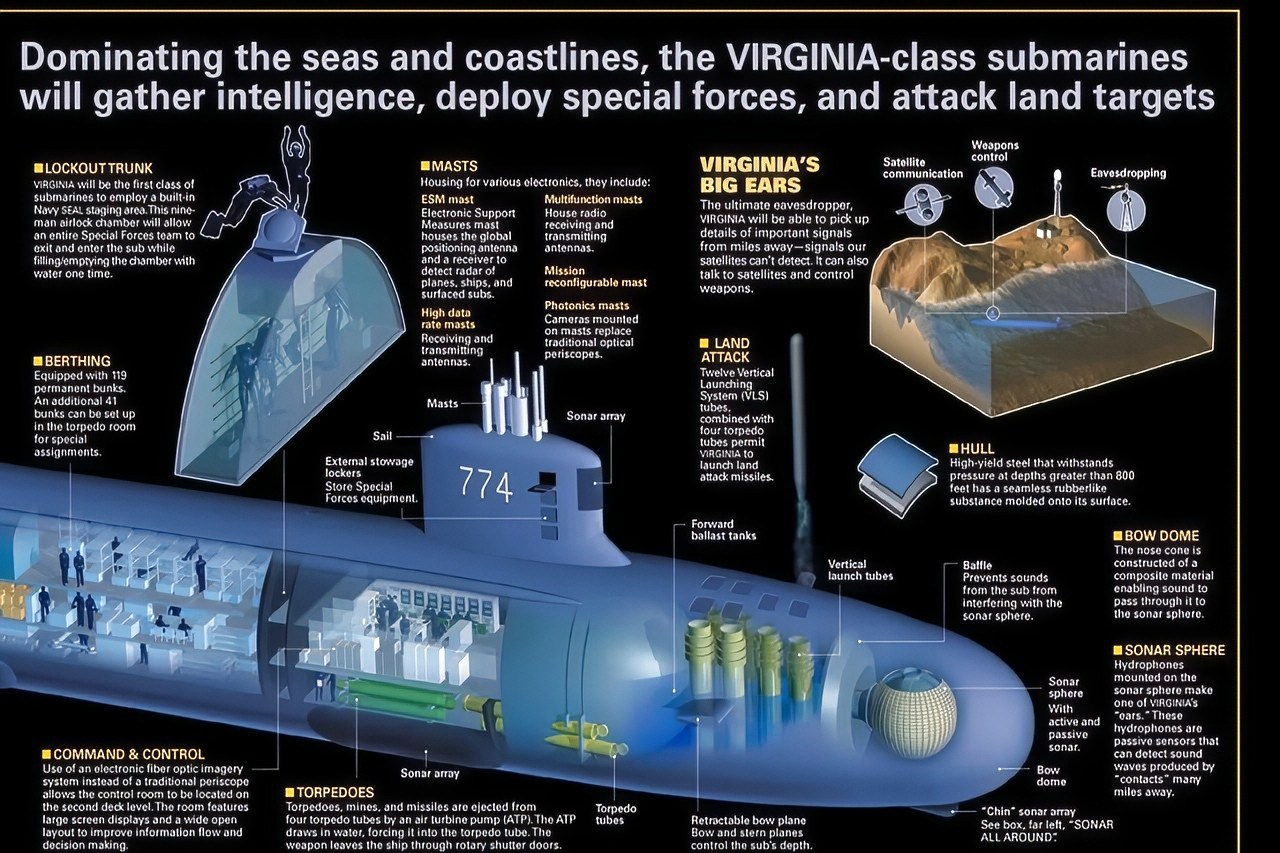
Virginia-Class Submarine Cut Out. Image Credit: Creative Commons.
-A recent contract fix shifted the Navy away from cost-plus terms that were “eating us alive,” but leaders admit infrastructure and management failures still loom large.
-With only 47 attack subs in the fleet against a requirement of 66, delay is becoming a strategic risk.
Why the Virginia-Class Submarine Program Is So Far Behind
Back in July, the Congressional Research Service sent a report to Congress that showed exactly why the next-generation Virginia-class submarine program is so far behind.
But even as the next-generation submarine remains behind schedule, so too is the Virginia-class submarine (Block V), which has been in production since 2019.
According to a GAO report released in April, which found that Navy shipbuilding is broadly behind schedule, “the Navy set a goal of producing two submarines per year with the project completed by 2028. But in June 2024, we found that the [Virginia Block V] program’s rate of production is at about 60% of its annual goal—putting it years behind schedule.”
That June 2024 report provided more detail on the status of the Virginia Block V.
“VCS [Virginia Class Submarine] program officials reported that the VCS delivery rate stabilized at 1.2 submarines per year, and they plan to produce at a rate of two submarines per year by 2028,” the 2024 report said. “However, the Navy will be challenged to improve production enough to meet the Australia-United Kingdom-United States initiative for Australia to acquire conventionally-armed nuclear-powered submarines, while also meeting the Navy’s planned submarine fleet numbers.”
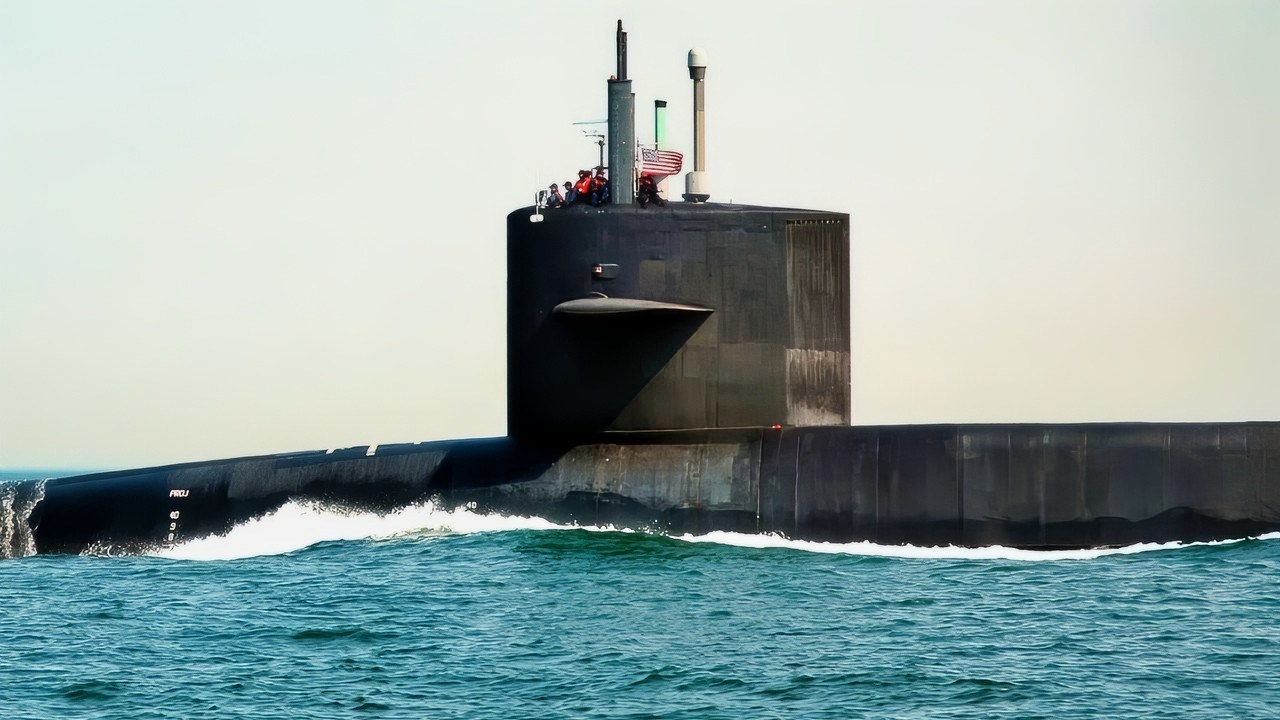
(March 31, 2006) – The guided missile submarine USS Florida (SSGN 728) conducts sea trials off the coast of Virginia. Florida will be delivered to the Fleet in April, and a Return To Service ceremony is scheduled for May 25 in Mayport, Fla. As the second of four SSBN submarines to be converted to SSGN, this nuclear-powered submarine will have the capability to: launch up to 154 Tomahawk cruise missiles; conduct sustained special warfare operations with up to 102 Special Operations Forces (SOF) personnel for short durations or 66 SOF personnel for sustained operations; and provide approximately 70 percent operational availability forward deployed in support of combatant mission requirements. U.S. Navy photo by Chief Journalist (SW/AW) Dave Fliesen.
There were signs of trouble the year before.
“In June 2023, the Navy found that the shipbuilder was not meeting efficiency and schedule criteria the program set to assess shipbuilder readiness for full construction for SSN 808. As a result, the Navy delayed that event,” the GAO report said.
The CRS report from June, meanwhile, states that if two Block V Virginia Class submarines are procured per year, and that “Virginia-class SSNs equipped with the Virginia Payload Module (VPM) have an estimated procurement cost of more than $4 billion per boat.”
A Contract Modification
In April, per USNI News, the Navy announced that it was awarding $18.5 billion to General Dynamics and HII to build what was described as “the final pair of Block V Virginia-class attack boats.”
“General Dynamics Electric Boat Corp. is being awarded $12,418,145,463, and if all options are exercised, the total value will be $17,152,265,971; and Huntington Ingalls Inc., Newport News Shipbuilding, is being awarded $1,293,694,000,” The Navy announced in the contract award announcement. “These contracts include options which, if exercised, would bring the cumulative value of the contract change to $18,445,959,971.”
Congress had appropriated $9.4 billion for the two boats in FY 2024, with an additional $1.95 billion in a stopgap bill, USNI said.
“Over the past two years, we successfully worked with the Navy, Congress, and the administration to secure funds that enable us to increase wages for the nuclear-powered vessel workforce and allow for significant additional investments in capacity, shipyard processes, and systems,” Mark Rayha, president of General Dynamics Electric Boat, said in a statement in the announcement of the contract.
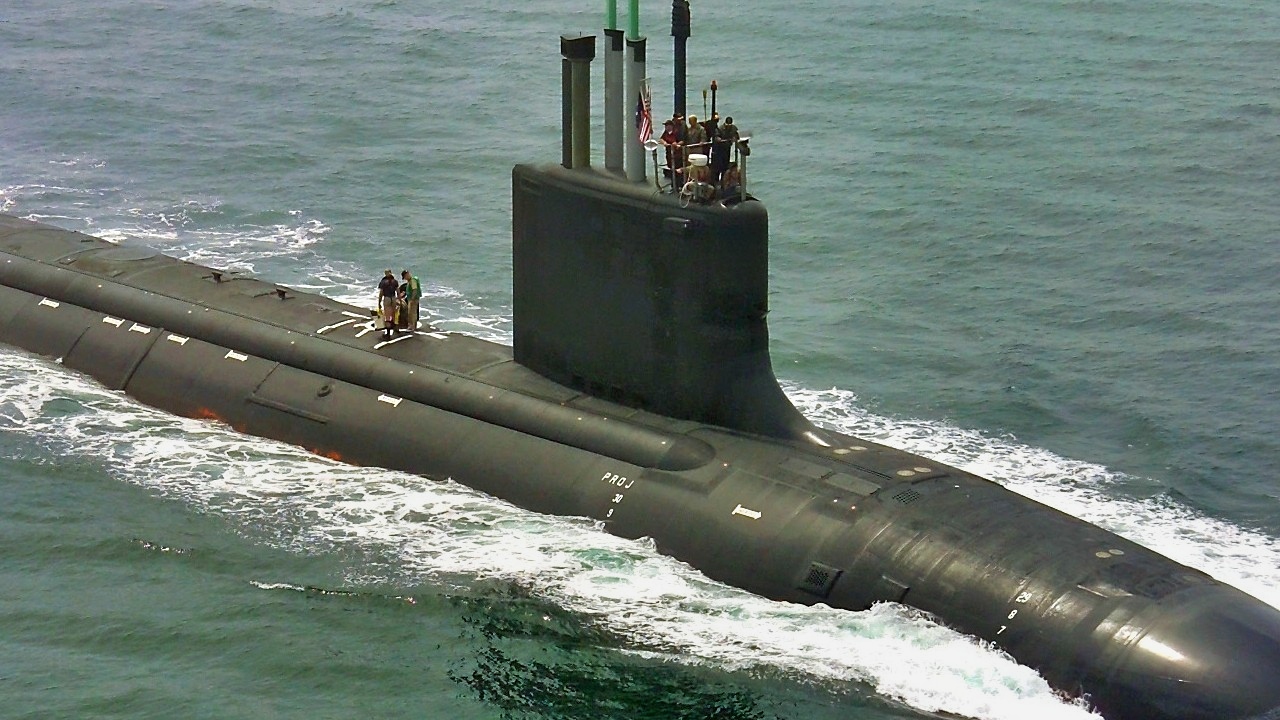
040730-N-1234E-001
Groton, Conn. (July 30, 2004) – The nation’s newest and most advanced nuclear-powered attack submarine and the lead ship of its class, PCU Virginia (SSN 774) returns to the General Dynamics Electric Boat shipyard following the successful completion of its first voyage in open seas called “alpha” sea trials. Virginia is the Navy’s only major combatant ready to join the fleet that was designed with the post-Cold War security environment in mind and embodies the war fighting and operational capabilities required to dominate the littorals while maintaining undersea dominance in the open ocean. Virginia and the rest of the ships of its class are designed specifically to incorporate emergent technologies that will provide new capabilities to meet new threats. Virginia will be delivered to the U.S. Navy this fall. U.S. Navy photo by General Dynamics Electric Boat (RELEASED)
“This contract modification validates the unique and important role submarines and submarine shipbuilders play in our national defense.”
USNI News had reported that the last two boats had been “underfunded,” due to an “explosion of workforce costs that raised the price of the two submarines by almost 20 percent.”
Secretary of the Navy John Phelan, per the report, was “involved in the final touches” of the contract, USNI News said.
“We recently re-negotiated the planned contract to deliver this critical capability, and appropriately share risk between the Navy and industry,” Phelan said in a separate statement. “We will be looking at all future contracts with a similar lens to ensure the appropriate level of risk sharing and value to the American taxpayer.”
In early November, as reported by Defence Industry Europe, HII said in an earnings call that it hoped a multi-year agreement to procure 15 nuclear submarines—some of which will be Block VI of the Virginia-class—for the US Navy could be finalized by the end of the year. This would include, per the report, “10 Block VI Virginia-class attack submarines and five Columbia-class ballistic missile submarines.”
The Secretary Speaks
The following month, Phelan discussed the sluggish submarine production in testimony before a House defense subcommittee.
The secretary addressed that contract modification.
“We had a cost-plus contract that was eating us alive … The future will be fixed-price with some incentives,” Phelan told the committee.
“The Department of the Navy has suffered from years of suboptimal management decisions, inefficient and burdensome bureaucracy, and poor capital allocation, resulting in delayed shipbuilding and huge cost overruns. Too often, taxpayer dollars are wasted, while maintenance backlogs grow and vital modernization efforts lag,” the Navy Secretary read in his prepared testimony before the subcommittee.
Answering Questions about the Virginia-Class Program
During the hearing, per USNI News, Chairman Rep. Ken Calvert (R-CA) specifically asked about the Virginia-class submarines.
“I fear that delays in the Virginia-class program will only be compounded by delays in Columbia-class submarine construction,” the chairman said. “The Virginia-class program continues to hover at a construction cadence of 1.2 submarines a year versus the necessary cadence of two per year.”

(Sept.9, 2011) The Virginia-class submarine Pre-Commissioning Unit (PCU) California (SSN 781) gets underway from Naval Station Norfolk to conduct weapons systems acceptance trials. California is the eighth Virginia-class submarine and is scheduled to be commissioned Oct. 29. (U.S. Navy photo by Mass Communication Specialist 2nd Class William Jamieson/Released)
Phelan gave some answers as to why that’s happened.
“The [US] industrial base has been hollowed out and infrastructure [piers and docks] shortened,” the secretary answered, per USNI News. He added, however, that the docks in Japan require less bureaucracy and achieve up to three times the productivity per shift.
“The Navy has an undersea warfighting requirement for 66 attack submarines,” Adm. James Kilby, the acting chief of naval operations, said in his own written testimony before the committee.
“We are well below our requirement, with 47 currently in inventory. As of April 2025, 24 Virginia-class submarines have been delivered, and 14 are under contract. Five Columbia-class submarines are in construction.”
More Trouble For the Next-Gen Submarine
Per Defense News, the idea is that the Next-Generation Attack Submarine, known as the SSN(X), is seen as a “successful combination of stealth, operational life, and autonomous technology.”
We’ve known since last year that the production goal has moved back from the 2030s to the 2040s, but the Congressional Research Service report laid out some of the reasons.
“The Navy’s FY2025 budget submission deferred the envisaged procurement of the first SSN(X) from FY2035 to FY2040 due, the Navy stated, to limitations on the Navy’s total budget. The Navy’s proposed FY2026 budget requests $622.8 million in research and development funding for the SSN(X) program,” the Congressional Research Service report says.
About the Author: Stephen Silver
Stephen Silver is an award-winning journalist, essayist, and film critic, and contributor to the Philadelphia Inquirer, the Jewish Telegraphic Agency, Broad Street Review, and Splice Today. The co-founder of the Philadelphia Film Critics Circle, Stephen lives in suburban Philadelphia with his wife and two sons. For over a decade, Stephen has authored thousands of articles that focus on politics, national security, technology, and the economy. Follow him on X (formerly Twitter) at @StephenSilver, and subscribe to his Substack newsletter.


