

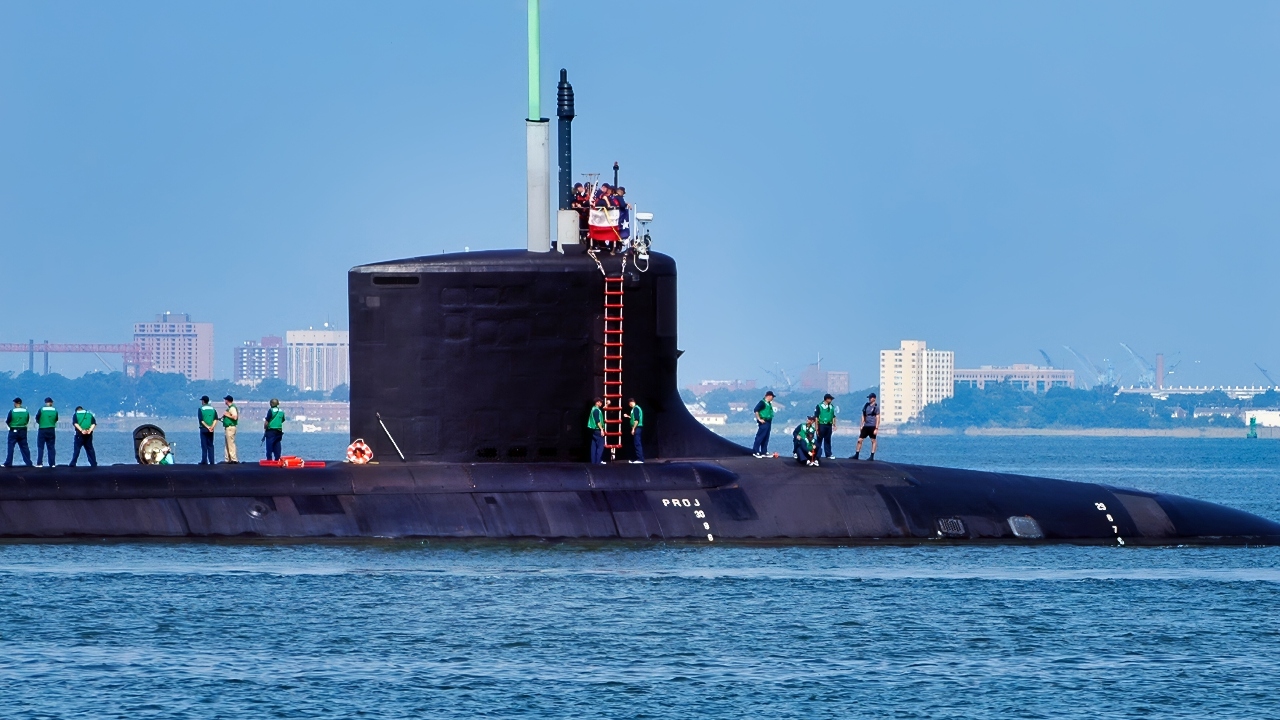
Key Points and Summary – The U.S. Navy’s upcoming Virginia-class Block VI submarines represent a significant leap in undersea warfare, designed to ensure continued maritime dominance.
-The centerpiece of this upgrade is the Virginia Payload Module (VPM), an 84-foot section that triples the submarine’s Tomahawk cruise missile capacity from 12 to 40.
-This massive increase in firepower is crucial to replacing the capability of four retiring Ohio-class guided-missile submarines.
-The Block VI will also feature enhanced stealth, advanced sonar, and new “seabed warfare” capabilities, making it a cornerstone of future naval strategy.
Will The Block VI Virginia-Class Boats Keep The USN Dominant?
The US Navy’s Virginia-class Block VI submarines are a significant upgrade to the US Navy’s submarine fleet, incorporating advancements in stealth, sonar, and payload capacity.
These submarines are designed to support anti-submarine warfare, surface ship warfare, special operations, and land-attack missions. The Block VI introduces the Virginia Payload Module (VPM), which enhances Tomahawk missile capacity and flexibility.
General Dynamics Electric Boat (GDEB) has secured a contract modification worth $1.06 billion to procure long-lead-time materials for the construction of Virginia-class Block VI submarines.
GDEB is the prime contractor and lead design yard for the Virginia-class. It builds the vessels in a teaming arrangement with HII’s Newport News Shipbuilding. The Navy currently has 24 Virginia-class boats in service, with another 16 either awaiting delivery or under construction.
Virginia-Class Submarines Are Fast:
The Virginia class is among the five fastest submarines in the world. A Virginia-class submarine can travel at a submerged speed of 25+ knots (28+ miles per hour).
This is achieved using a nuclear reactor for propulsion and a pump-jet propulsor. They are also designed to remain submerged for extended periods, potentially up to three months, depending on food supplies.
The Seawolf class of the US Navy is the fastest operational submarine in the world, able to travel at 35 mph under the ocean’s surface.
Features Of the Navy’s Virginia Block VI Submarines:
In a webinar for the annual symposium of the Naval Submarine League, Rear Adm. Dave Goggins, program executive officer for Submarines, said, “Block VI continues that trend of delivering increasingly capable and lethal platforms block to block.”
“Block VI will focus on building upon the acoustic superiority advancements of 790 [USS South Dakota, SSN 790],” Goggins said. “The key thing here is to really enable that organic subsea, seabed warfare capability for the first time.”
Goggins said some of the features the Navy is looking at include improved stealth to operate in contested environments; enhanced sonar performance resulting in greater tactical advantage [found] in a bow conformal array; the ability to sense and interact with more of the water column and seafloor.
Virginia Payload Module:
The Block VIs will be the second set of Virginia-class attack submarines to feature the Virginia Payload Module (VPM), which will meet the Navy’s requirement for a large-scale land strike missile platform after the service decommissions four Ohio-class guided-missile submarines by the end of the decade.
In the last several years, the Ohio guided-missile boats, each capable of fielding 154 Tomahawk Land Attack Missiles, have been a favorite of combatant commanders.
USS Florida (SSGN-728) was deployed for almost two years as a defense against threats in the Mediterranean and the Middle East, returning last August.
The VPM inserts four Multiple All-up-round Canisters (MAC) in the middle of the submarine in addition to two in the bow. Each MAC tube can contain seven Tomahawk cruise missiles. The Navy has stated that it will need 20 VPM boats to compensate for the loss of strike missiles when the Ohio-class submarines retire.
The module is 84 feet long—bringing the total length of the Virginia-class subs up from 377 feet to 461 feet, the Navy file said—and can store and launch payloads with diameters larger than the 21-inch diameter of a torpedo or Tomahawk missile. This will increase the Virginia-class boats’ Tomahawk missile capacity from 12 to 40.
Virginia Block VI Fills Strategic Investment:
By incorporating the VPM into the new Virginia-class boats, the cost of each boat will increase by 15 percent. However, it will triple the firepower of each submarine in the class, thereby mitigating the losses of Ohio-class missiles.
However, this isn’t just a new Navy contract. This is a strategic investment in the US Navy’s continued maritime supremacy and national security. These submarines are imperative to the Navy’s firepower as the aging Ohio-class boomers are retired.
The Block VI submarines are the Navy’s next-generation undersea warfare platforms, providing the Navy with enhanced strike options and greater flexibility in mission planning.
These submarines are designed for land strike missions, anti-submarine and surface ship warfare, special operations support, and intelligence, surveillance, and reconnaissance (ISR) missions.
New Technology Emerging:
The US Navy is using strong fiber optic cable to connect undersea submarines to drones able to travel to the surface and interface with surface gateway technologies in a position to essentially translate acoustic data gathered by submarines beneath the surface into RF signals and other kinds of data links able to share information with air, surface, and land communications nodes.
This line of communication enables a submarine to use its long-range, high-fidelity acoustic sensors to gather sensitive threat information and network it to a drone, which will surface and interface with gateway systems in real-time, sending time-sensitive threat data to surface ships, aircraft, and land bases.
Among the new technologies is the Navy’s hypersonic weapons. The Navy intends to arm its submarines with the Conventional Prompt Strike weapon before 2028. The arrival of undersea-launched hypersonics will ensure the Navy has a high-speed attack advantage.
And once the long-awaited Columbia-class missile boats finally come online, the Virginia Block VI boats will give the US Navy continued superiority over near-peer threats against China and Russia.
About the Author: Steve Balestrieri
Steve Balestrieri is a National Security Columnist. He served as a US Army Special Forces NCO and Warrant Officer. In addition to writing on defense, he covers the NFL for PatsFans.com and is a member of the Pro Football Writers of America (PFWA). His work was regularly featured in many military publications.
Military Affairs
China’s Stealth Air Force Has 1 Mission


