

Article Summary – HMS Daring, the Royal Navy’s first Type 45 destroyer, has spent more than eight years out of action after chronic propulsion failures exposed deep flaws in Britain’s most advanced surface combatant.
-Designed around the WR-21 gas turbine and an integrated electric drive, the ship repeatedly suffered total power loss in warm waters, triggering blackouts and emergency returns to port.
-The Ministry of Defence launched a £160 million Power Improvement Project to rip out and replace the original generators, forcing invasive hull cuts and a protracted refit.
-Daring’s long lay-up highlights systemic design, yard capacity, and supply chain problems now haunting the entire Type 45 fleet.
The Type 45’s Fatal Flaw: Why HMS Daring Spent Nearly a Decade Laid Up
In October 2025, news sources reported that the HMS Daring, a Type 45 destroyer, would be returning to service after a lengthy maintenance cycle that kept the ship out of action for more than 8 years.
The Daring was laid up after a fundamental flaw was discovered with the propulsion system present in all Type 45 destroyers in the UK’s fleet.
This extended maintenance period exposed a number of fundamental flaws with the Type 45, despite being one of England’s most capable warships.
Intro into the Type 45 Destroyer
The Type 45 destroyers, also known as the Daring-class, are among the most advanced surface ships in the British Royal Navy.
They are often compared to the U.S. Navy’s Arleigh Burke-class destroyers, and some even claim that they surpass their American counterparts in several respects.
The Type 45 was built to replace the aging Type 42 (Sheffield-class) destroyers, which were first introduced in the 1960s.
The project was a joint effort between BAE Systems and numerous other manufacturers that provided electronics and other systems.
As with many other British naval programs, the Type 45 project was plagued by cost overruns and delays.
The first of six ships was finally accepted into service in 2009.
The Type 45 is significantly larger than its predecessors, measuring approximately 152.4 meters (500 feet) in length, with a beam of 21.2 meters (69 feet 7 inches), a draught of 7.4 meters (24 feet 3 inches), and a displacement of about 7,350 metric tons.
They are powered by two Rolls-Royce WR-21 gas turbines driving GE alternators, along with two Wärtsilä 12V200 diesel generators.
For propulsion, the Type 45 is fitted with an integrated electric propulsion (IEP) system, which provides greater efficiency and simplifies maintenance.
In terms of armament, the destroyer is equipped with 48 vertical launch systems capable of firing anti-air or anti-ship missiles, depending on the mission.
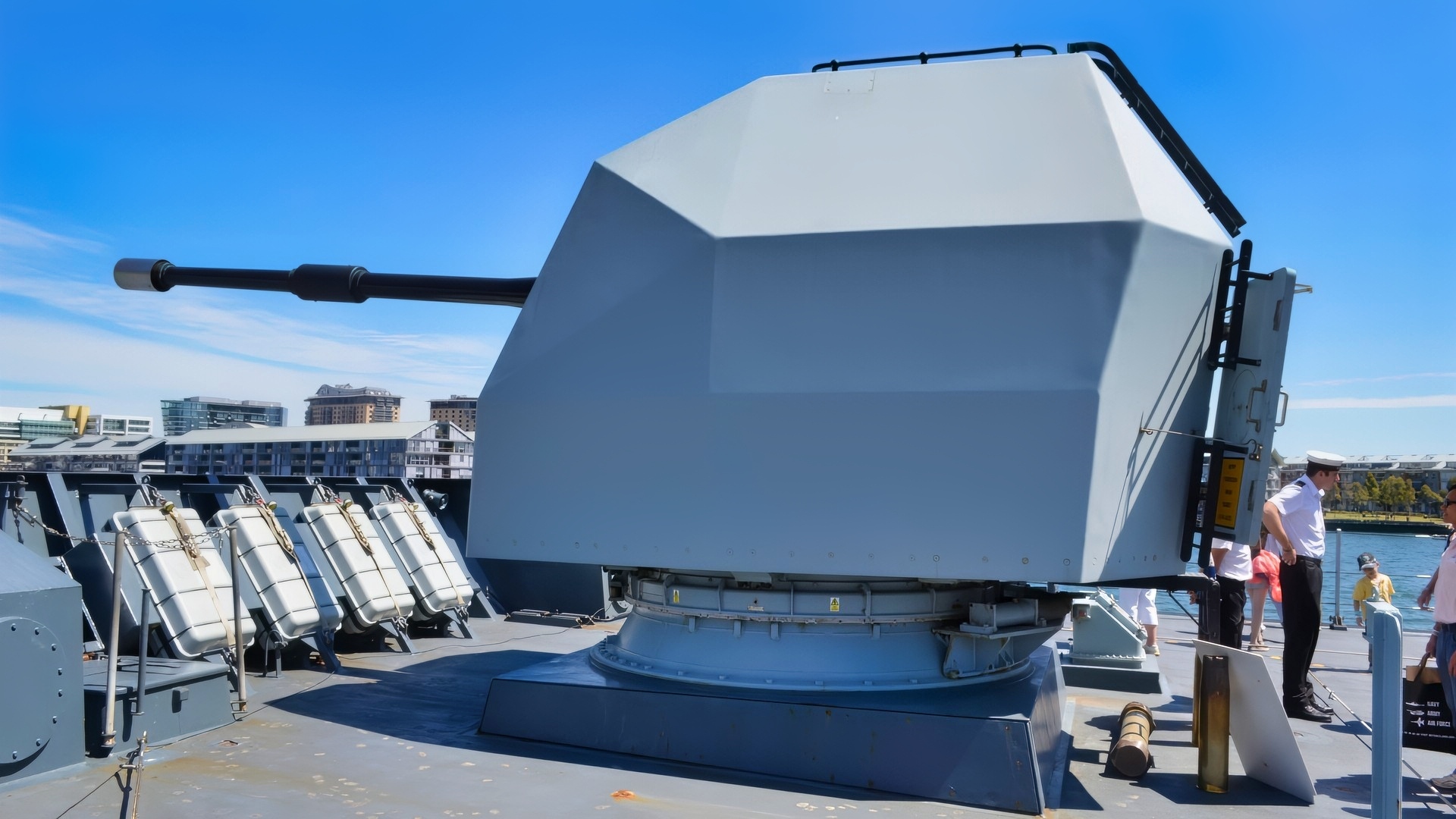
It is also fitted with several guns, including one 4.5-inch Mark 8 naval gun and multiple machine guns for close-range air defense.
Why the HMS Daring Was Out of Action for so Long
Despite their impressive capabilities, the Type 45 destroyers had several flaws.
Nowhere was this more evident than on the HMS Daring.
After commissioning in July 2009 and entering service in 2010, HMS Daring completed several high-profile missions.
It participated in anti-piracy patrols in the Red Sea, conducted maritime security operations in the Persian Gulf, and provided humanitarian assistance in the Philippines following Typhoon Haiyan in 2013. It also supported coalition forces in the Middle East during Operation Inherent Resolve.
For nearly seven years, Daring was a visible symbol of British naval power. Yet beneath the surface, serious technical problems were brewing, issues that would eventually sideline the ship for nearly a decade.
The primary reason for HMS Daring’s extended absence lies in its propulsion system, specifically the Rolls-Royce WR-21 gas turbines and their associated Northrop Grumman-designed intercooler units.
These turbines were intended to deliver fuel efficiency and high performance, but they proved unreliable in warm climates such as the Persian Gulf. The intercooler was supposed to manage air temperature entering the turbines, but in tropical conditions, it caused catastrophic failures rather than the intended “graceful degradation.”
Instead of losing some efficiency, ships experienced total power loss, leaving them dead in the water during deployments. This was not a minor inconvenience, it was a mission-critical failure that compromised operational safety.
A Fundamental Flaw with the Type 45
When the turbines failed, the electrical load shifted to the ship’s diesel generators, which were not designed to handle such demand. This led to cascading failures, blackouts, and complete loss of propulsion. The problem was systemic across all six Type 45 destroyers, but HMS Daring, as the first of the class, bore the brunt of early design shortcomings.
To address these issues, the Ministry of Defence launched the Power Improvement Project (PIP) in 2018, a £160 million program aimed at retrofitting all Type 45 destroyers. For HMS Daring, this meant removing two original diesel generators and installing three larger, more reliable generators.
It required cutting into the hull to access machinery spaces and upgrading high-voltage electrical systems to support future sensors and weapons. The PIP was not a quick fix. It demanded deep structural modifications, making it one of the most invasive refits in Royal Navy history. Work began at Cammell Laird shipyard in Birkenhead and later continued at Portsmouth Naval Base.
One Delay Leads to Another
As work continued, the problems grew worse. The complexity of the engineering work was immense because the Type 45 was built as an integrated, non-modular system, which made retrofitting extremely difficult.
Unlike modern modular warships, where components can be swapped relatively easily, the Daring-class required cutting into the hull and reconfiguring internal spaces. Limited dockyard capacity also slowed progress, as only a few facilities could handle ships of this size and complexity, creating scheduling bottlenecks.
Supply chain disruptions caused by the COVID-19 pandemic delayed the delivery of critical components, including generators and electrical systems. Personnel shortages, both in terms of crew and skilled engineers, further hindered progress.
HRH The Countess of Wessex, Lady Sponsor of HMS Daring, donned overalls and ventured into engine spaces, recognising the combined efforts of @RN_engineers and @BAES_Maritime in delivering upgrades and enhancements during refit. pic.twitter.com/Cs8kqOWJjs
— HMS Daring (@HMSDaring) July 20, 2021
At times, ships were cannibalized for parts to keep others operational. Beyond propulsion fixes, HMS Daring received capability enhancements, including improved combat systems and preparations for future integration of advanced sensors and weapons. These upgrades extended the timeline even further.
HMS Daring was commissioned in 2009 and served actively until 2016, including deployments to the Gulf and humanitarian missions.
In April 2017, it was withdrawn from service due to propulsion failures.
After a year in dry dock HMS Daring floats once more thanks to @RN_engineers and @BAES_Maritime. Next stop is PIP @CammellLaird. pic.twitter.com/B3xcO99KhS
— HMS Daring (@HMSDaring) June 17, 2021
In 2018, the PIP contract was awarded, and work began at Cammell Laird. By late 2022, major engineering work was completed, and the ship returned to Portsmouth.
From 2023 to 2025, the regeneration phase focused on testing, certification, and crew training.
HMS Daring is projected to rejoin the fleet after trials in 2026.
About the Author: Isaac Seitz
Isaac Seitz, a Defense Columnist, graduated from Patrick Henry College’s Strategic Intelligence and National Security program. He has also studied Russian at Middlebury Language Schools and has worked as an intelligence Analyst in the private sector.


