

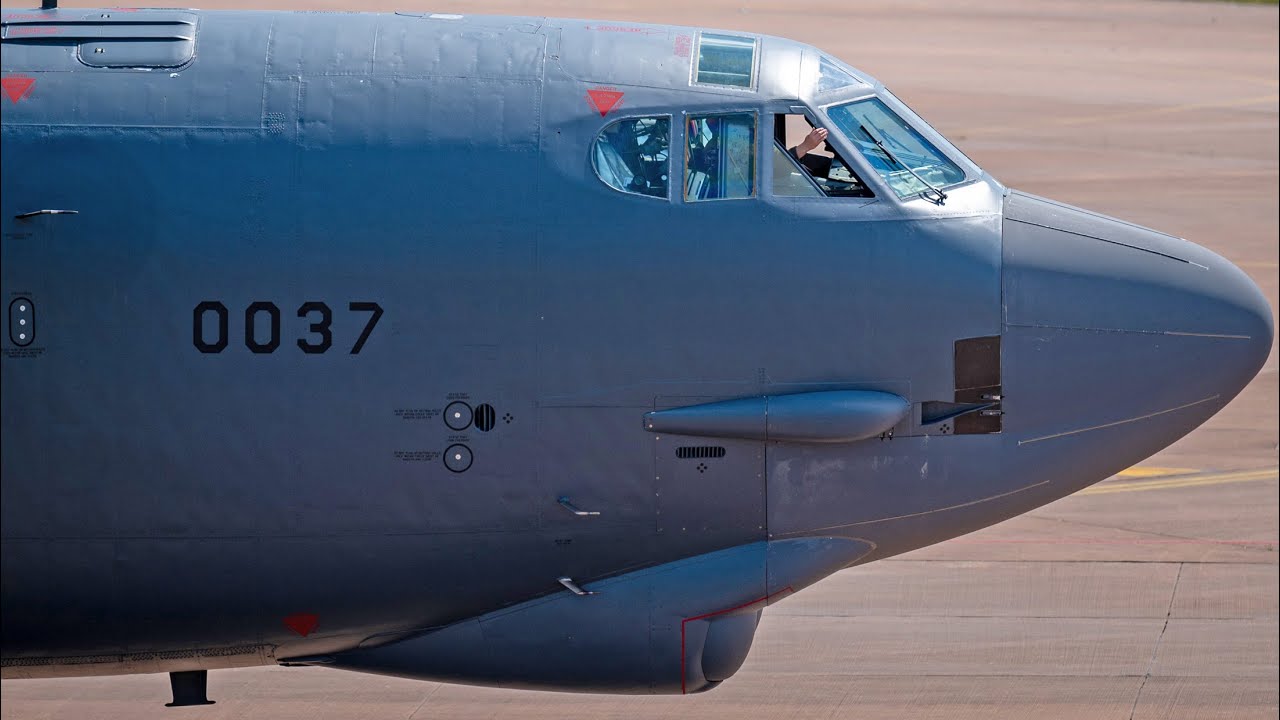
The U.S. Air Force resurrected 2 B-52 Stratofortress bombers from the Boneyard in the Arizona desert. B-52H “Ghost Rider” tail number 61-0007 was resurrected in 2015. It had sat at Davis-Monthan AFB Boneyard for 7 years. B-52H “Wise Guy” tail number 60-0034 was resurrected in 2016. It had sat at the Boneyard for 8 years since 2008. The Wise Guy resurrection was triggered by a 2016 B-52 crash at Andersen AFB in Guam. The crash dropped the operational B-52 fleet below the Congressional 76-aircraft threshold. The U.S. has not built a new B-52 since the early 1960s.
The B-52 Bombers That Came Back From the Dead: How “Ghost Rider” and “Wise Guy” Escaped the Boneyard
A B-52H Stratofortress assigned to the 5th Bomb Wing, prepares to take-off at Minot Air Force Base North Dakota, July 14, 2021. Strategic bomber missions enhance the readiness and training necessary to respond to any potential crisis or challenge across the globe. (U.S. Air Force photo by Senior Airman Jesse Jenny)
The United States is nearing a $1.5 trillion defense budget at a time when its national debt is nearing $40 trillion, and most Americans are struggling to pay for their cars and put food on the table. Despite this reality, the government keeps spending gobs of tax dollars on the military. Yet, few in power are asking if we’re getting bang for our buck.
After all, we’re told this money will go toward readiness and ensuring we have the best equipment available for when the next great war (coming soon) starts.
So why are we having to rely on ancient bombers brought out of mothballs at Davis-Monthan Air Force Base in Tucson, Ariz., the so-called “Boneyard”? Given the amount of money we’re spending on the military, how is it that we don’t have the most advanced platforms ready to fight in large numbers?
The story of the B-52H Stratofortress long-range strategic bomber known as “Ghost Rider” and its sister plane, “Wise Guy,” represents one of the most remarkable aircraft resurrection programs in US Air Force history. These were not museum restorations. They were combat bombers literally plucked from their slumber in the Air Force’s desert “boneyard,” and returned to operational nuclear service decades after they were built.

A U.S. Airman guides a B-52 Stratofortress into to its parking position at Morón Air Base, Spain, May 20, 2025. The 496th Air Base Squadron provided coordinated support across airfield operations, refueling, lodging, and security to ensure mission readiness. (U.S. Air Force photo by Cristina Oliveira)
A Legendary Airframe
The fact that the Air Force could do this at all speaks volumes about the legendary durability of the Boeing B-52 Stratofortress.
It also, sadly, highlights just how much–and how long–of a crisis America’s bomber fleet has been in. Because the restoration of these birds did not result from the disastrous Iran War.
Instead, they occurred well before that conflict erupted, when the United States was in a state of relative peace.
America put its Boneyard in the desert because the climate there is conducive to preserving planes. The desert’s lack of humidity prevents corrosion on the planes. Even so, restoring a bomber after sitting idle for anywhere between seven and ten years is almost unheard of. The B-52 fleet is unique because many of the airframes have long structural lives remaining. The jet engines are antiques by today’s standards.
But the airframes endure.
Usually, aircraft sent to the Boneyard that is managed by the Air Force’s 309th Aerospace Maintenance and Regeneration Group (AMARG) are stripped for spare parts and never fly again.
That was not the case, though, for the B-52Hs known as “Ghost Rider” and “Wise Guy,” respectively.

A B-52H Stratofortress taxis down the runway at Minot Air Force Base, N.D., Sept. 16, 2021. The bomber is capable of flying at high subsonic speeds at altitudes up to 50,000 feet. (U.S. Air Force photo by Airman 1st Class Zachary Wright)

A U.S. Air Force B-52 Stratofortress departs after being refueled by KC-135 Stratotanker over the Pacific Northwest July 18, 2024. The 92nd Air Refueling Wing and 141st ARW’s ability to rapidly generate airpower at a moment’s notice was put to the test when Air Mobility Command’s Inspector General team conducted a no-notice Nuclear Operational Readiness Inspection, July 16–18, 2024. During the NORI, Airmen demonstrated how various capabilities at Fairchild AFB enable units to generate and provide, when directed, specially trained and equipped KC-135 Stratotanker aircrews to conduct critical air refueling of U.S. Strategic Command-assigned strategic bomber and command and control aircraft. (U.S. Air Force photo by Staff Sgt. Lawrence Sena)
Why the Air Force Resurrected “Ghost Rider”
The first resurrection was of “Ghost Rider,” tail number 61-0007.
This iconic bird was resuscitated in 2015 after another B-52 was heavily damaged in an accident. “Ghost Rider” spent seven years sitting in the Arizona desert before maintainers at Davis-Monthan Air Force Base regenerated it for active service.
In fact, the regeneration of “Ghost Rider” became a proof of concept demonstrating that the Air Force could effectively “grow” another strategic bomber from storage rather than wait years for a replacement aircraft that did not yet exist.
As an aside, let us remember that the United States has not built a new B-52 since the early 1960s.
“Wise Guy” Came Back Because the Fleet Was Shrinking
Next came the restoration of “Wise Guy” a year later. That process was even more dramatic. “Wise Guy,” with the tail number 60-0034, had sat in mothballs since 2008. Eight years later, in 2016, a B-52 crashed during takeoff at Andersen Air Force Base in Guam. The crew survived, but the bomber was destroyed. This loss brought the operational B-52 fleet below the congressionally mandated 76-aircraft threshold.
So the Air Force decided to do something almost nobody thought possible again: rebirth another dead bomber.
Much to their credit, the Air Force succeeded in this second, even more extraordinary effort than the first (because of the age of “Wise Guy”).
The Resurrection Process
Bringing these legendary bombers back to life was not an easy process. It was not a simple matter of changing some batteries, updating some controls, adding new fuel, and repainting the Cold War-era planes. The process was a total overhaul.
“Wise Guy,” for instance, had cracked landing gear structures, missing engines, degraded fuel systems, worn hoses, damaged egress systems, and extensive age-related problems after years of sitting in desert storage.
To bring the plane up to fighting standards, maintainers had to replace fuel cells and lines, rebuild landing gear components, install new engines, repair wiring, inspect areas prone to structural fatigue, restore emergency bailout systems, and conduct extensive functional flight checks.
This was not just a process isolated to the 309th at Monthan-Davis AFB. It required close, long-term coordination with other elements in the Air Force, such as Barksdale AFB in Louisiana (where the B-52 has a hub) and Tinker AFB. The Air Force Life Cycle Management Center and Defense Logistics Agency supported the process. Then, personnel from the reserve and the active-duty maintainer teams had to be assembled and deployed for the process.
Oh, and thousands of components had to be sourced or rebuilt to complete the process.
A Flying Battleship
America’s B-52 Stratofortress continues proving that it is the greatest bomber the US has ever built. It deserves that title because it is insanely durable. This craft can also carry massive payloads over long distances. What’s more, as evidenced by the regeneration of the two B-52Hs in question, this bird is easy to modernize internally.
Generally, the B-52 is expected to remain operational into the 2050s, making it the oldest bomber in the world (it first took to the skies during the administration of President Harry S. Truman).
“Ghost Rider” and “Wise Guy” Became Symbols
By 2021, the only two B-52s ever to be regenerated from the Boneyard were parked together during maintenance at Tinker AFB. Aviation outlets treated the sight as if they were seeing ghosts standing side by side. But these weren’t ghosts.
They were symbols. Signs that the B-52 was one of the most durable systems ever built. Symptoms, sadly, of a defense industrial base that was so unreliable that US force planners had to reconstitute systems that were so old they had been written off until they were absolutely needed. And this rehabilitation did not occur during a major conflict. It occurred during relative peacetime. What that means is that the defense industrial base could not handle peacetime load, forcing the military to revive ancient B-52s long in mothballs.
Now imagine what happens during a high-intensity great-power conflict. Think about trying to replace lost planes that are not as durable as the B-52. Yes, the maintainers at Monthan-Davis AFB should be proud of the incredible technical skill they demonstrated bringing “Ghost Rider” and “Wise Guy” back to life.
But we should all be worried that the military is totally unprepared for the kind of fight they’re about to enter.
Clearly, $1.5 trillion doesn’t buy what it used to.
About the Author: Brandon J. Weichert
Brandon J. Weichert is the Senior National Security Editor at 19FortyFive.com. Recently, Weichert became the editor of the “NatSec Guy” section at Emerald. TV. He was previously the senior national security editor at The National Interest. Weichert hosts The National Security Hour on iHeartRadio, where he discusses national security policy every Wednesday at 8 p.m. Eastern. He hosts a companion show on Rumble entitled “National Security Talk.” Weichert consults regularly with various government institutions and private organizations on geopolitical issues. His writings have appeared in numerous publications, among them Popular Mechanics, National Review, MSN, and The American Spectator. And his books include Winning Space: How America Remains a Superpower, Biohacked: China’s Race to Control Life, and The Shadow War: Iran’s Quest for Supremacy. Weichert’s newest book, A Disaster of Our Own Making: How the West Lost Ukraine, is available for purchase at any bookstore. Follow him via Twitter/X @WeTheBrandon.


