

The U.S. military still fields some of the most advanced weapons systems in the world. But across multiple services, and especially the U.S. Army, major procurement programs are increasingly running into the same problem: new platforms take years to develop, cost far more than expected, and often arrive with compromises that force the Pentagon to rethink them before they even reach full production.
The U.S. Army’s cancellation of the M10 Booker combat vehicle in 2025 is the latest example of that pattern. The program was originally intended to provide infantry units with a highly mobile armored support vehicle, but the final design evolved into a heavier platform that no longer met some of its key deployment requirements.
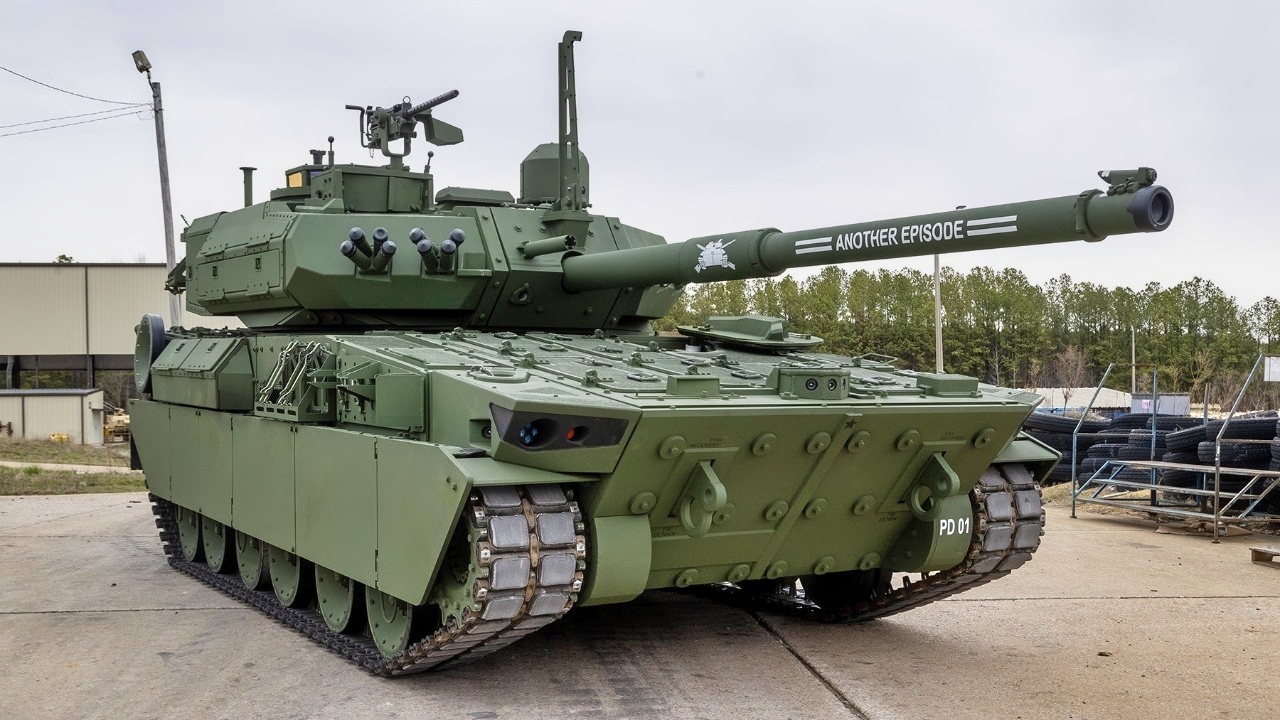
PD1 – Delivery of First Production Vehicle M10 Booker Combat Vehicle. Image Credit: U.S. Army.

The M10 Booker Combat Vehicle proudly displays its namesake on the gun tube during the Army Birthday Festival at the National Museum of the U.S. Army, June 10, 2023. The M10 Booker Combat Vehicle is named after two American service members: Pvt. Robert D. Booker, who posthumously received the Medal of Honor for actions in World War II, and Staff Sgt. Stevon A. Booker, who posthumously received the Distinguished Service Cross for actions during Operation Iraqi Freedom. Their stories and actions articulate the Army’s need for the M10 Booker Combat Vehicle, an infantry assault vehicle that will provide protection and lethality to destroy threats like the ones that took the lives of these two Soldiers. (U.S. Army photo by Bernardo Fuller)

M10 Booker. Image Credit: Creative Commons.
At the same time, the Army has also abandoned a major upgrade plan for its M1 Abrams tank, choosing instead to pursue a completely redesigned version called the M1E3.
The decisions we keep seeing reflect a deep challenge facing the Pentagon: the traditional way the U.S. develops military platforms may no longer match the pace and nature of modern warfare.
The M10 Booker and the Limits of Modern Armor
The M10 Booker program was originally conceived as part of the Army’s Mobile Protected Firepower initiative, designed to give infantry units a lighter armored vehicle capable of supporting troops in environments where heavier tanks might struggle to deploy.
However, the vehicle gradually drifted away from its original concept. By the time it entered production, the system had become significantly heavier than planned and was no longer easily deployable in some of the rapid-response roles envisioned during its early development.
In June 2025, the Army confirmed it would cease procurement of the M10 Booker and cancel plans for full-rate production, despite having already produced several vehicles during low-rate initial production. The program had already cost roughly $1 billion in development and production spending, underscoring the financial stakes involved when major weapons programs fail to meet expectations.
The decision to terminate the vehicle was the result of a reassessment of how armored forces should evolve at a time when drones and networked sensors become an increasingly normal part of combat.
Even the M1 Abrams Had Its Limits
The challenges facing the Booker program mirror issues that have emerged with the U.S. Army’s main battle tank. For years, the Army planned to field the M1A2 SEPv4, the latest modernization package for the M1 Abrams tank. The upgrade was intended to introduce new sensors, networking systems, and improved targeting capabilities.
But the SEPv4 upgrade was ultimately canceled in 2023, with Army officials deciding instead to invest in a more fundamental redesign of the platform known as the M1E3 Abrams.
The reason was straightforward: additional upgrades were pushing the tank’s weight and complexity to levels that raised concerns about mobility and future battlefield survivability.
Rather than continuing to add systems to a platform first introduced in the early 1980s, the Army chose to begin work on a lighter and more modular design that could incorporate modern electronics and digital architecture from the start.
The M1E3 program is expected to reach major testing milestones later this decade, with early prototypes already under development as the Army attempts to redesign its core armored platform for future conflicts.
Incremental upgrades, it seems, are no longer the Pentagon’s preferred solution for some crucial assets.
A Smaller Defense Industrial Base
Another factor complicating U.S. weapons development is the structure of the defense industrial base itself. During the Cold War, the United States maintained multiple competing manufacturers for major categories of military equipment. Over the past three decades, consolidation has left only a handful of prime contractors responsible for producing tanks, ships, aircraft, and key subsystems.
The story of the M10 Booker proves just how concentrated the industry has become. The vehicle was produced by General Dynamics Land Systems, with components manufactured across multiple facility before final assembly at the Army’s Anniston Army Depot. And with fewer companies competing to build major weapons systems, the Pentagon doesn’t have a large number of alternatives when programs encounter problems or delays.
At the same time, modern military hardware is increasingly dependent on commercial electronics and software components that evolve much faster than traditional defense acquisition cycles. So, by the time some systems enter production, parts of their technology “stack” may already be outdated compared to the civilian sector.
Modern Warfare Is Moving Faster Than Procurement
Perhaps the biggest challenge facing the Pentagon is that warfare itself is evolving faster than the acquisition system designed to supply it. Recent conflicts have demonstrated how rapidly technologies such as drones, electronic warfare, and long-range precision weapons can reshape the battlefield. In many cases, inexpensive systems have proven capable of threatening or destroying far more expensive platforms.
That reality is pushing U.S. military planners to reconsider how future forces should be structured. Instead of relying exclusively on large, highly complex platforms that take decades to develop, the Pentagon is increasingly exploring the use of cheaper, “attritable” systems that can be produced quickly and fielded in large numbers.
Programs like the M1E3 Abrams suggest the U.S. military is still committed to maintaining advanced heavy platforms. But the cancellation of the M10 Booker highlights the growing tension between traditional procurement models and the demands of modern warfare.
For the Pentagon, the challenge is not only building these advanced weapons, but doign so fast enough – and ensuring they remain relevant on a battlefield that is constantly changing, and at speeds never seen before.
About the Author: Jack Buckby
Jack Buckby is a British researcher and analyst specialising in defence and national security, based in New York. His work focuses on military capability, procurement, and strategic competition, producing and editing analysis for policy and defence audiences. He brings extensive editorial experience, with a career output spanning over 1,000 articles at 19FortyFive and National Security Journal, and has previously authored books and papers on extremism and deradicalisation.


