

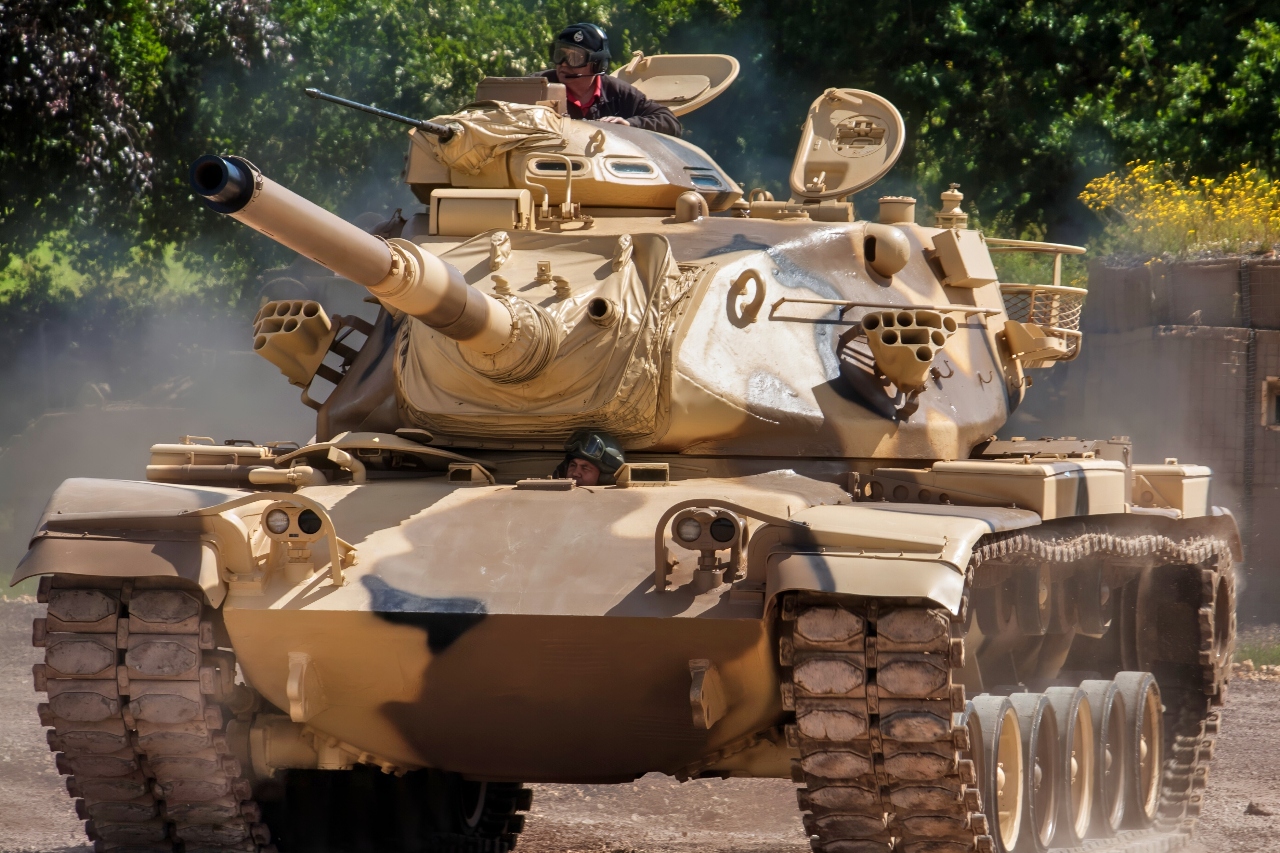
In the grand arsenal of American military power, some weapons capture the imagination—the sleek lines of a fighter jet, the silent menace of a nuclear submarine. Others simply do the hard work. For more than three decades, the M60 Patton main battle tank was the latter. It was neither glamorous nor revolutionary. It was a brawler; a 50-ton beast of steel and diesel fumes that stood as the backbone of U.S. armored forces, holding the line from the Fulda Gap to the Middle East.
Meet the M60 Tank
To understand the M60, you have to understand the fear that created it.
In the late 1950s, U.S. intelligence realized with growing alarm that our frontline M48 Patton tank was dangerously outmatched by the new Soviet T-54/55, a machine being produced in terrifying numbers. The T-54’s 100mm gun could tear through the M48’s armor, while our 90mm cannon would struggle in return.
Take it from me, as I have done a lot of wargaming in various tank battles: when your main battle tank can’t win a one-on-one fight, you don’t have a strategy; you have a catastrophe waiting to happen.
What Made the M60 A Legend
The M60 was the answer, born of necessity and rushed into service in 1960.
It was an evolutionary, not revolutionary, design, but it featured two critical upgrades.
First was the main armament: the now-legendary British Royal Ordnance L7 105mm gun, a weapon so effective it became the NATO standard for decades. Second was the Continental V-12 air-cooled diesel engine, which gave the tank the range and reliability needed to fight a sustained war in Europe.
This was a machine built for one purpose: to kill Soviet tanks in large numbers.
It Could Adapt
Like any workhorse, the M60 was constantly adapted for new tasks.
The initial design, with its rounded M48-style turret, soon gave way to the M60A1 in 1962, featuring a new “needlenose” turret with superior ballistic protection. T
his became the iconic variant. The most ambitious, and ultimately failed, version was the M60A2, cynically nicknamed the “Starship” by its crews. It boasted a 152mm gun/launcher that could fire conventional rounds or a Shillelagh anti-tank missile. It was a technological marvel on paper, but a maintenance nightmare in the field, and was quickly retired.
The M60A3 Was a Powerhouse
The final and most advanced U.S. version was the M60A3. Introduced in the late 1970s, it was a testament to how a solid, older design could be upgraded with modern technology. The A3 incorporated a laser rangefinder, a solid-state ballistic computer, and, most importantly, a Tank Thermal Sight (TTS).
For the first time, an American tank crew could see and kill targets in total darkness or through smoke and haze as effectively as they could in broad daylight—a capability that would prove decisive.
Going to War
While the M60 never saw combat in Vietnam, its trial by fire came during the 1973 Yom Kippur War. In the hands of Israeli crews, the M60 proved deadly, particularly on the Golan Heights where it helped smash the Syrian armored assault. But the war also exposed its flaws.
Its tall profile made it an easy target for Egyptian anti-tank missiles along the Suez Canal, and its hydraulic fluid had a nasty habit of igniting when the armor was penetrated.
Operation Desert Storm
The M60’s final, and perhaps most impressive, act in U.S. service came during Operation Desert Storm in 1991. While the world was captivated by the new M1 Abrams, the U.S. Marine Corps charged into Kuwait with their heavily upgraded M60A1s, fitted with explosive reactive armor (ERA) tiles.
In the largest tank battle in Marine Corps history, these old Cold War warriors devastated Iraqi armored divisions, destroying hundreds of Soviet-made T-55s, T-62s, and even the more modern T-72s. They proved that a well-trained crew in a solid, upgraded tank could still dominate the battlefield.
Ultimately, the M60 was a product of its time. Its all-steel armor could not compete with the advanced composite materials of the M1 Abrams, and its design had reached the limits of its potential. It was phased out of U.S. service in the 1990s.
The M60 Fights On
Yet, the story wasn’t over. Thousands were sold to allies, and many, heavily upgraded, continue to serve to this day. The M60 was never the most advanced tank of its era, but for a generation, it was the tank America and its allies counted on. It was the workhorse that held the line.
More About Harry Kazianis
Harry J. Kazianis (@Grecianformula) is Editor-In-Chief and President of National Security Journal. He was the former Senior Director of National Security Affairs at the Center for the National Interest (CFTNI), a foreign policy think tank founded by Richard Nixon based in Washington, DC. Harry has over a decade of experience in think tanks and national security publishing. His ideas have been published in the NY Times, The Washington Post, The Wall Street Journal, CNN, and many other outlets worldwide. He has held positions at CSIS, the Heritage Foundation, the University of Nottingham, and several other institutions related to national security research and studies. He holds a Master’s degree focusing on international affairs from Harvard University.
Military Affairs
China’s Stealth Air Force Has 1 Mission


