

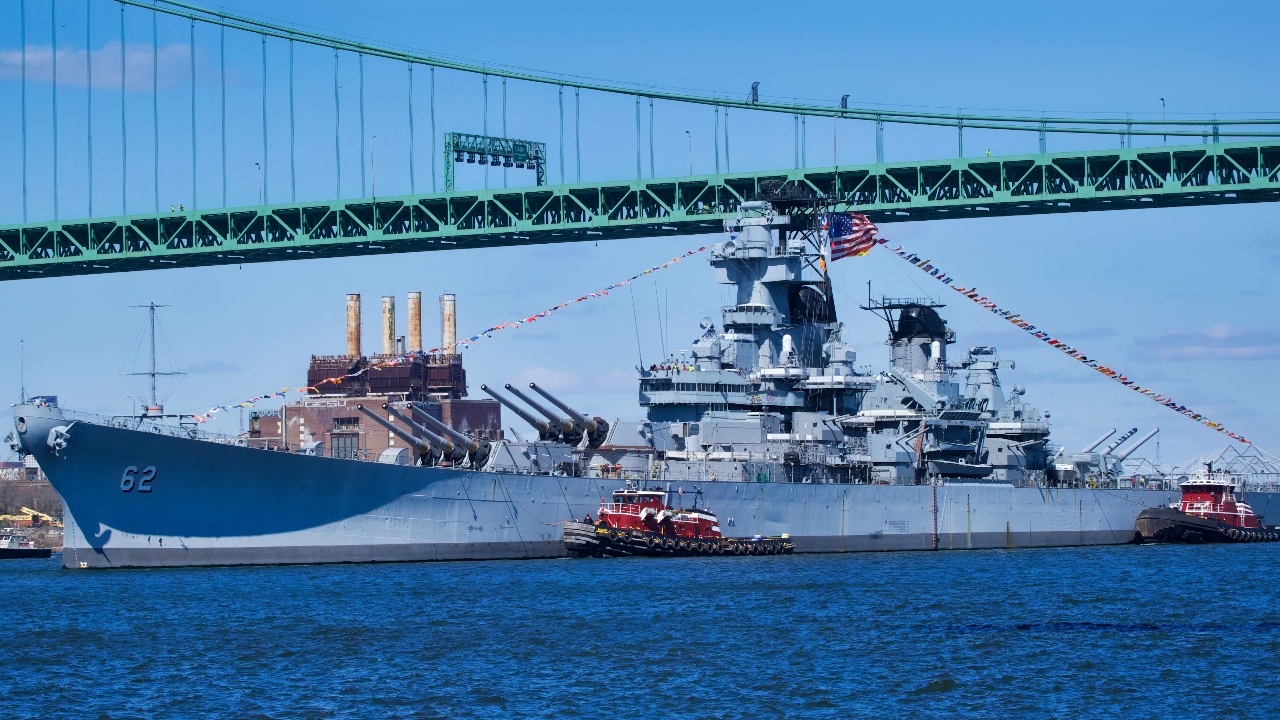
Key Points and Summary – The iconic Iowa-class battleships came closer to being nuclear-armed platforms than many realize.
During the Cold War, the US Navy developed the Mk-23 “Katie,” a 16-inch nuclear artillery shell, specifically for these warships.
There were also cruise missile options.
Nuclear-Amed Iowa-Class Battleships?
During the Second World War, the big Iowa-Class battleships provided outstanding naval gunfire to support amphibious landings; however, their limited range was surpassed by aircraft carriers in naval battles.
In the 1950s, the US Navy explored equipping these battleships with nuclear artillery shells, such as the “Katie” (Mk 23).
Additionally, a cruise missile option was also possible.
The old battlewagons nearly got an upgrade that would have placed them in the nuclear age.
Nuclear Artillery Shells (Mk-23 “Katie”)
The US Navy developed the Mk-23 “Katie” 16-inch nuclear artillery shell, with a yield comparable to the Hiroshima bomb, for use on the Iowa-class battleships.
The US produced 50 of the ‘Katie’ nuclear shells. Storage and launch modifications were considered, but the project was ultimately shelved due to the rise of aircraft carriers and long-range bombers. The Air Force, still in its early years, was very protective of what it considered its turf.
While the Navy never confirmed or denied the deployment of these shells, some modifications were made to the battleships for their potential use. By 1962, all Mk-23 nuclear 16-inch shells were withdrawn without (obviously) being fired in combat.
However, the Navy fired only one of the training shells in a peaceful demonstration, and then sent the rest to the National Atomic Museum in Albuquerque, New Mexico.
Regulus II Cruise Missiles and Iowa-Class
There was also another way to get battleships with nuclear weapons, use a cruise missile platform to make it happen.
In June 1953, Vought was selected by the Navy to develop the Regulus II, a supersonic successor to the subsonic Regulus ship-launched cruise missile.
The Regulus II would address the first-generation missile’s drawbacks by featuring autonomous inertial navigation, an extended range, and a supersonic dash capability against air defenses.
However, due to the development of the Polaris missile, the Regulus II project was canceled after only two years.
About the Author: Steve Balestrieri
Steve Balestrieri is a National Security Columnist. He served as a US Army Special Forces NCO and Warrant Officer. In addition to writing on defense, he covers the NFL for PatsFans.com and is a member of the Pro Football Writers of America (PFWA). His work was regularly featured in many military publications.
Russia’s Bomber Forces
Tu-22M3: The Bomber Ukraine Hit With Drones


