

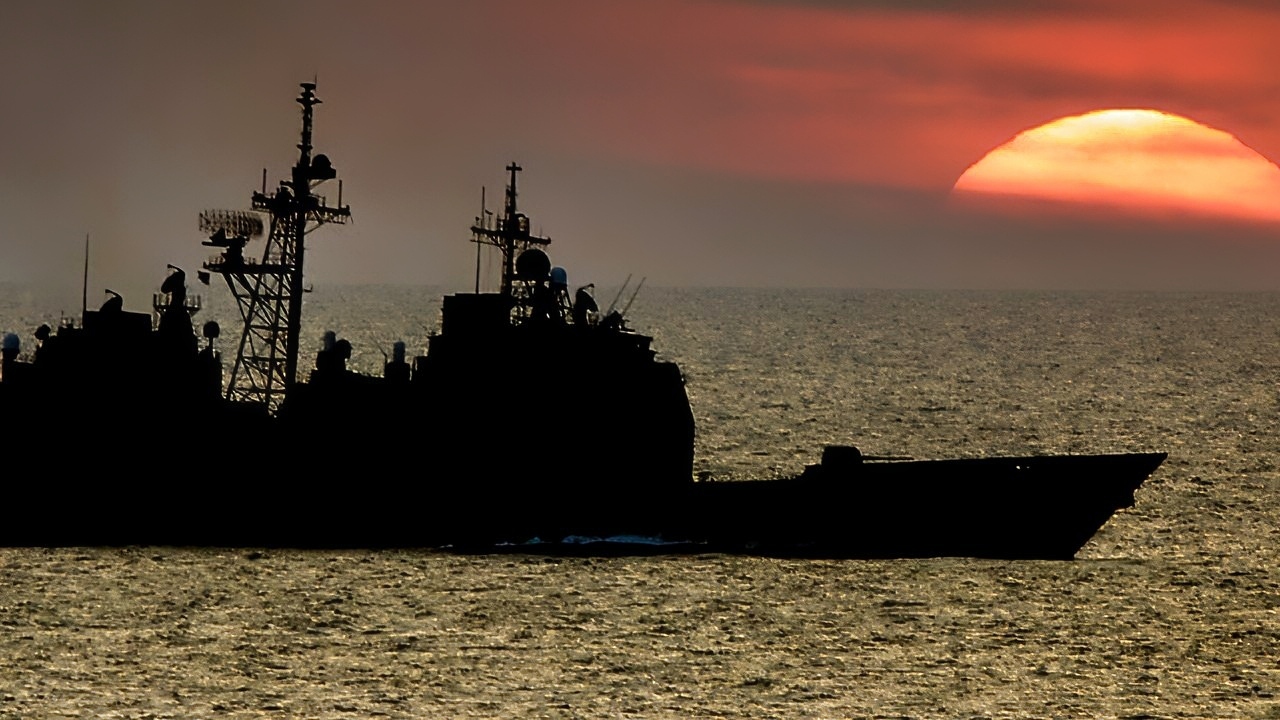
Key Points and Summary – The U.S. Navy is rapidly retiring its powerful Ticonderoga-class cruisers, sparking a debate over fleet size in the face of a rising China.
-However, the program intended to keep these ships in service has been a disastrous failure. A scathing 2024 GAO report revealed the Navy spent nearly $4 billion on modernization, “wasting” an incredible $1.84 billion on four cruisers that were fully upgraded and then retired without ever returning to sea.
-This costly debacle, which will see only three cruisers complete the process, serves as a stark lesson in military mismanagement.
Ticonderoga Class-Cruisers: Mistakes In Modernization Personified
The U.S. Navy’s Ticonderoga-class ships were initially planned as a class of destroyers. But the increased combat capability offered by the Aegis Combat System and the passive phased-array AN/SPY-1 radar, and the class’s ability to operate as flagships, justified a change in classification from DDG (guided-missile destroyer) to CG (guided-missile cruiser) shortly before the keels were laid down for the USS Ticonderoga and Yorktown.
The Navy built 27 of these multi-role cruisers. They can fire Tomahawk cruise missiles, RUM-139 anti-submarine rockets, and anti-ballistic missiles. The Ticonderoga class was designed to sail as a member of a carrier strike group or an Amphibious Ready Group (ARG), and the ships can perform interdiction and escort missions.
The Ticonderoga-class cruisers are being retired quickly, and that is troublesome for the Navy.
Background of the Ticonderoga-class Cruisers
According to U.S. Navy doctrine, guided-missile cruisers primarily operate in a Battle Force role. They are capable of carrying out many missions, including air warfare, undersea warfare, naval surface fire support, and surface warfare operations. They act as surface combatants to support carriers or amphibious forces, or they operate independently as flagships of SAGs.
Cruisers are equipped with Tomahawk cruise missiles, giving them additional long-range strike warfare capability. Some Aegis cruisers have been outfitted with a ballistic missile defense capability.
Over the next several years, several Ticonderoga-class cruisers will undergo a structured modernization to ensure they reach their projected 35-year service life.
The Cruiser Modernization program aimed to enhance the Ticonderoga class by modernizing the computing and display infrastructure, as well as the Hull, Mechanical, and Electrical (HM&E) systems.
Weapons and sensors will also be enhanced to improve their anti-submarine capabilities, including the addition of short-range electro-optical systems that can monitor the ship’s surroundings without emitting radar.
Routine machinery upgrades will improve all ship functions. The modernized cruisers are expected to become more cost-efficient to operate.
Did The Navy Move To Retire the Ticonderoga-Class Too Soon?
The Navy plans to retire the entire Ticonderoga-class by the end of the decade to make room for the incoming Flight III Arleigh Burke-class destroyers.
However, some members of Congress are pushing to keep the cruisers in service longer, arguing that the ships bring firepower, radar, and significant capabilities to the Navy’s surface fleet. Of the 27 ships in the class, 14 are already retired.
It makes sense that the Navy wants to bring in the modern Arleigh Burke cruisers into service as quickly as possible. However, Congress is also right that the Navy should keep as much firepower as possible.
Modernizing and maintaining these high-powered warships makes sense in a threat environment in which China now operates a larger navy than the U.S.
Quality matters as much, if not more, than quantity; yet, the Ticonderoga-class cruisers bring substantial additional firepower, surface warfare versatility, and anti-submarine capabilities to the fleet.
For these reasons, it might seem to make sense to revamp a number of the warships and keep them in service. However, this is the era of tight budgets, and there is only so much funding to allocate to all programs. The Navy has contracted for 10 DDG-51 Flight III destroyers to arrive at an accelerated pace in the coming years.
Failures of the Cruiser Modernization Program:
In December 2024, the U.S. Government Accountability Office (GAO) published a scathing report stating that the Navy spent nearly $4 billion modernizing seven of its aging Ticonderogas over the past decade.
Nearly half of that money, $1.84 billion, was “wasted” on modernizing four cruisers that never returned to sea and were subsequently retired by the Navy.
In late August and early September 2024, the Navy decommissioned three Ticonderoga-class cruisers. The USS Cowpens left service on Aug. 28 after 33 years of service, followed by the USS Leyte Gulf and USS Antietam on Sept. 20 and Sept. 27, respectively, each after operating for 37 years.
Three Modernized Cruisers Complete The Process
But only three of the large surface combatants will complete the modernization process. In a Nov. 4, 2024 release, it was announced that the Department of the Navy planned to operate the USS Gettysburg, USS Chosin, and USS Cape St George beyond their expected service life, adding a cumulative decade to their previous out-of-service date.
All three cruisers have received HM&E and combat system upgrades. The Gettysburg and Chosin completed their modernization in FY 2023 and FY 2024, respectively, while Cape St George was on schedule to complete the process in FY 2024.
In 2 Words: Total Waste
Former U.S. Navy Secretary Carlos Del Toro said, “After learning hard lessons from the cruiser modernisation program, we are only extending ships that have completed modernization and have the material readiness needed to continue advancing our … mission.”
The GAO, in its report, identified numerous issues with how the Navy conducted the modernization effort. It serves as an example of how not to conduct an operation of this kind. Hopefully, the Navy will learn from it.
About the Author: Steve Balestrieri
Steve Balestrieri is a National Security Columnist. He served as a US Army Special Forces NCO and Warrant Officer. In addition to writing on defense, he covers the NFL for PatsFans.com and is a member of the Pro Football Writers of America (PFWA). His work was regularly featured in many military publications
Military Affairs
China’s Stealth Air Force Has 1 Mission


