

The Zumwalt-Class: The Navy’s Failed 21st Century Battleship?
Key Points and Summary
-The Zumwalt-class destroyer, once envisioned as the revolutionary backbone of the U.S. Navy’s future fleet, became a case study in military procurement failure.
-Conceived as a stealthy, technologically advanced warship, the program was crippled by staggering cost overruns, with the price per ship ballooning to over $7.5 billion.
-Its futuristic Advanced Gun System was rendered useless when the cost of a single precision-guided shell soared to nearly $1 million.

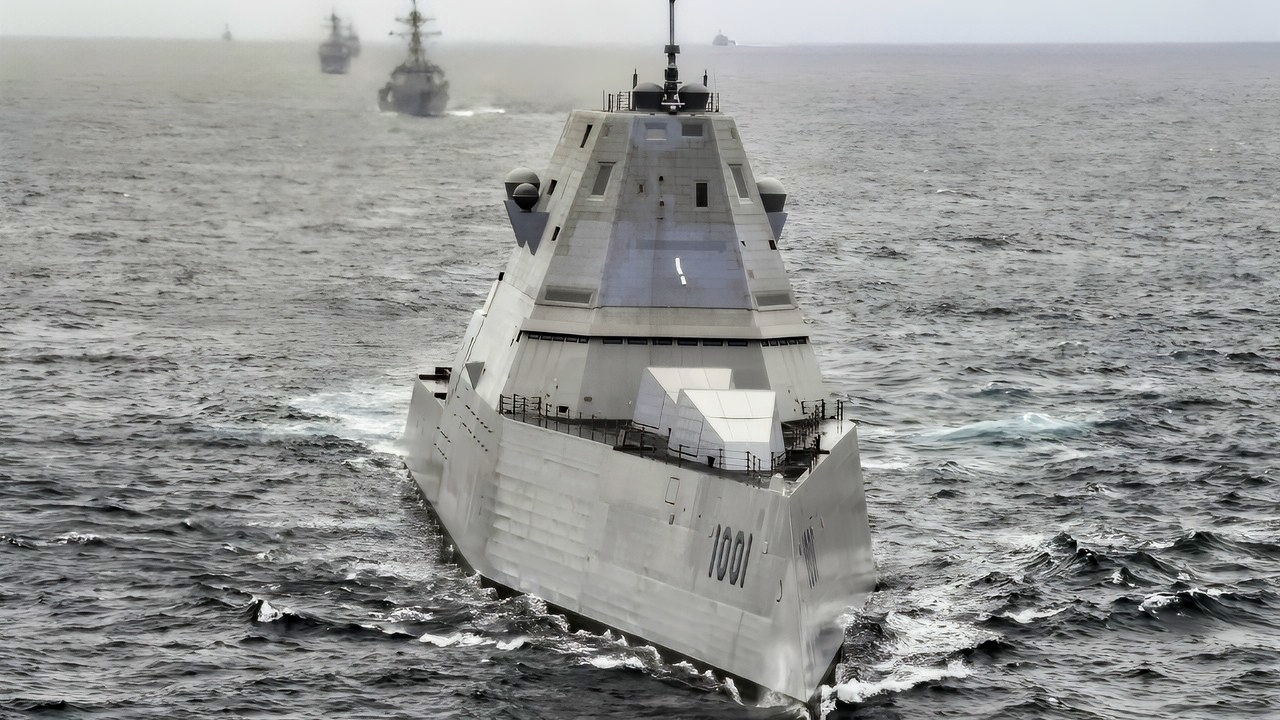
Zumwalt-class Guided Missile Destroyer USS Michael Monsoor (DDG 1001) transits the Pacific Ocean, June 25, 2022. Twenty-six nations, 38 ships, four submarines, more than 170 aircraft and 25,000 personnel are participating in RIMPAC from June 29 to Aug 4 in and around Hawaiian Islands and Southern California. The world’s largest international maritime exercise, RIMPAC provides a unique training opportunity while fostering and sustaining cooperative relationships among participants critical to ensuring the safety of sea lanes and security on the world’s oceans. RIMPAC 2022 is the 28th exercise in the series that began in 1971.
-The planned fleet of 32 ships was slashed to just three, which are now being repurposed as testbeds for hypersonic missiles.
-Some experts argue that the Zumwalt reminds them of the Iowa-class battleships built during late World War II: nice to have, but not truly needed.
The Zumwalt-Class: The Stealth Destroyer Idea
The Zumwalt-class destroyer stands as one of the most ambitious and technologically advanced naval projects ever undertaken by the United States.
Conceived during the post-Cold War era, the program aimed to revolutionize surface warfare by introducing a stealthy, multi-mission destroyer capable of dominating littoral and open-ocean environments.
Named after Admiral Elmo Zumwalt, a reform-minded Chief of Naval Operations, the class was envisioned as a cornerstone of the Navy’s 21st-century fleet.
However, only three ships were ultimately built out of the planned thirty-two.
What exactly happened with the project? Why was the Zumwalt ultimately canned despite its innovative design?
The project was ultimately shelved due to its high cost, technical difficulties, and shifting strategic priorities.

(July 28, 2022) U.S. Navy Zumwalt-class guided-missile destroyer USS Michael Monsoor (DDG 1001) sails in formation during Rim of the Pacific (RIMPAC) 2022, July 28. Twenty-six nations, 38 ships, three submarines, more than 30 unmanned systems, approximately 170 aircraft and 25,000 personnel are participating in RIMPAC from June 29 to Aug. 4 in and around the Hawaiian Islands and Southern California. The world’s largest international maritime exercise, RIMPAC provides a unique training opportunity while fostering and sustaining cooperative relationships among participants critical to ensuring the safety of sea lanes and security on the world’s oceans. RIMPAC 2022 is the 28th exercise in the series that began in 1971. (U.S. Navy photo by Mass Communication Specialist 3rd Class Aleksandr Freutel)
The Troubled Development History of the Zumwalt-Class
The Zumwalt-class originated from the DD-21 program, later renamed DD(X), which was part of the Surface Combatant for the 21st Century (SC21) initiative.
This initiative sought to modernize the Navy’s surface fleet in response to evolving global threats and technological opportunities.
The Navy envisioned the Zumwalt-class as a replacement for aging frigates and destroyers, with capabilities tailored to support Marine strike forces, conduct littoral warfare, and provide naval gunfire support, a role traditionally filled by battleships.
The ships were designed to operate close to shore, delivering precision strikes and supporting ground forces with advanced firepower and sensor systems.
Early on in the program, the ship’s cost was already starting to cause problems.
Initially, the Navy had intended to build 32 of these destroyers, but this number was gradually reduced to seven due to budget constraints.
In 2008, the Navy notified Congress that it wanted to procure more Arleigh Burke-class destroyers and stated that it no longer needed the DD(X) next-generation destroyer.
This did not fly too well with Congress, which questioned why the Navy had even bothered with the project in the first place.
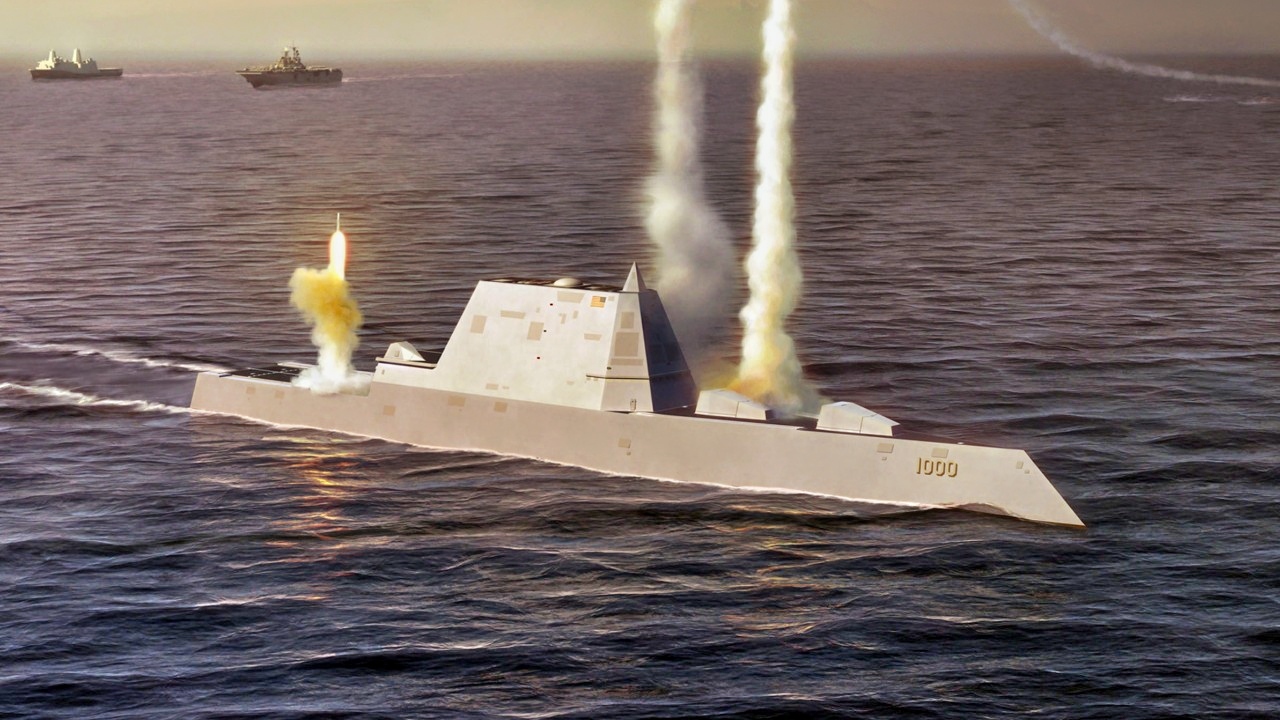
The US Navy’s troubled Zumwalt-class destroyers are being revitalized with the integration of Conventional Prompt Strike (CPS) hypersonic missiles, transforming them into powerful long-range strike platforms. The original class of 32 ships was cut to just three after its Advanced Gun System failed due to exorbitant costs. Now, these stealthy, $8 billion warships are having their defunct guns replaced with vertical launch tubes for hypersonic weapons. This upgrade will dramatically increase their strike range from a mere 63 miles to over 1,700 miles, making the Zumwalts relevant and formidable assets for deterring adversaries like China in the 21st century.
The Navy Finally Pulls the Plug
Once hoped to be the new backbone of the U.S. Navy’s destroyer fleet, the DD(X) program ended with only three ships being produced.
According to reports, the total cost of the procurement was around $22.5 billion, with research and development costs of roughly $7.5 billion per ship.
The first ship of the class, the USS Zumwalt (DDG-1000), was commissioned in 201,6 with the second, the USS Michael Monsoor (DDG-1001), commissioned in 2019.
The third and final ship of the class, the USS Lyndon B. Johnson (DDG-1002), is currently undergoing sea trials and is expected to be commissioned into service sometime in 2027.
The Zumwalt-class destroyer serves as a case study in the challenges of modern naval procurement and shipbuilding.
While its design and capabilities were groundbreaking, the program was ultimately undone by cost, complexity, and strategic shifts.
Only three ships were built, but they continue to serve as valuable platforms for experimentation and modernization.
In the future, when the Navy finally replaces the Arleigh Burke-class, the lessons of the Zumwalt-class will likely inform the development of the next generation of surface ships, hopefully with fewer missteps and greater success.
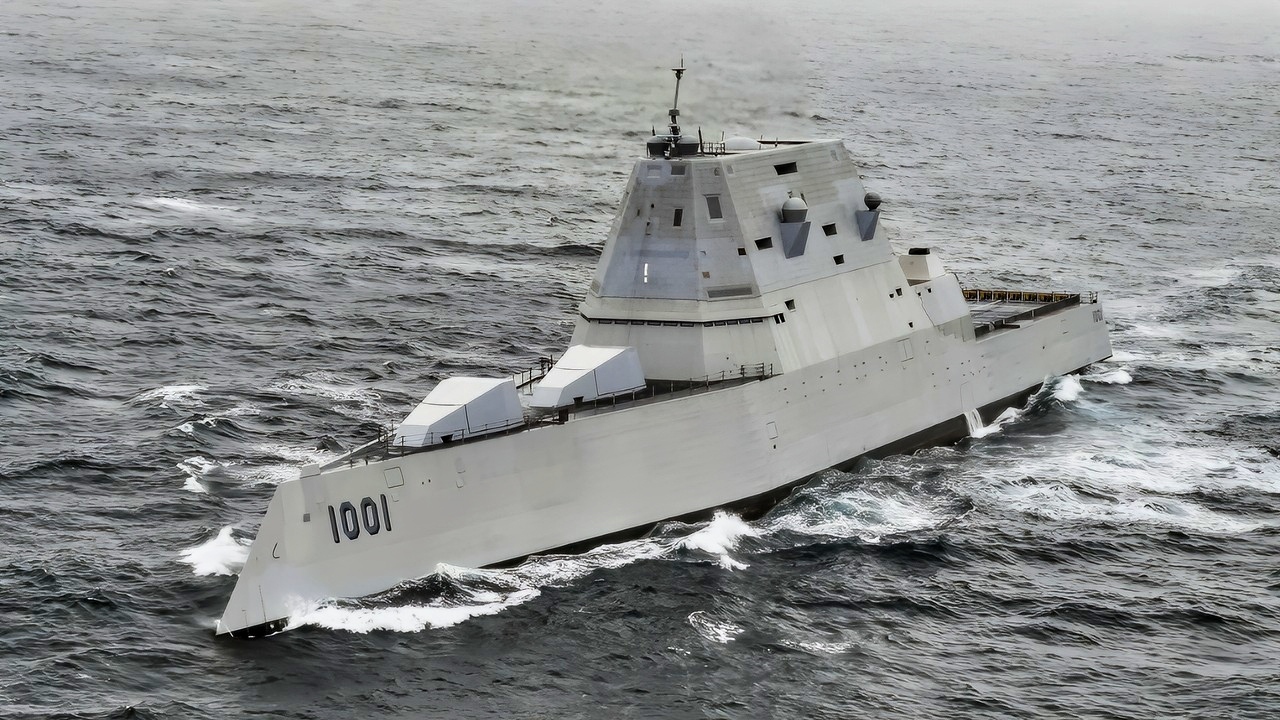
(April 21, 2021) Zumwalt-class guided-missile destroyer USS Michael Monsoor (DDG 1001) participates in U.S. Pacific Fleet’s Unmanned Systems Integrated Battle Problem (UxS IBP) 21, April 21. UxS IBP 21 integrates manned and unmanned capabilities into challenging operational scenarios to generate warfighting advantages. (U.S. Navy photo by Chief Mass Communication Specialist Shannon Renfroe)
The Next-Generation Destroyer
Despite the destroyer’s ultimate end, the ships themselves were remarkably well designed. One of the most striking features of the Zumwalt-class is its wave-piercing tumblehome hull, which slopes inward above the waterline.
This design, although it makes the ship look quite ugly, reduces the ship’s radar cross-section, making it appear as a small fishing vessel on radar despite its massive size.
The hull also contributes to improved seakeeping, allowing the ship to maintain stability in rough seas. The stealth characteristics of the Zumwalt-class were a central selling point, enabling it to approach hostile shores with minimal detection.
Another revolutionary aspect of the Zumwalt-class is its Integrated Power System (IPS). Unlike traditional ships that separate power generation for propulsion and ship systems, the IPS allows electricity generated by gas turbines to be distributed across all ship functions.
This architecture supports future high-energy weapons such as railguns and lasers, and provides an impressive 78 megawatts of power, comparable to a nuclear-powered aircraft carrier.
The IPS not only enhances operational flexibility but also positions the Zumwalt-class as a testbed for next-generation naval technologies.
The ships are equipped with the AN/SPY-3 Multi-Function Radar, capable of conducting air surveillance and tracking over land and sea.
The Total Ship Computing Environment Infrastructure (TSCEI) integrates all ship systems into a unified digital architecture, enhancing automation and reducing crew requirements.
This level of integration was unprecedented and aimed to streamline operations while improving situational awareness and response times.
A Well-Designed Platform that the Navy Didn’t Need
Initially, the Zumwalt-class featured two 155 mm Advanced Gun Systems (AGS), designed to fire Long Range Land Attack Projectiles (LRLAP) with a range of up to 83 nautical miles.
These guns were intended to provide precision fire support for ground forces, replacing the naval gunfire capabilities lost with the retirement of the Iowa-class battleships.
However, the cost of each LRLAP round, estimated at $800,000 to $1 million, rendered the guns impractical.
The Navy eventually canceled LRLAP procurement, leaving the guns functionally inoperable and undermining one of the ship’s core missions.
In addition to the AGS, the Zumwalt-class features 80 Mk 57 Peripheral Vertical Launch System (PVLS) cells, capable of launching Tomahawk missiles, SM-6s, Evolved SeaSparrow Missiles, and anti-submarine rockets.
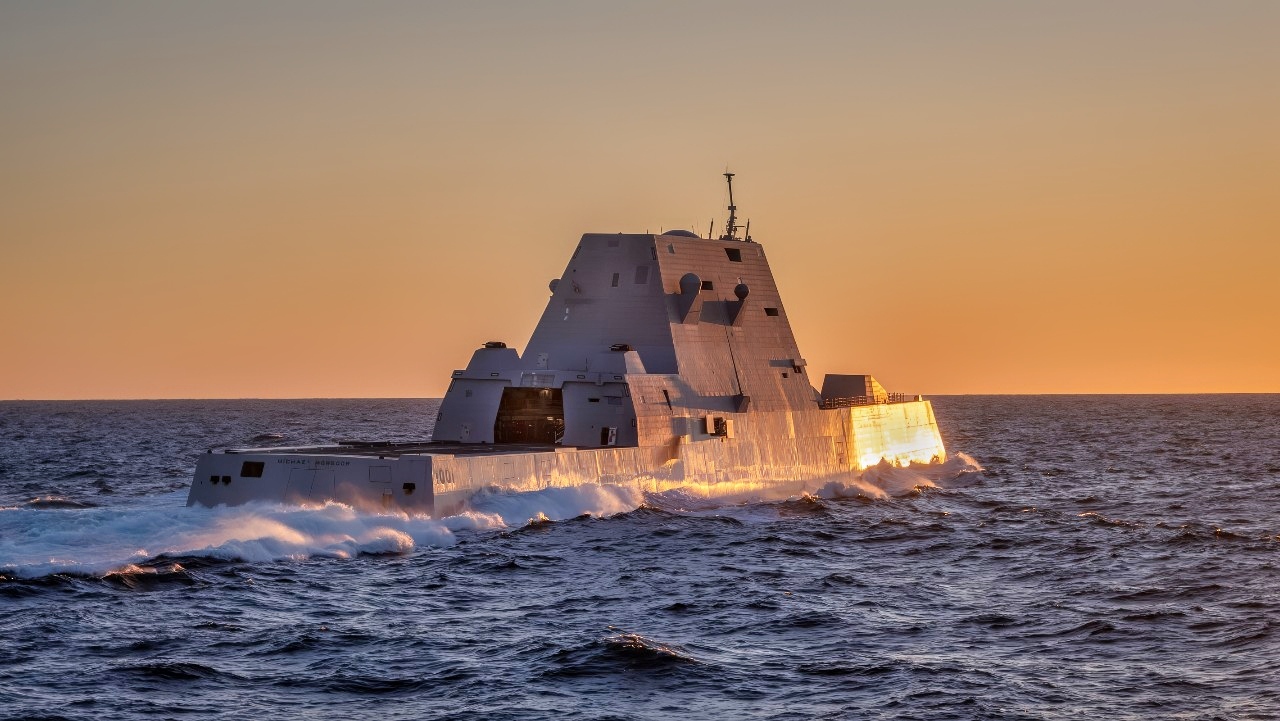
(February 10, 2024) — The Zumwalt Class Guided Missile Destroyer USS Michael Monsoor (DDG 1001) breaks away from the Henry J. Kaiser-class fleet replenishment oiler USNS Pecos (T-AO 197) shortly before sunset after taking on fuel. (U.S. Navy photo by Chief Mass Communication Specialist Mark D. Faram)
The PVLS design enhances survivability by directing explosions outward, minimizing internal damage in the event of a missile failure or attack. This system provides the Zumwalt-class with robust multi-mission capabilities, including strike, anti-air, and anti-submarine warfare.
Why the U.S. Only Has Three Zumwalt-Class Destroyers
So, what exactly happened with the Zumwalt?
Why did such an ambitious project end up dead in the water? Despite its impressive design and capabilities, the Zumwalt-class faced significant challenges that ultimately led to the reduction of the program.
One of the primary issues was cost. Originally estimated at $1.4 billion per ship, the final cost ballooned to between $7.5 and $8 billion per ship, including research and development.
The total program cost reached approximately $22.5 billion, triggering a Nunn–McCurdy Amendment breach, which requires re-certification of programs that exceed cost thresholds. These cost overruns made the program politically and financially untenable.
Technological challenges also plagued the Zumwalt-class. The ambitious nature of the ship meant that many of its systems were experimental and required extensive testing and integration. The AGS and LRLAP were cutting-edge but ultimately impractical.
The ship’s electrical systems, automation, and stealth features introduced reliability issues, and one Zumwalt even broke down in the Panama Canal, which highlighted the difficulties of deploying such a complex vessel. These issues eroded confidence in the program and raised concerns about its operational viability.
Shifting Strategic Priorities
After conducting a few reassessments, the Navy realized it did not need the new destroyers as much as they originally thought.
In 2008, the Navy reevaluated its needs and concluded that the Zumwalt-class was not well-suited for area air defense or ballistic missile threats, which were becoming more prominent. The Navy decided to revert to building more Arleigh Burke-class destroyers, which were cheaper, proven, and easier to mass produce.
The Arleigh Burke-class offered robust air defense capabilities and could be built in larger numbers, making them a more practical choice for fleet modernization.
The original plan called for thirty-two Zumwalt-class destroyers, but this number was gradually reduced to twenty-four, then seven, and finally three.
Several factors contributed to this drastic reduction. The exorbitant costs of the ships and their ammunition made the program unsustainable. Budget constraints forced the Navy to prioritize other programs, including aircraft carriers and submarines.
The changing threat landscape, particularly the rise of ballistic missile and anti-ship missile threats, led the Navy to favor platforms with better air defense capabilities. Technical limitations, such as the failure of the AGS and other systems, undermined the ship’s core mission of land attack. Operational concerns, including reliability issues and maintenance challenges, further diminished the program’s appeal.
What to Do With the Zumwalt-Class?
Despite all the difficulties, the Navy still has a plan for the Zumwalt-class. The three destroyers are currently being retrofitted with hypersonic missile systems. The Navy plans to install Conventional Prompt Strike (CPS) weapons, replacing the AGS mounts with launchers for Mach 5+ boost-glide missiles.
This retrofit may breathe new life into the Zumwalt-class, transforming them into long-range strike platforms capable of penetrating advanced enemy defenses. The ships also serve as valuable platforms for experimentation and modernization, including the testing of hypersonic missiles, advanced sensors, and autonomous systems.
Overall, the Zumwalt-class destroyers are exceptionally well design ships, but in my mind they are emblematic of what is wrong with the DoD’s procurement and requirements process.
Much like the Army’s M10 Booker, the Zumwalt-class was designed with lofty requirements, with very little consideration given to battlefield realities or the Navy’s actual needs.
Zumwalt-Class: The Battleship Problem?
The end result is a well-made but ultimately useless vessel that is not built in a large enough number to make a meaningful difference in a large-scale war. Some would even call this a battleship problem the Navy had confronted before in the Iowa-class battleships built towards the end of World War II.
The decision to convert the ships into hypersonic missile carriers is the best use of these ships.
Rather than simply scrapping them, using them as a testbed for future technologies is a good way to ensure that these ships were not a complete waste of taxpayer dollars.
But at the end of the day, they might just be like those last U.S. Navy battlewagons: nice to have, but not really needed, at least, according to many experts.
About the Author: Isaac Seitz
Isaac Seitz, a Defense Columnist, graduated from Patrick Henry College’s Strategic Intelligence and National Security program. He has also studied Russian at Middlebury Language Schools and has worked as an intelligence Analyst in the private sector.
More Military
Seawolf-Class: The Best Submarine Ever?
The Royal Navy Has a Destroyer Stuck in Port for 3,000 Days
America Is the King of Stealth Fighters
China’s J-20 Mighty Dragon Stealth Fighter Has Just 1 Mission


Bubba
September 9, 2025 at 1:25 pm
Was this written with A I. ?
How many times did the cost and number of ships produces have to be repeated in the article?
In total there was one paragraph of information , and the rest was repetitive.