
Iran says that it captured a sophisticated American autonomous underwater vehicle near the entrance to the Strait of Hormuz.
Washington confirmed the incident, saying one of its drones was lost after it malfunctioned, but both sides are telling different stories with significantly different consequences.
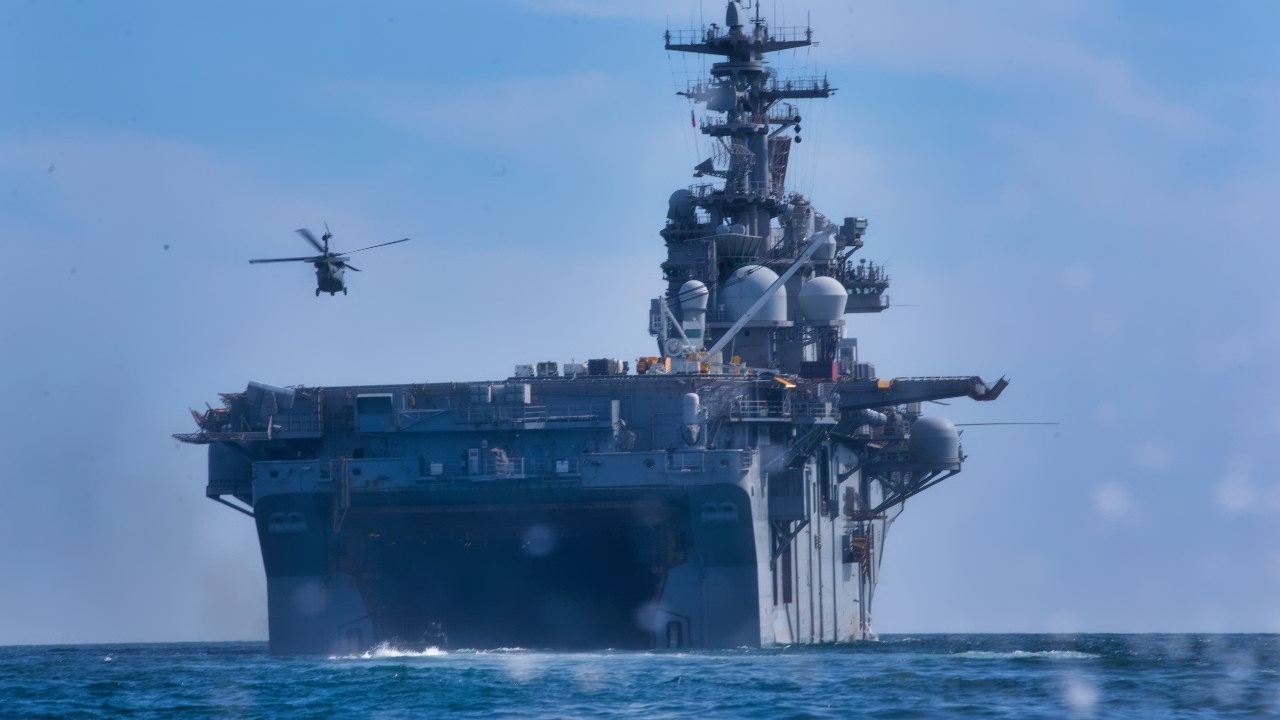
U.S. Marines with Bravo Company, 2d Assault Amphibious Battalion, 2d Marine Division approach the USS Wasp (LHD 1) in assault amphibious vehicles off of Onslow Beach during a three-day ship-to-shore exercise on Camp Lejeune, N.C., June 27, 2020. During the exercise, the Marines conducted amphibious maneuvers and dynamic ship-to-shore operations with the USS Wasp (LHD 1). (U.S. Marine Corps photo by Lance Cpl. Jacqueline Parsons)
The Islamic Revolutionary Guard Corps announced on Tuesday, September 8, that the drone was captured, identifying it as a Dive-LD autonomous underwater vehicle built by defense company Anduril Industries.
A series of photographs of the drone published by the IRGC through Iranian media, and later carried by Western outlets including Reuters, show the white Anduril-made vessel in Iranian hands.
Iranian media also published video footage purporting to show the roughly 19-foot submersible being lifted out of the water.
Iran boasted about capturing the vehicle and suggested it would reverse-engineer the technology inside.
That’s a problem for the U.S. if it does indeed contain advanced tech that Russia, China, or Iran have never seen before — but Washington indicated that it doesn’t.
What Iran Claimed
The IRGC Navy said on September 8 that it had “trapped one of the most modern, intelligent and unmanned submarines” currently in operation by the United States as it approached the entrance to the Strait of Hormuz.
The IRGC said it obtained the vehicle during an intelligence mission earlier that morning. Iranian outlets quickly identified it as the Dive-LD, and Iranian media described the news as a significant intelligence coup and victory.
Sepah News, the IRGC’s official news outlet, posted footage on Telegram showing the vehicle being raised from the water in a net. South Korea’s Yonhap news agency, which reviewed the footage, said that the 17-second video clip was accompanied by a mocking message that described the drone as America’s “smart whale” and thanked Washington for the “gift.”
“Your smart whale is now with us, cooperating very well and answering all questions.
Thank you for your gifts!” the accompanying post reads.
It is clear, between Western reports and Iranian statements, that the Dive-LD was indeed captured – but what Iran could not prove was the extent of the technology within the vessel, or exactly how it was captured.
CENTCOM Says the Drone Was Already Disabled
U.S. Central Command offered a different account of what happened, with CENTCOM spokesman Navy Capt. Tim Hawkins saying that the underwater drone had malfunctioned more than a day before Iran announced its seizure.
According to the U.S., the drone had been surveying regional waters as part of U.S. operations, but was not captured by an Iranian operation.
Speaking to Defense Scoop, Hawkins said that the drone “was essentially dead in the water for more than a day.”
“An underwater drone operated by U.S. forces malfunctioned more than a day ago,” Hawkins said. “It was surveying regional waters in support of ongoing operations.”
Hawkins also told The Washington Post that the drone contained “no exquisite defense technology” that Iran would be able to exploit, and that it was also an older model.
A Pentagon spokesperson was quoted by Reuters as saying that the defective vehicle had also not collected any sensitive information that Iran could exploit.
Washington, then, is not disputing the fact that a drone has been captured by Iran – but officials are suggesting that Iran is presenting its capture as a greater victory than it really is.
The vehicle was disabled and captured because of the defect, not because of an Iranian operation, and it does not contain any technology that Iran or its partners can exploit. That’s the message from the United States, at least.
Anduril Responds
Manufacturer Anduril also confirmed the loss, but the company pushed back against any suggestion that Iran had secured a particularly valuable piece of American military technology.
The company described the Dive-LD drone as an “attritable autonomous system,” meaning that it is effectively designed to be lost.
“Dive-LD is an attritable autonomous system, meaning it is designed from the outset to operate in dangerous environments where loss of the vehicle is an expected possibility.
Its purpose is to keep warfighters out of the most dangerous parts of the undersea mission,” a spokesperson for the company said in a statement.
“This vehicle had already delivered significant value operating thousands of hours in months-long operations in CENTCOM.”
A First for the Iran War
The incident marks the first time that the Pentagon has acknowledged the loss of an underwater drone since the war began in February.
CENTCOM has not confirmed whether other U.S. sea drones have been captured.
This is not, after all, the first time that these drones have been deployed in the region since the war began, and the deployment of the Anduril model confirms that the U.S. is using autonomous systems as part of its surveillance missions beneath the waters around Hormuz.
About the Author: Jack Buckby
Jack Buckby is a British researcher and analyst specializing in defense and national security, based in New York. His work focuses on military capability, procurement, and strategic competition, producing and editing analysis for policy and defense audiences. He brings extensive editorial experience, with a career output spanning over 1,000 articles at 19FortyFive and National Security Journal, and has previously authored books and papers on extremism and deradicalization.


