

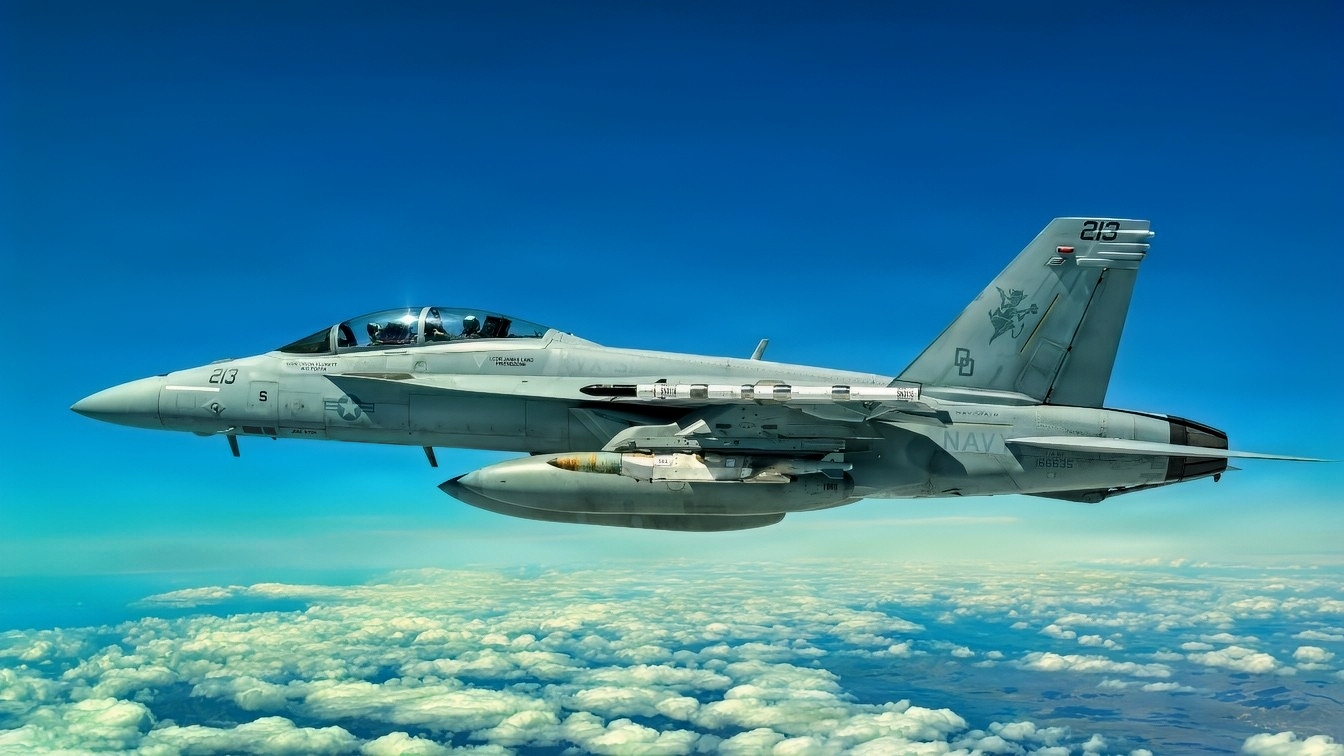
The Pentagon is debating its military presence in the Middle East after months of Iranian missile and drone attacks revealing the vulnerability of some of its largest forward bases. The discussion is still ongoing, with no official decisions made on mothballing any particular installations.
‘Quiet Talk’ Over How War Ends
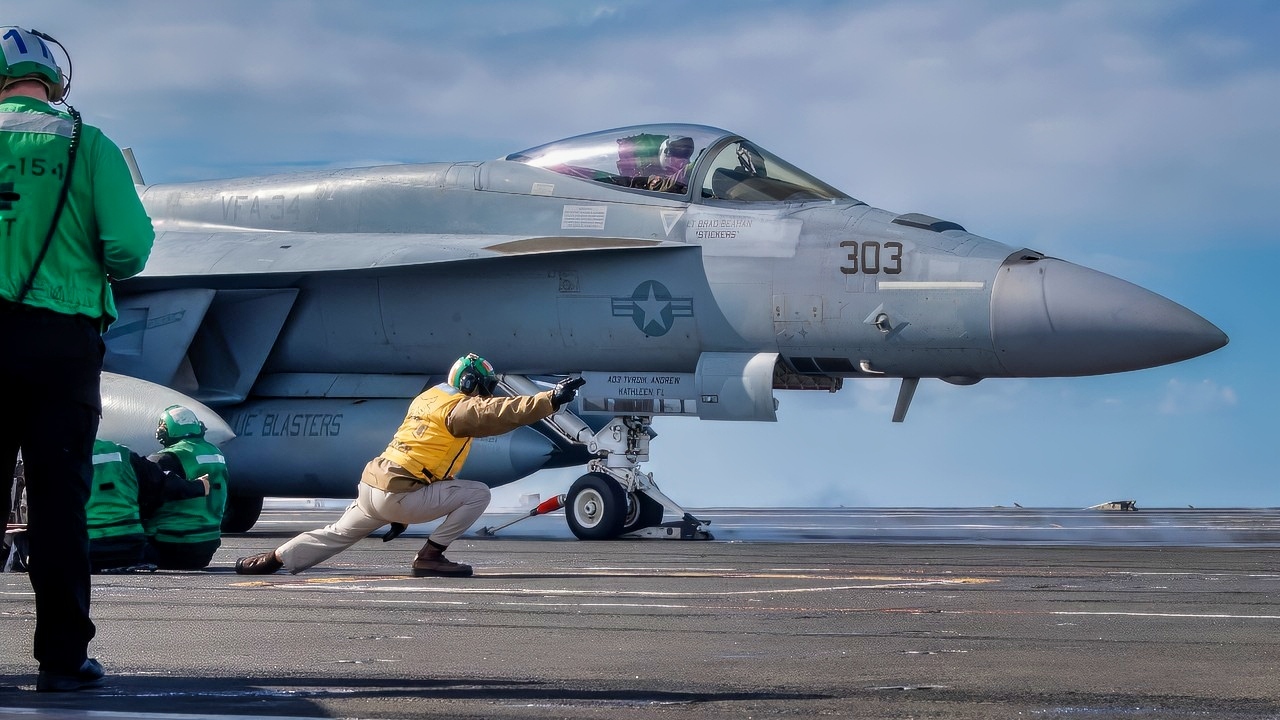
U.S. Navy Lt. Andrew Bentley signals an F/A-18E Super Hornet, assigned to the “Blue Blasters” of Strike Fighter Squadron (VFA) 34, to launch from the flight deck of the Nimitz-class aircraft carrier USS Theodore Roosevelt (CVN 71), Nov. 30, 2023. Theodore Roosevelt, the flagship of Carrier Strike Group Nine (CSG 9), is conducting integrated training exercises in the U.S. 3rd Fleet area of operations. (U.S. Navy photo by Mass Communication Specialist 3rd Class Adina Phebus)
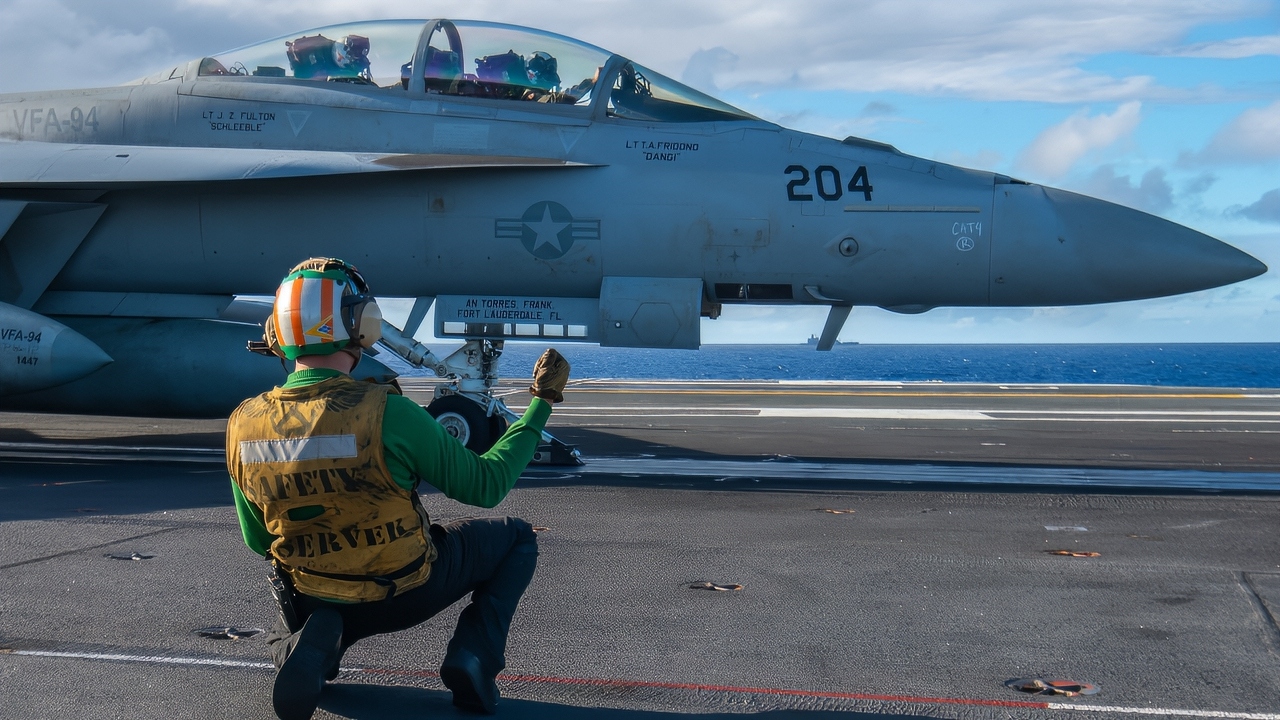
(Dec. 31, 2022) An F/A-18E Super Hornet assigned to the “Mighty Shrikes” of Strike Fighter Squadron (VFA) 94 prepares to launch from the aircraft carrier USS Nimitz (CVN 68) to participate in a long-range maritime strike demonstration. Nimitz is in 7th Fleet conducting routine operations. 7th Fleet is the U.S. Navy’s largest forward-deployed numbered fleet, and routinely interacts and operates with 35 maritime nations in preserving a free and open Indo-Pacific region. (U.S. Navy photo by Mass Communication Specialist 2nd Class Justin McTaggart)
CNN reported Monday, citing six sources, that there have been recent low-key discussions about cutting the number of people and facilities typically stationed in the Middle East if the Trump administration succeeds in ending the Iran conflict. One American official said, “The vulnerabilities were always known, but the U.S. never acted on it with urgency.”
The damage inflicted on American bases is now well-documented. A Pentagon inspector general’s report obtained by CNN and dated Sept. 14 details how Iranian attacks have damaged and destroyed hundreds of buildings and structures in U.S. bases in Kuwait, Bahrain, Qatar, UAE, Saudi Arabia, Iraq, Oman, and Jordan during the conflict.
The report — which covered the costs of the war up to June 30 — listed the expenses for the Pentagon’s Operation Epic Fury at $33.4 billion as of June 2, not including the still-undetermined costs of repairing damage to the facilities.
The Bahrain Example
Naval Support Activity Bahrain, the home port of the U.S. Fifth Fleet, was particularly hard hit.
Acting Secretary of the Navy Hung Cao said this month that the Iranians “blew the hell out of Bahrain.” Chief of Naval Operations Adm.
Daryl Caudle was asked during a town hall meeting on Aug. 31 when fleet personnel could return to the kingdom to retrieve their personal property.
“We’re not getting back in there anytime soon,” Caudle told his audience. “I just want to be completely honest with that.”
The attack severed Navy logistical lines, with supplies having to be rerouted from Singapore and Diego Garcia, a much smaller U.S. base in the Indian Ocean, according to Task & Purpose. Retired Gen. David Petraeus – a former commander of CENTCOM and CIA director – said U.S. forces had already been withdrawn from some positions in the eastern Gulf “[as] those bases are no longer viable”
Petraeus warned that Washington should not mistake these vulnerabilities for an opportunity to disengage from the region. “Trying to leave the Middle East for the United States is like Michael Corleone trying to leave the mafia,” the retired four-star general said during an appearance on The Cipher Brief. “You just keep getting sucked back in.”
The Pentagon itself has questioned the value of rebuilding some of these bases. Pentagon Comptroller Jules “Jay” Hurst mentioned during a briefing on the defense budget in April that “we might change how we build bases in the Middle East based on this conflict.”
When asked how much it would cost to restore the facilities already damaged by Iran, Hurst said, “It really depends on how we decide to rebuild those or if we do.” According to CNN, the Pentagon is considering reinforcing the remaining installations.
Guarantor to Integrator
The reduction in America’s Gulf footprint has long been a priority.
In his 2024 strategic posture statement, Gen. Michael Kurilla, then-CENTCOM commander, said the command’s mission was “gradually shifting from security guarantor to security integrator.”
In other words, CENTCOM is moving away from a sole reliance on U.S. troops for security and toward a more comprehensive approach that includes intelligence-sharing, arms sales, and joint ballistic missile defenses – a rotation which will likely require fewer troops on the ground.
Former National Security Council director for Arabian Peninsula affairs Allison Minor told the Christian Science Monitor that the developments could “shift away from this idea of a U.S. security guarantee in the Gulf.”
Defense Priorities analyst Jennifer Kavanagh said Tehran’s wish for America to withdraw is no reason for the Trump administration not to do so if it deems the move strategically prudent. “Sure, Iran wants the U.S. to pull back, but that doesn’t mean it’s the wrong strategic choice,” she told the Monitor.
U.S.’ Changing Role in the Region
America’s troop reductions are part of a larger strategic reassessment in the Middle East. On Wednesday, the U.S. military announced the Iraq drawdown was complete under the security agreement finalized with Baghdad in 2024.
This milestone reflects the success of a 12-year campaign that defeated ISIS as an organized military threat in Iraq and across the region,” said Pentagon spokesperson Sean Parnell in a press release. Iraqi Prime Minister Ali al-Zaidi called the withdrawal the beginning of “a new phase” in which “Iraqi sovereignty” and “balanced partnerships with its friends” take center stage.
There is currently no official list of bases in the Gulf that the U.S. is considering for permanent closure.
About the Author: Georgia Gilholy
Georgia Gilholy is a journalist based in the United Kingdom who has been published in Newsweek, The Times of Israel, and the Spectator. Gilholy writes about international politics, culture, and education. You can follow her on X: @llggeorgia.


