


Key Points and Summary – The U.S. Army’s XM30—formerly OMFV—is a soldier-centric Bradley replacement designed to fight manned or unmanned.
-Prototypes from American Rheinmetall and GDLS are in soldier touch-points and operational testing ahead of a 2027 down-select and production award.
-Missions range from acting as a forward robotic attacker and C2 node for swarms of unmanned systems to delivering a nine-soldier squad under armor.
-Requirements emphasize autonomy/semi-autonomy, advanced fire control, sensors, protection, and high mobility (including bridge/urban access).
-Weapon options under evaluation include a new cannon, AT missiles, SHORAD-style counter-drone effects (e.g., Stinger/Coyote), and organic launch-and-recover drones to out-range and out-sense future threats.
XM30: Army’s Next IFV Blends Autonomy, Drones, and a 9-Soldier Squad
Tracking targets, conducting attacks, and “closing” with the enemy as a forward, unmanned robotic vehicle or delivering a nine-man squad into hostile fire under armor.
These are a few of the intended missions for the Army’s evolving XM30 replacement infantry fighting vehicle.
The platform can be configured to operate as a command and control node, controlling groups of unmanned systems in combat, or it can engage in direct contact with its cannon, anti-tank weapons, and an infantry squad ready to dismount and attack.
The Army is currently testing and evaluating prototype XM30s from both American Rheinmetall and General Dynamics Land Systems in preparation for what will ultimately be a “down-select” and production contract for the vehicles.
Throughout the developmental process, the Army has been gathering feedback from soldiers in experimental exercises and conducting a wide range of operational tests to refine requirements and establish performance parameters.
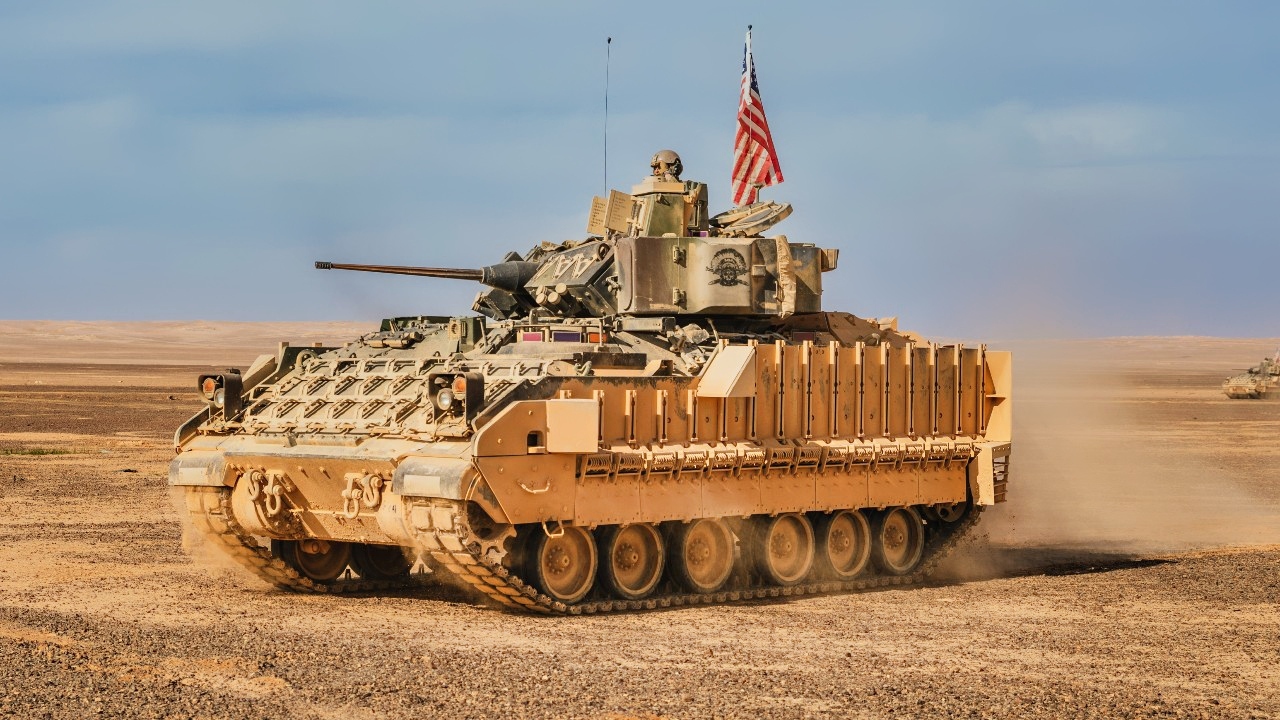
U.S. Army Soldiers assigned to 2nd Squadron, 278th Armored Cavalry Regiment, Task Force Reaper, conduct movement procedures with M2 Bradley Fighting Vehicles during the Jade Cobra VI exercise in the U.S. Central Command’s area of responsibility, Feb. 19, 2025. Jade Cobra VI strengthens military-to-military partnerships, increases readiness, and facilitates security cooperation between the United States and Jordan. (U.S. Army photo by Staff Sgt. Hector Tinoco)
The concept has been to provide input to the two vendor teams in preparation for an Army decision to move one of the designs into production in 2027.
XM30: Optionally Manned Fighting Vehicle
Previously called the “Optionally Manned Fighting Vehicle,” the Army’s Bradley replacement is referred to by weapons developers as being engineered with a “soldier-centric” design intended to change and improve soldier lethality in a new threat environment.
Many of the specific technologies are proprietary to competing vendors or unavailable due to security reasons; however, there are several key areas of technological focus as the service further refines its requirements.
Designers will engineer the vehicle to operate autonomously and unmanned, meaning it can navigate and transit complex terrain, transport infantry, and perform sensing missions without needing human intervention.
The vehicle can also function in a “semi-autonomous” fashion, meaning it can receive command and control input from human decision-makers, operate unmanned air and ground systems, and conduct high-risk reconnaissance missions under enemy fire.
Not surprisingly, much of the innovation being built into the vehicle relates to establishing the fire-control technologies, sensors, and optics, as well as protections and maneuverability, necessary to support future formations.
Lightweight & Mobile XM30
In recent years, senior Army weapons developers have explained that initial concepts for the vehicle included engineering a new infantry carrier that was powerful, lethal, and precise enough to “out-range” an enemy with fires and also be light and maneuverable enough to cross 80 percent or more of bridges, narrowly configured urban areas, and other challenged, high-threat transit areas.
As for weapons applications, the two variants and the US Army’s lead weapons developers are likely exploring a range of cutting-edge requirements, including a Short-Range-Air-Defense-like counter-drone capability, such as a Stinger missile, and an ability to launch and recover advanced drones.
One possibility for American Rheinmetall could involve the integration of a counter-drone-counter air vehicle-launched drone made by one of their XM30 teammates, Raytheon’s Coyote.
Raytheon has been developing an advanced Block 2 Coyote, which includes a larger, optimized warhead with advanced tracking capabilities, as described by its developers.
Specific solutions being integrated are likely still being determined; however, both General Dynamics and ARV are likely to be integrating and testing a wide range of cutting-edge weapons systems, including drones, cannons, sensors, and counter-air weapons. General Dynamics Land Systems, for example, has engineered several armored vehicles capable of launching and recovering surveillance and attack drones.
About the Author: Kris Osborn
Kris Osborn is the President of Warrior Maven – Center for Military Modernization. Osborn previously served at the Pentagon as a highly qualified expert in the Office of the Assistant Secretary of the Army—Acquisition, Logistics & Technology. Osborn has also worked as an anchor and on-air military specialist at national TV networks. He has appeared as a guest military expert on Fox News, MSNBC, The Military Channel, and The History Channel. He also has a Masters Degree in Comparative Literature from Columbia University.
More Military
The B-1B Lancer Bomber: Can It Fire Hypersonic Missiles?
USS Enterprise (CVN-65): Best Aircraft Carrier Ever?
The Kitty Hawk-Class Aircraft Carriers Have A Message for the U.S. Navy
The X-43A Hit Mach 9.6 (And It Was Cancelled?)
The Montana-Class Battleships Have a Message for the U.S. Navy


James j whalen
September 25, 2025 at 9:42 am
Article reads like it was written by AI