


The Good, Bad, And The Ugly About the Bradley Fighting Vehicle
The Bradley Fighting Vehicle (BFV) is an American tracked armored fighting vehicle of the United States developed by FMC Corporation and now manufactured by BAE Systems Land & Armaments. It is named for US General of the Army Omar Bradley of World War II fame.
The Bradley is designed to transport infantry or cavalry scouts with armor protection, while providing covering fire to suppress enemy troops and armored vehicles.
Variants include the M2 Bradley infantry fighting vehicle and the M3 Bradley reconnaissance vehicle. The M2 holds a crew of three—a commander, a gunner, and a driver—along with six fully equipped soldiers.
The M3 mainly conducts scout missions and carries two scout troopers in addition to the regular crew of three, with space for additional BGM-71 TOW missiles.
The Bradley has served in several wars during the past 35 years and is still the Army’s primary infantry fighting vehicle.
Currently, the Army has about 4,500 M2 and M3 Bradleys spread among its units, including those in the Army National Guard, as well as another approximately 2,000 in storage, according to The International Institute for Strategic Studies’ The Military Balance.
Design History
It would be surprising to most people to learn that the design and development of the M-2 Bradley Fighting Vehicle began in the early 1960s, right about the time that the M-113 was incorporated into the US Army.
In 1964, the Army recognized that in a future war in Europe would require an infantry fighting vehicle that would have a turret with a 20mm cannon, a 7.62mm machine gun, five sealed firing ports for infantry troops inside, and a sealed hull for protection against NBC elements (nuclear, biological, chemical), and have enough speed to keep up with the new M-1 tank that was in development.
In 1967, the Soviets released the BMP-1, which in Russian is Boyevaya Mashina Pyekhoty (infantry fighting vehicle), which was sealed against NBC contaminants, had a 73mm gun, firing ports, and was fast enough to keep up with the Soviet armor. This compelled the Army to once again look at the MICV (mechanized infantry combat vehicle.
Different prototypes were tested and rejected, one of them being the excellent German Marder IFV.
In October 1976, the Army would combine the roles of scout and IFV, as the previous Armored Reconnaissance Scout Vehicle had been canceled. The Army agreed to make the armor protection comparable to the earlier prototype, XM723. The TBAT-II turret, equipped with a 25 mm Bushmaster cannon and a TOW missile launcher, would be used for both vehicles.
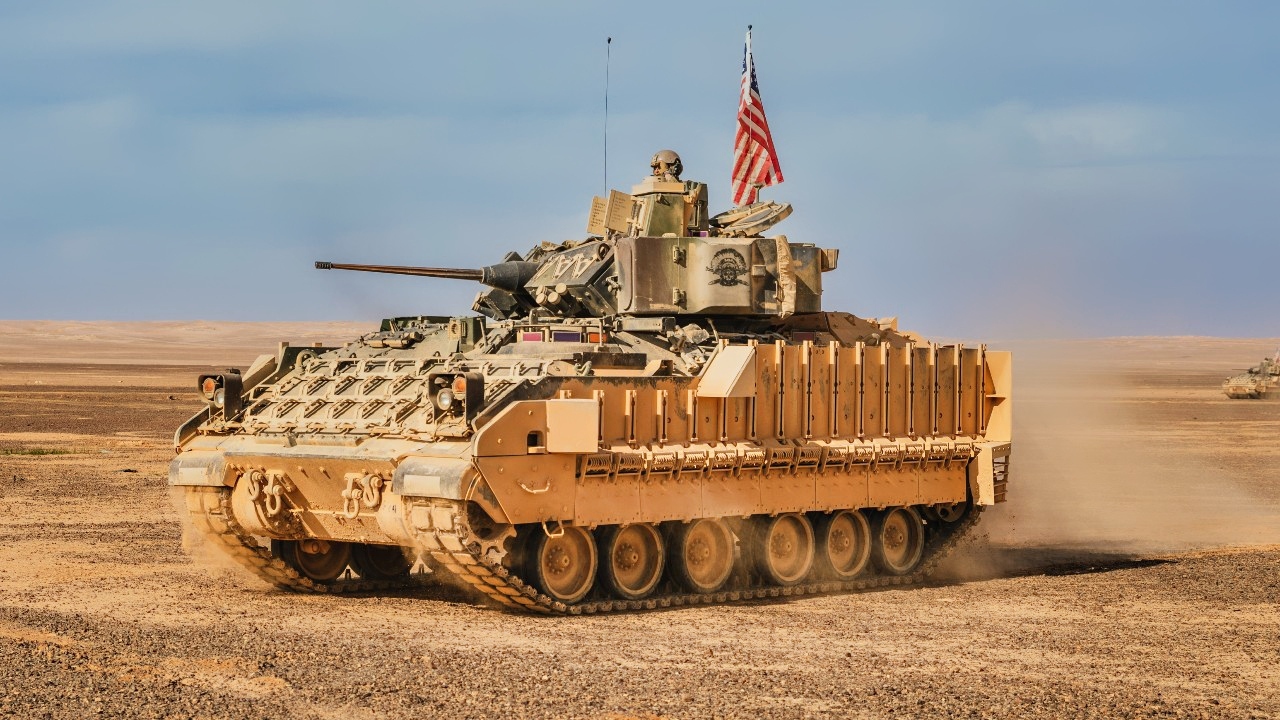
U.S. Army Soldiers assigned to 2nd Squadron, 278th Armored Cavalry Regiment, Task Force Reaper, conduct movement procedures with M2 Bradley Fighting Vehicles during the Jade Cobra VI exercise in the U.S. Central Command’s area of responsibility, Feb. 19, 2025. Jade Cobra VI strengthens military-to-military partnerships, increases readiness, and facilitates security cooperation between the United States and Jordan. (U.S. Army photo by Staff Sgt. Hector Tinoco)
The following year, the IFV was renamed the XM2, and the cavalry scout was named the XM3.
The XM2/3 passed the Army Systems Acquisition Review Council Milestone III review in 1979. In December 1979, the XM2 and XM3 were type classified as the M2 and M3, respectively. Final approval for production came from the Secretary of Defense in February 1980.
In October 1981, the vehicle was named the “Bradley” for World War II Army General Omar Bradley, who had died earlier that year.
Colonel Burton’s Pentagon Wars
Air Force Col. James G. Burton, an Office of the Secretary of Defense official, advocated the use of comprehensive live fire tests on fully loaded Bradley fighting vehicles to evaluate their survivability. The Army and Air Force agreed to establish the joint live fire testing program in 1984.
The result was one of the most controversial stories of that era. Burton was a whistleblower over the testing of the Bradley Fighting Vehicle. Burton meticulously details in his book, “The Pentagon Wars,” how careerism, incompetence, and willful stupidity collide in a tragically ironic way to undermine the testing of the weapons meant to protect troops.
His book was later made into a black comedy film of the same name.
Burton disagreed with the Aberdeen Proving Ground’s Ballistic Research Laboratory (BRL), which preferred smaller, more controlled, “building block” tests.
They claimed that such limited, completely unrealistic, according to Burton, testing would improve the databases used to model vehicle survivability, as opposed to complete tests with random shots that would provide a far more accurate picture of its performance under real battlefield conditions, but produce less valuable statistical data.
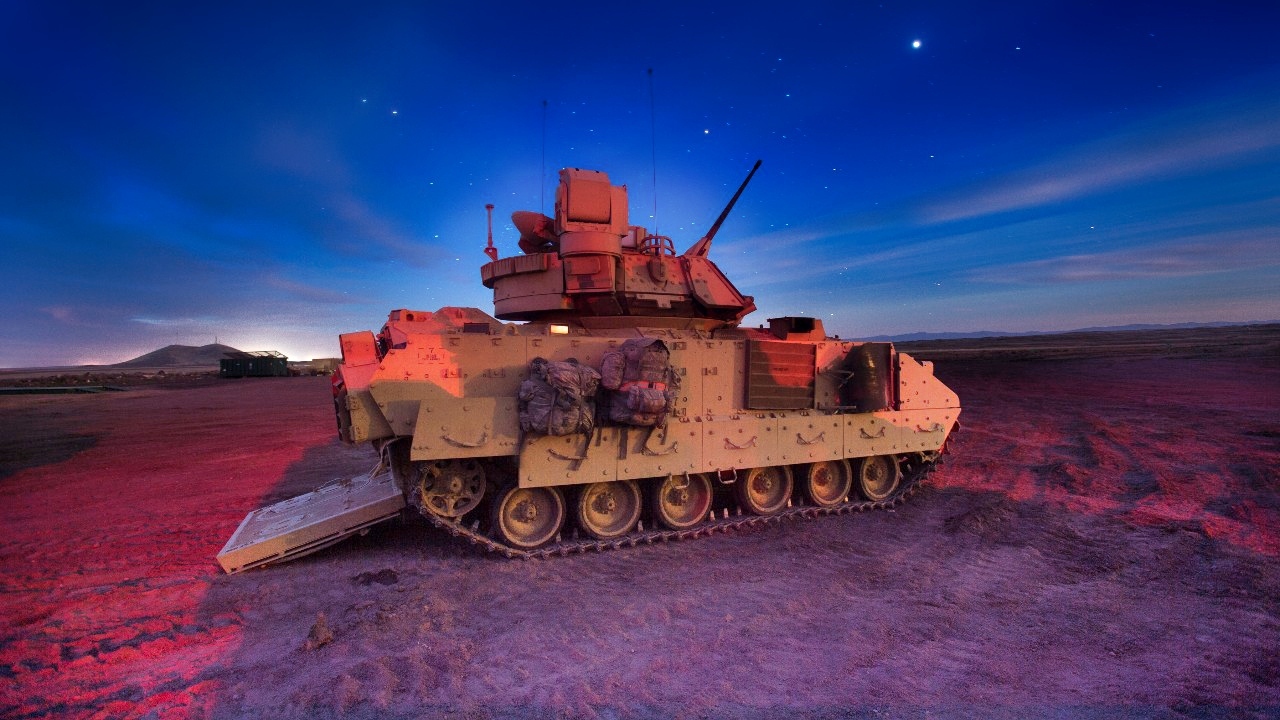
Engineers with the 116th Brigade Engineer Battalion conduct M2A3 Bradley fighting vehicle gunnery qualification on March 27, 2018, Orchard Combat Training Center, south of Boise, Idaho. Combat engineers with the 116th BEB trained through gunnery table XII, evaluating their ability to execute collective platoon-level tasks in a tactical live-fire environment; including integrating dismounted soldiers with their assigned BFV. (U.S. Army National Guard photo by 1LT Robert Barney)
The Bradley carried more ammunition than any other vehicle on the battlefield, forcing out five of the eleven troops it was supposed to have. All of this ammunition made the vehicle both a prime enemy target and highly combustible for the troops inside, as the ammo was packed throughout the vehicle.
FMC manufactured a version for the Israeli Defense Forces, which demanded that the fuel tank and ammo be stored in external compartments, separate from troops.
Burton insisted that this version was needed for the US Army, but he was only partially successful. After years of Burton advocating, the Army moved some ammunition out of the troop compartment, but they never went so far as to store it separately.
Burton insisted on a series of “overmatch” tests in which weapons would be fired at the Bradley that were known to be able to penetrate its armor easily, including Russian ordnance.
Burton saw attempts to avoid such tests as dishonest, while the BRL saw them as wasteful, as they already knew the vehicle would fail. The disagreements became so contentious that testing was suspended, while a congressional inquiry resulted.

Troopers with 3rd Armored Brigade Combat Team, 1st Cavalry Division firing the 25mm canon on a Bradley fighting vehicle in order to zero the vehicles weapons systems at a range in Poland. Ranges such as these familiarize troopers with the vehicles systems in order to ensure combat readiness.
“By refusing to conduct realistic tests against a vehicle fully loaded with fuel and live ammunition, the Army senior leadership, in my opinion, demonstrated that it had a callous disregard for the lives of troops in the field. I could arrive at no other conclusion (pg 190).”
Additional armor improvements to vehicle survivability were added to production vehicles by 1988. Though Burton’s actions accelerated the implementation of these changes, the changes did come about through the BRL.
Burton was later transferred over this, but refused the transfer, opting to retire instead.
The Bradley In The Gulf Wars
The Bradley had “weathered the storm” between disagreements within the Army, Congress, and the Government Accounting Office (GAO); now it would face real combat in the desert during Operation Desert Storm.
Despite all of the misgivings about the program, the Bradley performed outstandingly during Desert Storm.
M2 Bradleys destroyed more Iraqi armored vehicles than the M1 Abrams. A few kills against Iraqi T-72 tanks at close range are reported.
A total of 20 Bradleys were lost—three by enemy fire and 17 due to friendly fire incidents. Another 12 were damaged.
The Army identified contributing factors in the friendly fire incidents, so infrared identification panels and other marking/identification measures were added to the Bradley.
GAO Report Praises The Bradley In Desert Storm
The official report published by the US General Accounting Office (GAO reported the following:
“The Bradley’s weapon systems proved to be lethal and effective against a variety of enemy targets. Commanders, crews, and officials from the Center for Army Lessons Learned (CALL) and the Army Infantry Center reported that the 25-mm automatic gun was a very versatile weapon.
“Crews we spoke with used the 25-mm automatic gun primarily for clearing bunkers and firing on lightly armored vehicles.
“While the 25-mm automatic gun is not the weapon of choice for engaging tanks, vehicle commanders, crews, and CALL and Army Infantry Center personnel reported isolated instances in which the 25-mm automatic gun had killed tanks…
“The Bradley’s TOW missile system was lethal at long ranges against all forms of enemy armor, such as tanks, with few missile failures reported.
“For example, crews from the 1st Armored Division and 2nd Armored Cavalry Regiment stated they had used the TOW to destroy Iraqi tanks. Crews reported destroying tanks at ranges from 800 to 3,700 meters.
Although 20 were destroyed (17 in blue on blue firing), the report noted that the Bradleys had good crew and troop survivability.
The Invasion of Iraq
However, during Operation Iraqi Freedom (OIF), the following decade, the vehicle proved vulnerable to IEDs and RPGs; in 2006 alone, 55 Bradleys were destroyed and 700 others damaged, and by the end of OIF, roughly 150 Bradleys ended up destroyed.
This was a different war, primarily against insurgents, after the Iraqi Army was quickly swept aside again. And operating in urban areas made the Bradleys more susceptible to RPG fire and IEDs.
The Bradley has also expanded its role from an infantry and cavalry fighting vehicle to include variants that increase missions in fire support, battle command, and transport for army engineers.
Bradleys can also be distinguished by the team and missiles they carry– the Bradley Stinger Fighting Vehicle carries a MANPADS (man-portable air defense systems, including shoulder-launched surface-to-air missiles) team with Stinger missiles under armor.
The Replacement For the Bradley
The Army began development for a replacement for the Bradley in 2010, and to quote Yogi Berra, “it was like deja vu all over again.”
The Army has been making the same mistakes again, something that was pointed out in the article by Mark Thompson for the Project On Government Oversight (POGO) watchdog organization’s website, with the pun-laden title “The Army’s Lousy Tracked Record.”
About the Author: Stephen Balestrieri
Steve Balestrieri is a National Security Columnist. He served as a US Army Special Forces NCO and Warrant Officer. In addition to writing on defense, he covers the NFL for PatsFans.com and is a member of the Pro Football Writers of America (PFWA). His work was regularly featured in many military publications.
More Military
F-111 Aardvark ‘Fighter-Bomber’ Has a Message For the U.S. Air Force
A U.S. Navy Submarine ‘Sank’ A British Aircraft Carrier
Russia’s Su-33 Aircraft Carrier Fighter Has No Aircraft Carrier


