


Key Points and Summary – The Air Force’s External Heavy-Stores Pylon program (about $50M in FY26) will equip B-1B Lancers with new load-adaptable pylons, adding thousands of pounds of external carriage for stand-off weapons.
-Wind-tunnel testing, LRU/wiring tweaks, and software updates come first, aiming to integrate JASSM and LRASM—and pave the way for hypersonic options like AGM-183A ARRW and HACM.

U.S. Air Force F-16 Fighting Falcons intercept two U.S. Air Force B-1B Lancers during exercise Amalgam Dart 21-2, March 23, 2021. The exercise will run from March 20-26 and range from the Beaufort Sea to Thule, Greenland and extend south down the Eastern Atlantic to the U.S. coast of Maine. Amalgam Dart 21-2 provides NORAD the opportunity to hone homeland defense skills as Canadian, U.S., and NATO forces operate together in the Arctic. A bi-national Canadian and American command, NORAD employs network space-based, aerial and ground based sensors, air-to-air refueling tankers, and fighter aircraft controlled by a sophisticated command and control network to deter, detect and defend against aerial threats that originate outside or within North American airspace. NATO E-3 Early Warning Aircraft, Royal Canadian Air Force CF-18 fighter aircraft, CP-140 long-range patrol aircraft, CC-130 search and rescue and tactical aircraft, and a CC-150T air refueler; as well as U.S. Air Force F-16 fighter aircraft, KC-10 Extender refueler, KC-46 Pegasus, KC-135 Stratotanker, as well as C-130 and C-17 transport aircraft will participate in the exercise. (U.S. Air National Guard courtesy photo)
-The shift aligns with a future fight centered on long-range, beyond-visual-range strikes, allowing B-1Bs to launch from safer distances while the B-21 Raider comes online.
-With anti-ship reach and expanded missile capacity, the upgrade keeps the B-1B relevant—and lethal—well into the 2030s.
New Pylons for B-1B Make the Lancer Relevant Into the 2030s
It’s taken years of planning, finagling, and fidgeting, but the B-1B Lancer bomber is finally getting external pylons.
The process to this point has been a long time in the making. Engineers and technicians have long sought to implement this feature, enabling the bomber to carry hypersonic weapons, and it appears they will soon get their wish.
The B-1B will also have the ability to carry different types of payloads. This comes at a time when the Lancers’ days are numbered as the new B-21 Raider stealth bomber will eventually replace them.

A B-1B Lancer aircraft from the 34th Bomb Squadron departs from Al Udeid Air Base, Qatar, April 8, 2017. This departure marks the airframe’s first mission in the U.S. Air Force Central Command’s area of operations in more than two years. (U.S. Air Force photo by Staff Sgt. Joshua Horton)
But that could take until the early 2030s before the last B-1B flies missions regularly.
The New Additions Will Be Relatively Inexpensive
The Air Force officially refers to the pylon addition as the External Heavy-Stores Pylon program.
The service branch requested over $50 million for the project in its FY2026 budget request.
The program will focus on the 42 B-1s on active duty that will require the update.
The Air Force would like to see 44 Lancers to serve full-time as the pylons are added.
Summed Up In 1 Word: Hypersonics
The pylon program will work in tandem with the Hypersonic Integration Program, which will integrate MACH 5+ weapons into the B-1B. “Maximum carriage of existing standoff munitions on the B-1B provides near-term increased volume of fires from standoff ranges and serves to mitigate transition risk of the Air Force bomber fleet prior to the emergence of the B-21 as a combat bomber,” according to budget documents reviewed by the War Zone.

A U.S. Air Force B-1B Lancer assigned to the 34th Expeditionary Bomb Squadron, Ellsworth Air Force Base, South Dakota, flies over the United States, July 2, 2025. The B-1B is a heavy bomber with up to a 75,000 pound payload. (U.S. Air National Guard photo by Airman Spencer Strubbe)
The Next War Will Be About Beyond-Visual-Range Missiles
Stand-off weapons are the key ingredient that the Air Force is trying to add to its arsenal of munitions that are launched from its airplanes.
The next war is expected to be a missile fight aimed at disabling the enemy from beyond visual range.
China has an assortment of ballistic missiles it can launch from the ground and from the air. The Air Force needs its bombers to be able to deploy different types of cruise missiles at ground targets.
The Lancer was initially designed to carry nuclear-tipped cruise missiles on its external hardpoints, and these could also be the launch point for hypersonic missiles in the future.
The cruise missiles would be 5,000-pound munitions with a “proven weapons shape” from a Load Adaptable Pylon.
However, arms control agreements removed the nuclear weapons capability from the B-1B bomber. It has since completed many conventional missions.
But hardpoints have not been used very often.
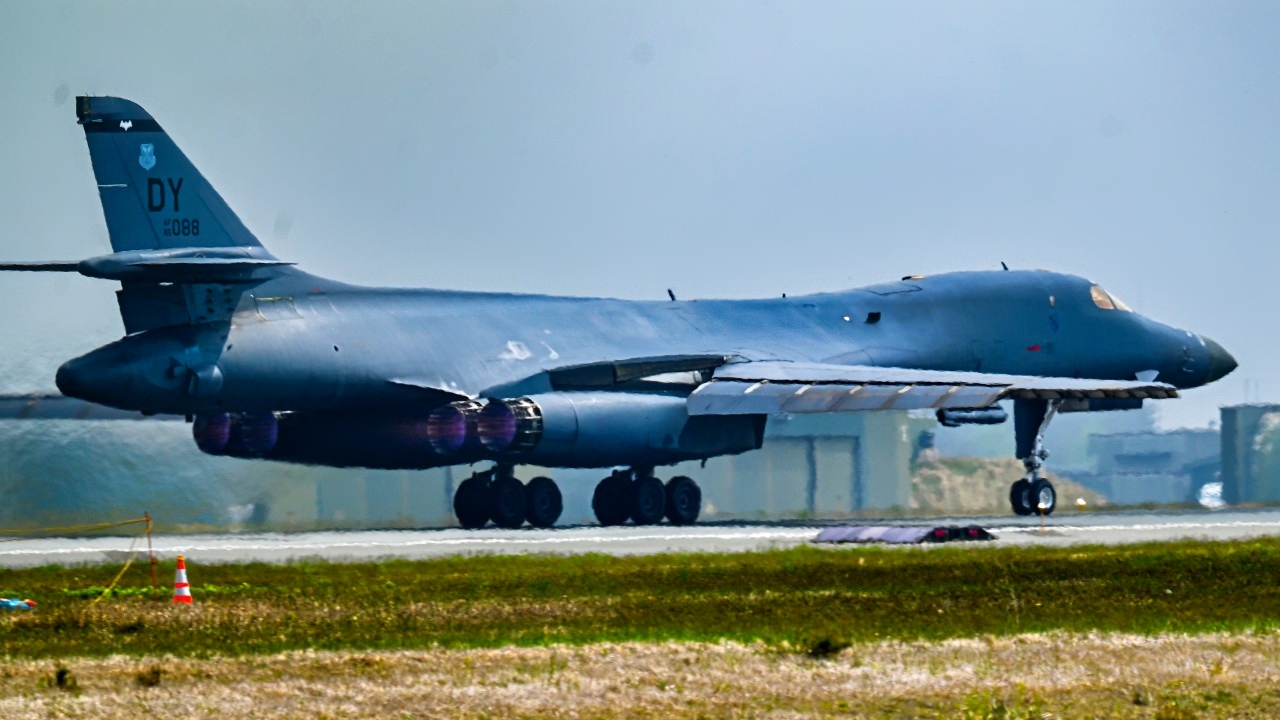
A B-1B Lancer prepares to return to Dyess Air Force Base, Texas, during Bomber Task Force 25-2 at Misawa Air Base, Japan, May 15, 2025. BTF missions provide opportunities to train and work with our allies and partners in joint and combined operations and exercises. (U.S. Air Force photo by Airman 1st Class Mattison Cole)
Exciting Developments For the B-1B to Diversify Its Attack Mission Set
The B-1B has rehearsed firing the AGM-158 Joint Air-To-Surface Standoff Missile (JASSM) cruise missile on an external pylon.
The pylons can carry a load of up to 7,500 pounds. The B-1B can also transport the Sniper Advanced Targeting Pod.
Engineers will be testing the External Heavy-Stores Pylon program in wind tunnels in the coming months. The service also aims to “begin hardware design to include changes to aircraft Line Replaceable Units (LRUs) and wiring” and “begin software updates to recognize pylon stations and weapons.”
Two Different Hypersonic Models Could Be on Board in the Future
As for hypersonics, the B-1B will someday launch the AGM-183A Air-Launched Rapid Response Weapon (ARRW).
This is an exciting munition that will make the B-1B relevant until the B-21 replaces it.
The ARRW has already been tested on the B-52. There is also the air-breathing Hypersonic Attack Cruise Missile (HACM) that could be mated with the B-1B.

B-1B Lancer at USAF Museum in July 2025. Image Credit: National Security Journal.
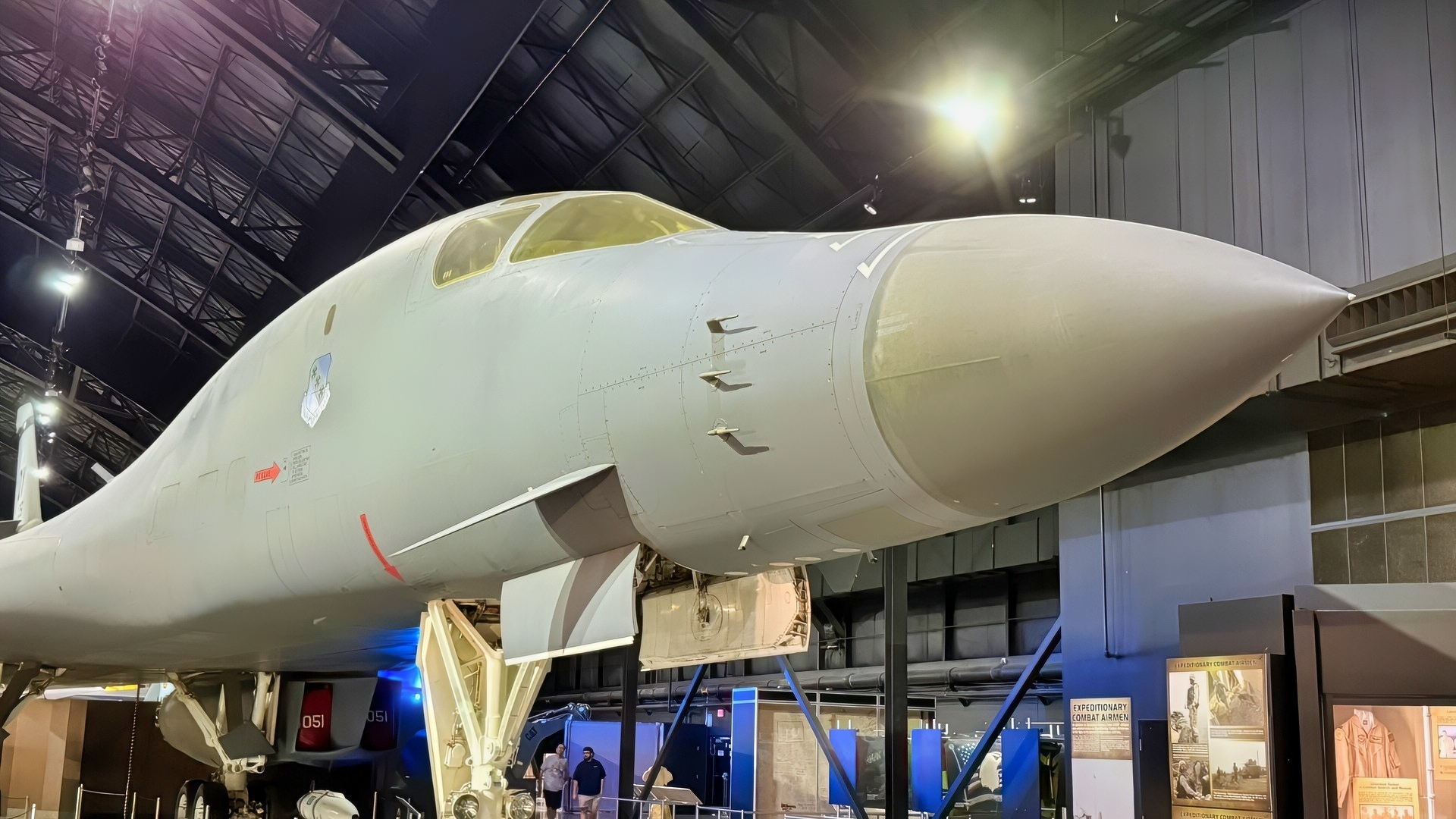
B-1B Lancer 2025 National Security Journal. Image Credit: Harry J. Kazianis/NSJ.
When the hypersonic weapons are ready, the B-1B could carry 31 of them externally and internally. This would be a massive development for the Lancer program, and the money spent on the external pods would be well worth the investment. The Air Force is seeking to extend the life of the B-1B and enhance its lethality and destructive power. With hypersonic weapons, there would be a clear advantage to the B-1B that could allow it to serve for many more years.
That’s not all. The B-1B also has a ship-killing component. It can fire the AGM-158C Long-Range Anti-Ship Missile (LRASM) if the technicians get their way, using the last budget proposal expenditure objective. This is an essential weapon for use in East Asia, as the Chinese have a significant number of warships that could benefit from a solution provided by the Air Force. The latest LRASM update will extend the missile’s range to approximately 600 miles, nearly twice as far as the previous version. LRASMs are seen as key tactical weapons in a naval conflict.
The B-1B needs new capabilities to remain a go-to bomber in the future. The pylon additions have taken a significant amount of time to implement.
Still, the Air Force is investing resources into the B-1B, which is good news, as the bombers will eventually be retired, despite their long and distinguished service over the years.
We’ll keep an eye on the External Heavy-Stores Pylon program. This is something the Air Force needs desperately in future conflicts. The hypersonic weapons component is compelling, and having the B-1B carry more of these newfangled munitions is welcome news.
Fifty million dollars is not a massive sum of money when you consider the entire defense budget, so the pylons are worth the investment. Let’s see if the B-1B can leverage this new addition for the future fight that will depend so much on long-range stand-off missile use.
About the Author: Brent M. Eastwood
Brent M. Eastwood, PhD is the author of Don’t Turn Your Back On the World: a Conservative Foreign Policy and Humans, Machines, and Data: Future Trends in Warfare plus two other books. Brent was the founder and CEO of a tech firm that predicted world events using artificial intelligence. He served as a legislative fellow for US Senator Tim Scott and advised the senator on defense and foreign policy issues. He has taught at American University, George Washington University, and George Mason University. Brent is a former US Army Infantry officer. He can be followed on X @BMEastwood.
More Military
The F/A-18 Hornet Fighter Has a Message for the U.S. Navy
F-15E Strike Eagle Has Just 1 Mission
Russia’s Su-27 Flanker Fighter: Moscow’s Best Warplane Ever? You Decide
Iowa-Class Battleship USS Wisconsin Has a Message for the U.S. Navy
The U.S. Navy’s USS Connecticut Seawolf-Class Nuclear Attack Submarine Summed Up in 4 Words


Carl Vickoren
September 27, 2025 at 11:55 pm
If the “Bone will be good until the 2030s”? The Air Force claim that only the B-52 & the
B-21 will be in the in the Inventory!