

Iran has presented a proposal to the United States to end its seven-month conflict within a week.
Iranian Foreign Minister Abbas Araghchi told reporters at the United Nations General Assembly that his country was willing to implement the plan pending U.S. agreement.
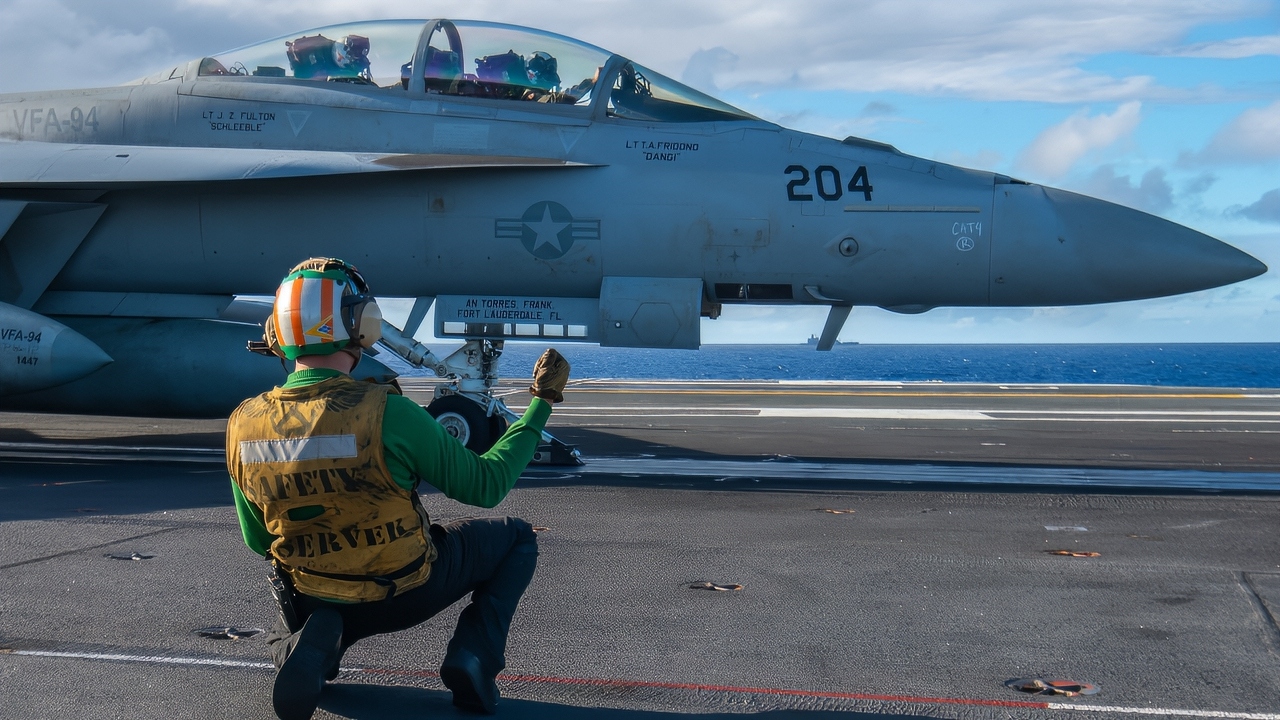
(Dec. 31, 2022) An F/A-18E Super Hornet assigned to the “Mighty Shrikes” of Strike Fighter Squadron (VFA) 94 prepares to launch from the aircraft carrier USS Nimitz (CVN 68) to participate in a long-range maritime strike demonstration. Nimitz is in 7th Fleet conducting routine operations. 7th Fleet is the U.S. Navy’s largest forward-deployed numbered fleet, and routinely interacts and operates with 35 maritime nations in preserving a free and open Indo-Pacific region. (U.S. Navy photo by Mass Communication Specialist 2nd Class Justin McTaggart)
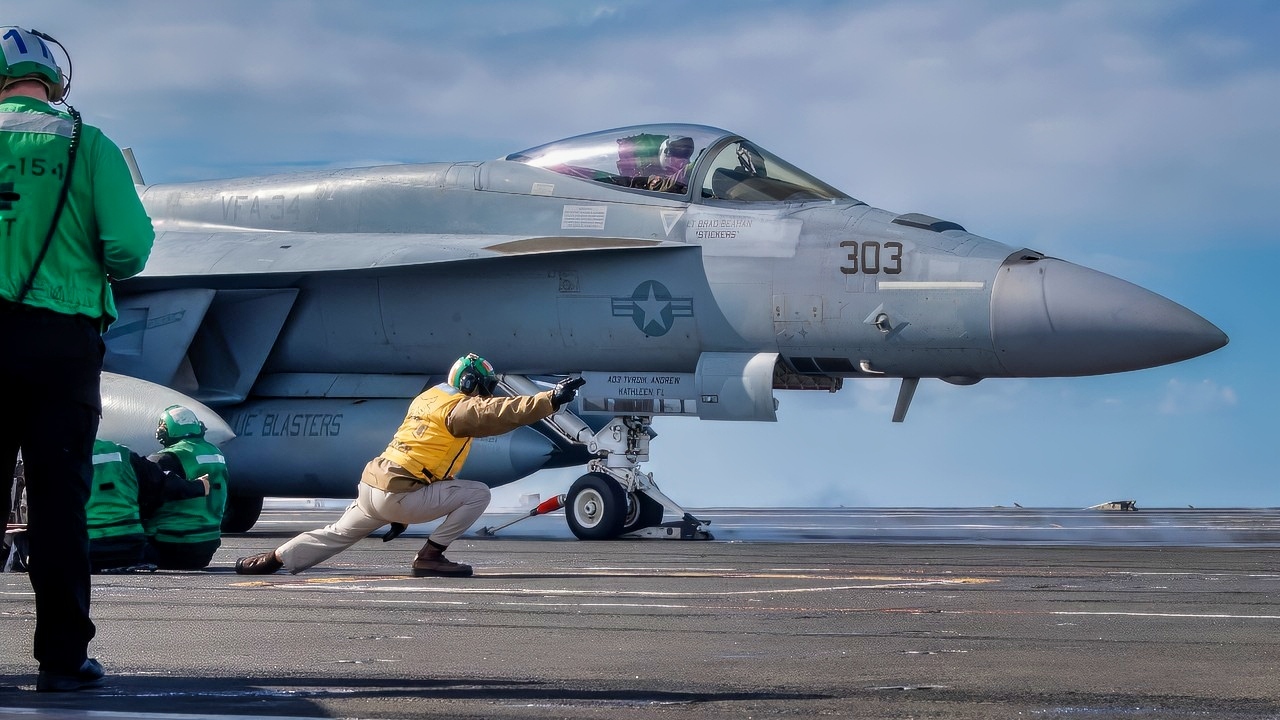
U.S. Navy Lt. Andrew Bentley signals an F/A-18E Super Hornet, assigned to the “Blue Blasters” of Strike Fighter Squadron (VFA) 34, to launch from the flight deck of the Nimitz-class aircraft carrier USS Theodore Roosevelt (CVN 71), Nov. 30, 2023. Theodore Roosevelt, the flagship of Carrier Strike Group Nine (CSG 9), is conducting integrated training exercises in the U.S. 3rd Fleet area of operations. (U.S. Navy photo by Mass Communication Specialist 3rd Class Adina Phebus)
It is believed to mirror the previously signed Memorandum of Understanding that sought to end hostilities earlier this year.
Proposal Presented
Araghchi’s comments came on the sidelines of an eventful U.N. General Assembly in which the presidents of both the U.S. and Iran traded public threats. Donald Trump reiterated a previously aired possibility of “annihilating” Iran, while President Masoud Pezeshkian said his country would not “bend the knee” to the U.S. President.
Diplomatic progress, however, followed shortly after Trump’s 35-minute speech, when U.S. and Iranian officials met for more than three hours through mediators. Special Envoy Steve Witkoff said the discussions would “prove constructive and promising” after the meeting.
On Thursday, 24th September, Araghchi said a proposal had been presented following the discussions. Speaking to reporters, the Iranian Foreign Minister said: “We have introduced a plan to the United States through the mediators that if certain conditions are met, the Strait of Hormuz would be open at the end of the seventh day and talks would restart.”
He added that “it would be better” if the deal was reached before the midterm elections. President Trump has previously remarked that he expected Tehran to seek a deal immediately after the November vote.
Conditions for Conclusion
Araghchi added that a seven-day timeframe was proposed in which all hostilities, including in Lebanon, would end.
The U.S. would also release Iran’s frozen assets, estimated to be at least $12 billion, waive sanctions on Iranian oil and lift the ongoing naval blockade on the country’s ports.
On the seventh and final day, the Strait of Hormuz would reopen before discussions over Tehran’s nuclear program would begin.
Iran has shown greater willingness to reach a deal in recent days, with reports of a possible proposal sent to U.S. officials last week.
Supreme National Security Council Secretary Mohsen Rezaei told Al Jazeera last weekend that Iran’s conditions were “an end to the war on all fronts, the release of our frozen funds and an end to the naval blockade.”
Rinse and Repeat
Araghchi told reporters on Thursday that the Iranian proposal mirrored the Memorandum of Understanding (MoU) the two warring nations previously signed.
Brokered by Pakistan, the MoU was a 60-day “framework agreement” that sought an end to the fighting, but excluded negotiations on Iran’s nuclear program – a key justification by Trump at the beginning of the war.
Despite being signed by both Trump and Pezeshkian, the MoU effectively ended when Iran struck commercial shipping in the Strait of Hormuz in early July.
A 60-day window to negotiate a permanent end to the conflict passed on Monday, 17th August, with neither side making an effort to renew it until the Iranian proposal emerged earlier this week.
The Pros and Cons for President Trump
“This is a smart move,” Ali Vaez, Iran director of the International Crisis Group, told the New York Times. “They know it’s very tempting for President Trump because it ends an unpopular war and brings down energy prices in the run-up to the midterms.
But it also restores a deal that was largely favorable to the Iranians. A compressed timeline to get to the nuclear issue should be appealing to an impatient president.”
The proposal very much puts the ball firmly in Washington’s court.
Trump has previously supported the conditions set out in the MoU. It also brings forward the discussions over Iran’s nuclear program, referencing Trump’s oft-repeated demand that Tehran “never has a nuclear weapon.”
If he can finalize the one part of the deal that was never agreed to in the MoU, Trump could claim the agreement as a surrender by Iran.
However, there’s no denying that the MoU failed once, and a similar agreement may fail again. Many Americans’ issue with the war is the knock-on rise in living costs.
The MoU ended because Iran attacked commercial shipping. If shipowners aren’t confident those strikes won’t be repeated this time around, the strait may as well remain closed, keeping oil prices high and effectively negating a core part of the deal.
Trump said last week he had a “big decision” to make. He may have another one after reviewing the Iranian proposal.
About the Author: Shay Bottomley
Shay Bottomley is a British journalist. He has written for the Western Standard, Business Insider, Maidenhead Advertiser, Slough Express, Windsor Express, Berkshire Live and Southend Echo.