


Trump Is Looking Beyond Pickaxe Mountain at Iran’s Remaining Nuclear Sites: President Donald Trump’s threat against Pickaxe Mountain has focused attention on one deeply buried site near Natanz. U.S. planners have other possible nuclear-related targets in Iran, including Isfahan, Fordow, Natanz and Taleghan 2 at the Parchin military complex, according to a Wall Street Journal review.
Pickaxe Mountain is an uninspected tunnel complex that Iran has continued constructing near Natanz. The Associated Press reported that the halls may sit about 100 meters underground. Israeli intelligence reportedly believes centrifuges were moved there, but public evidence does not confirm that uranium enrichment has begun inside the mountain.
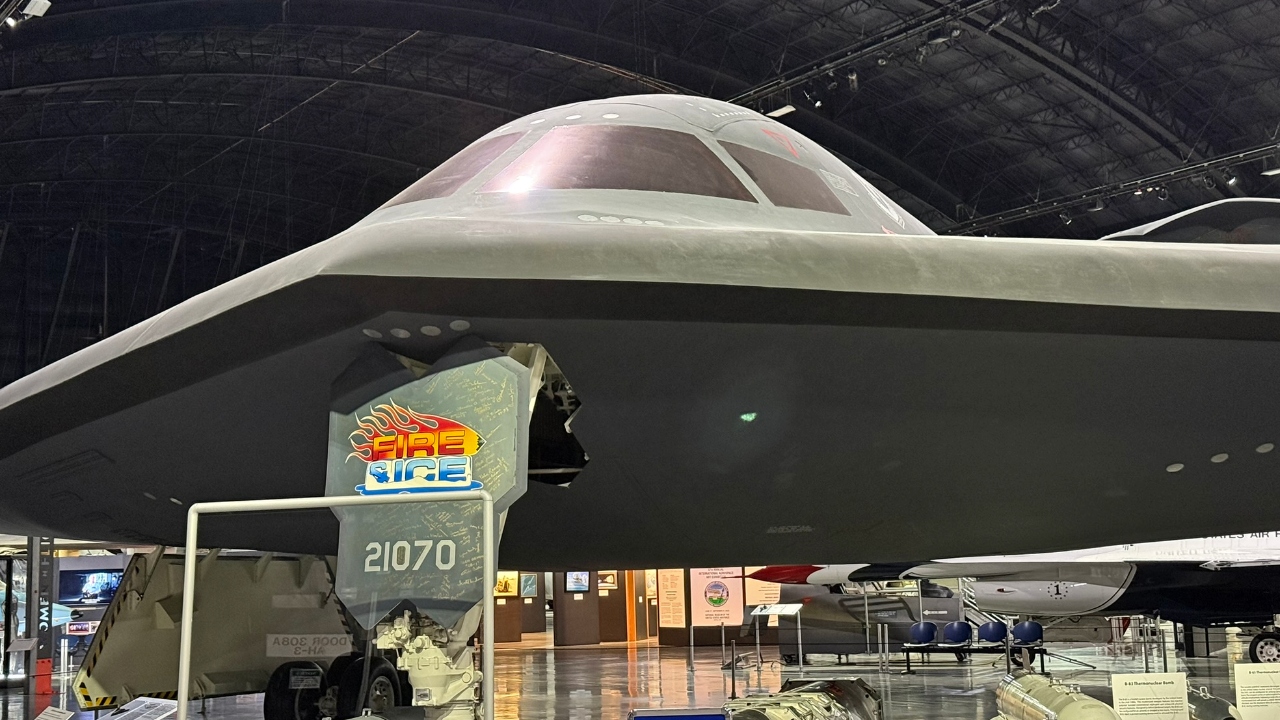
B-2 Bomber @ U.S. Air Force Museum. Image Credit: National Security Journal.

B-2 Stealth Bomber at USAF Museum July 19 2025. Image Credit: Harry J. Kazianis/National Security Journal.
Isfahan presents a more immediate material question. International Atomic Energy Agency Director General Rafael Grossi said more than 200 kilograms of Iran’s uranium enriched to 60 percent was probably stored in an underground complex there. A Reuters account of the assessment said inspectors had not verified whether the material remained in place after the strikes.
Taleghan 2 raises a different concern. The site at Parchin was connected to Iran’s former AMAD nuclear-weapons work and has been rebuilt after repeated attacks. Imagery from June and July showed cranes, new concrete and repairs, according to the Institute for Science and International Security. The images do not prove that current nuclear-weapons activity is taking place there.
Iran’s Isfahan Site May Hold the Most Important Material
Iran has rebuilt buildings and replaced centrifuges before. Enriched uranium determines how quickly Tehran could restore an enrichment option. The IAEA estimated that Iran possessed 440.9 kilograms enriched to 60 percent before the major attacks, enough under the agency’s yardstick for several weapons if enriched further. The unresolved location of that stockpile makes verified accounting central to any settlement.
A strike on Isfahan could damage tunnel entrances, utilities or support buildings while making the material harder to locate afterward. Proposals for a ground operation to seize or destroy the uranium carry extreme military risk. Bombing a storage site does not provide proof that the material was destroyed.
Fordow and Natanz Remain Unverified After Earlier Strikes
Fordow and Natanz absorbed major U.S. and Israeli attacks, but inspectors have not returned to the bombed enrichment sites. A Reuters status review found that the condition of the underground halls remained uncertain without direct access. Further strikes could hit repaired entrances, ventilation, electrical equipment or other surface systems.
Another crater does not establish what remains underground. The earlier campaign showed why repeated bombing can become a continuing suppression strategy. Iran can clear entrances, move equipment and place new work deeper underground between attacks.
Taleghan 2 Presents a Weaponization Question
Taleghan 2 matters because its history concerns high-explosive testing associated with nuclear-warhead development rather than uranium enrichment. Analysts have identified what may be a large containment chamber inside the rebuilt structure, although conventional weapons research could use similar equipment. The ambiguity requires intelligence stronger than satellite imagery before the site becomes a central target.
The Mighty B-2 Spirit Stealth Bomber. Image Credit: National Security Journal.
The repair work fits a broader Iranian pattern of restoring and hardening damaged facilities. It also strengthens the argument inside Iran that sensitive programs should be buried more deeply. The war itself may increase Tehran’s incentive to preserve a nuclear deterrent option.
IAEA Access Would Clarify What Another Strike Cannot
Past strikes have delayed work, destroyed equipment and forced Iran to spend more on protection. Inspectors are still needed to establish where the enriched uranium is, whether centrifuges entered Pickaxe Mountain and what remains inside Fordow, Natanz and Isfahan.
The IAEA’s February safeguards report called access to the affected sites and nuclear material urgent. Until inspectors enter the underground facilities and account for the uranium, Washington will be choosing targets from satellite images and intelligence assessments rather than a verified inventory.
About the Author: Harry J. Kazianis
Harry J. Kazianis (@Grecianformula) was the former Senior Director of National Security Affairs at the Center for the National Interest (CFTNI), a foreign policy think tank founded by Richard Nixon based in Washington, DC. Harry has over a decade of experience in think tanks and national security publishing. His ideas have been published in the NY Times, The Washington Post, The Wall Street Journal, CNN, and many other outlets worldwide. He has held positions at CSIS, the Heritage Foundation, the University of Nottingham, and several other institutions related to national security research and studies. He is the former Executive Editor of the National Interest and the Diplomat. He holds a Master’s degree focusing on international affairs from Harvard University.


Hujjatullah M.H.Babu Sahib
July 27, 2026 at 5:06 am
At the rate the U.S. has been made to bomb every significant target standing on the surface and just below the surface in Iran by Trump and company, soon whether the U.S. runs out of munitions or not it would certainly run out of accessible Iranian targets soon. The biggest blunder Trump made was to bomb out the senior Ayatullah who faithfully kept Iran’s nuclear program and potential proliferation break in sacred check. Even when Hiroshima and Nagasaki were nuked by the U.S., the Japanese Emperor and spiritual father was spared and brought down to earth to facilitate a relatively civilized surrender of the Japanese masses and forces. Now, with an enraged and allegedly crippled junior Ayatullah kept in the shadows, what guarantee is there that the nuke genie in Iran would be kept bottled up by the revange-seeking masses pressuring its unjustifiably-diplomatic elites ? Furthermore, just because Isfahan is half of Iran it doesn’t also mean it keeps half of Iran’s HEU, does it ?