


President Donald Trump said on Sunday that U.S. strikes against Iran are unlikely to escalate due to the Islamic Republic’s weakened state.
“They’re a failing nation,” Trump said during an interview with CNN. “It just came out; you saw this year, 301% inflation. Highly unlikely it will be necessary.”
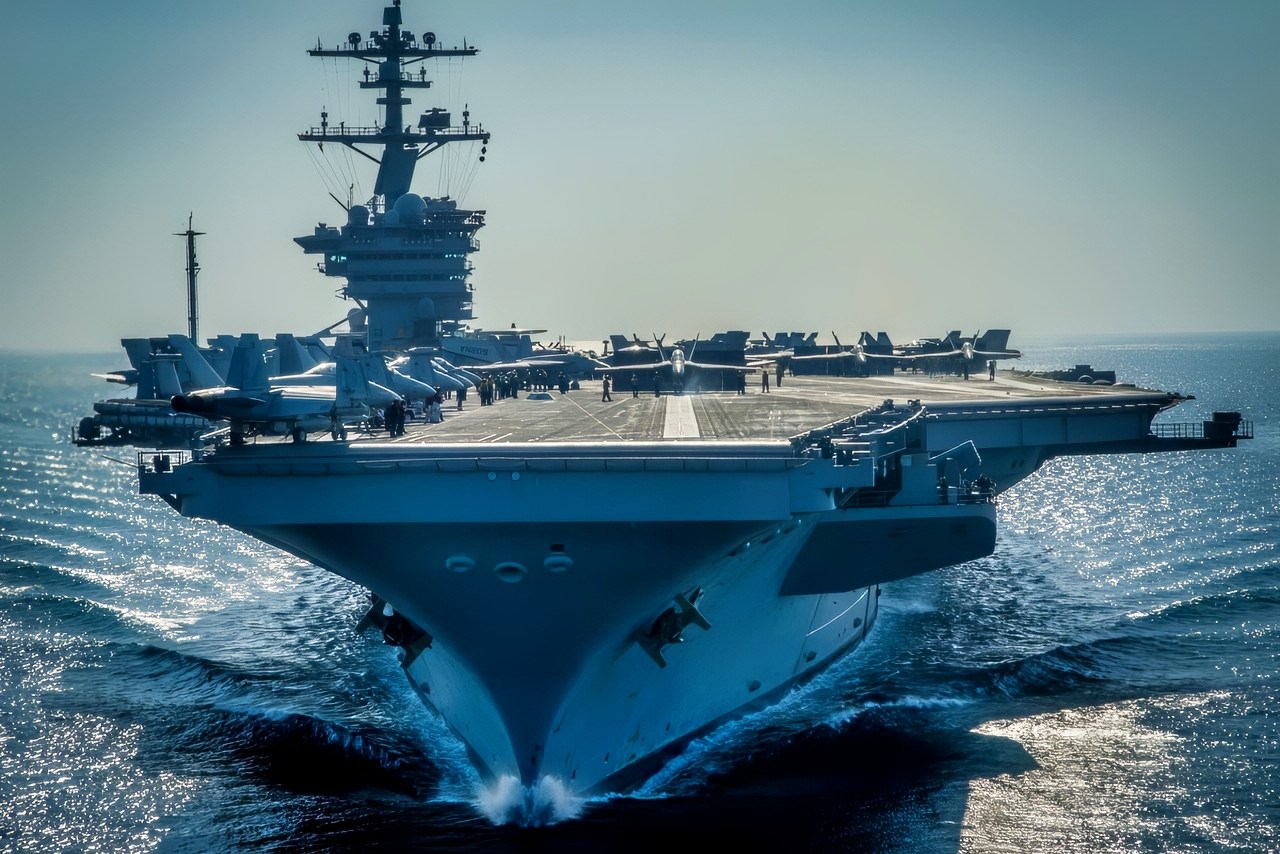
141208-N-WD464-386 ARABIAN GULF (Dec. 8, 2014) The Nimitz-class aircraft carrier USS Carl Vinson (CVN 70) prepares for flight operations in the Arabian Gulf. Carl Vinson is deployed in the U.S. 5th Fleet area of operations supporting Operation Inherent Resolve, strike operations in Iraq and Syria as directed, maritime security operations, and theater security cooperation efforts in the region. (U.S. Navy photo by Mass Communication Specialist 2nd Class Alex King/Released)
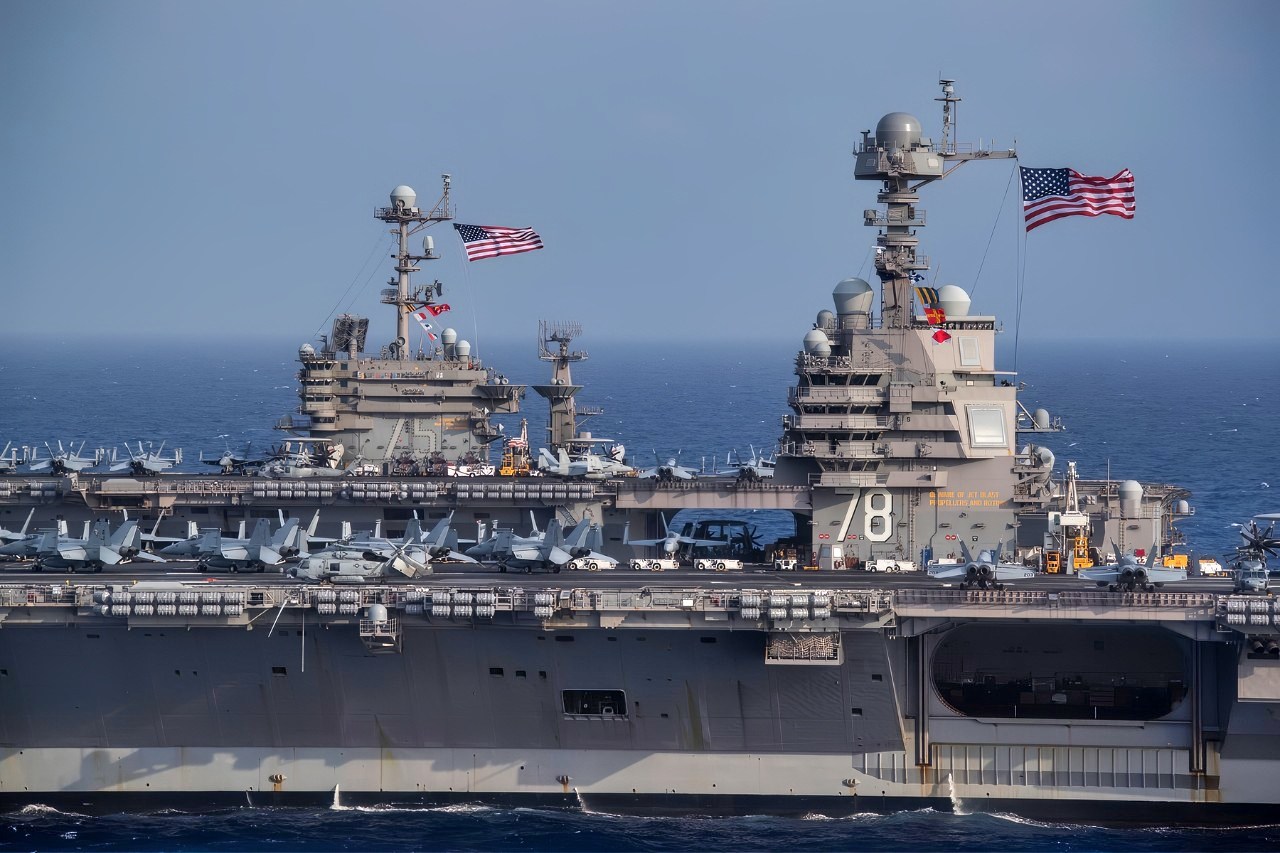
ATLANTIC OCEAN (June 4, 2020) The Ford-class aircraft carrier USS Gerald R. Ford (CVN 78) and the Nimitz-class aircraft carrier USS Harry S. Truman (CVN 75) transit the Atlantic Ocean, June 4, 2020.
However, following the midterm elections, which were a disaster for Trump and the GOP, Iran senses weakness in the administration and is pushing for a deal that is highly advantageous for Tehran.
The regime has also threatened to “rain down hell” if the U.S. decides to resume its attacks.
With Trump’s political opponents set to retake the Senate and House of Representatives, the administration has a limited timeframe to continue the war before the newly elected Democrats take their seats in Congress.
Iran Threatens Retaliation in Case the U.S. Resumes Attacks
Tehran has presented Washington with another ultimatum aimed at ending the war in the Middle East, according to Iran’s Foreign Minister, Abbas Araghchi. “Our 2-day proposal stands: meet the requirements, including an end to the war on all fronts, and you will see results,” Araghchi wrote on X.
“Or choose war, and see our alert and battle-hardened warriors rain down hell.” The foreign minister’s statements were echoed by an adviser to the commander of the IRGC’s Aerospace Force, who stated that weapons have been “secured for years to come.” IRGC Brigadier-General Ali Belali likewise warned that any renewed military activity could have serious repercussions. “The armed forces are at the ready, and if the enemy makes a mistake, Iran’s response will be devastating and severe,” he stated on his official Telegram channel. “As senior commanders of the armed forces have pointed out, we have upgraded our capabilities in the post-Ramadan War period.”
Over the past several weeks, Iran has been conducting ballistic missile tests from Omidiyeh in Khuzestan Province in the southwest.
According to some OSINT reports, Iran has launched over a dozen ballistic missiles in test launches in the past week alone, though not all of these launches have been verified.
At the same time, Iran’s Supreme Leader, Ayatollah Mojtaba Khamenei, who hasn’t made a public appearance since February 28, said any threat from the U.S. should be met with an immediate response, without geographical limits.
A few days later, the IRGC announced that it had lifted its self-imposed limit of 2,000 km (1,200 miles). Most of Iran’s ballistic missiles are believed to have a range of around 2,000 km. Some U.S. officials suspect that Iran may develop newer long-range ballistic missiles following the announcement.
The U.S. is Ready for Action
Although Trump has stated that renewed strikes are unlikely, the president added the caveat that military activity may resume depending on how Tehran acts.
“I’ve got three aircraft carriers here. The other one just arrived. We have three. They’re fully locked and loaded,” he said. Currently, the USS George Washington (CVN-73), the USS George H. W. Bush (CVN-77), and their carrier strike groups are operating in the Arabian Sea. The USS Theodore Roosevelt (CVN-71) is currently operating in the South China Sea near Malaysia and is expected to reach the Middle East by month’s end. Trump also told CNN that the U.S. has a list of targets it could hit at any moment. “We have 38 bridges in our sight that we can knock down in literally one hour,” he said. “They’ll all be down.”
The president continued that Iran’s defensive capabilities have been largely depleted, leaving the country mostly defenseless against any potential new strikes. “It’s unstoppable because they have no anti-aircraft stuff. All of their anti-aircraft [defense] is gone,” Trump said. He also claimed that Iran’s offensive munitions have likewise been depleted, with only a fraction of its pre-war inventory remaining. “The only thing they can do is operate at about a 10% level, make some missiles, and make some drones. Drones at about 15% because much of their factories are gone,” he said.
Activity on the Diplomatic Front
Despite the harsh rhetoric, both sides are still attempting to negotiate through intermediaries. According to Araghchi, negotiations have stalled for now because of the midterm elections in the U.S. “It will take some time for things to settle down and for the atmosphere to become conducive to the mediators resuming their visits,” he said. “We have to wait.” According to Qatari officials, the U.S. has been renewing its diplomatic efforts to de-escalate the conflict.
At the same time, the Iranian Foreign Ministry has remained in close contact with its counterparts across the region.
However, both sides still have a long way to go before there can be progress on the diplomatic front. Many of the main issues behind the conflict have not yet been resolved.
According to Secretary of State Marco Rubio, many of Iran’s demands of the U.S. are infeasible and unacceptable. “I wouldn’t say we’re on the verge of a breakthrough,” he told reporters. “Right now, it hasn’t been very productive because the Iranian demands are not only unacceptable but, in some cases, outrageous, ridiculous, and really not realistic.”
Without a diplomatic breakthrough, it remains to be seen whether the U.S. will continue pursuing the diplomatic route or try to end the conflict through military means.
About the Author: Isaac Seitz
Isaac Seitz, a Defense Columnist, graduated from Patrick Henry College’s Strategic Intelligence and National Security program. He has also studied Russian at Middlebury Language Schools and has worked as an intelligence Analyst in the private sector.


