

Under new military leadership, Iran appears to be preparing for what could become one of the most consequential moments of the war and the greatest test of the U.S. naval blockade.
Reports on Friday, August 14, revealed how a massive Iranian oil tanker was being loaded with crude oil at the country’s most important export terminal following weeks of inactivity.
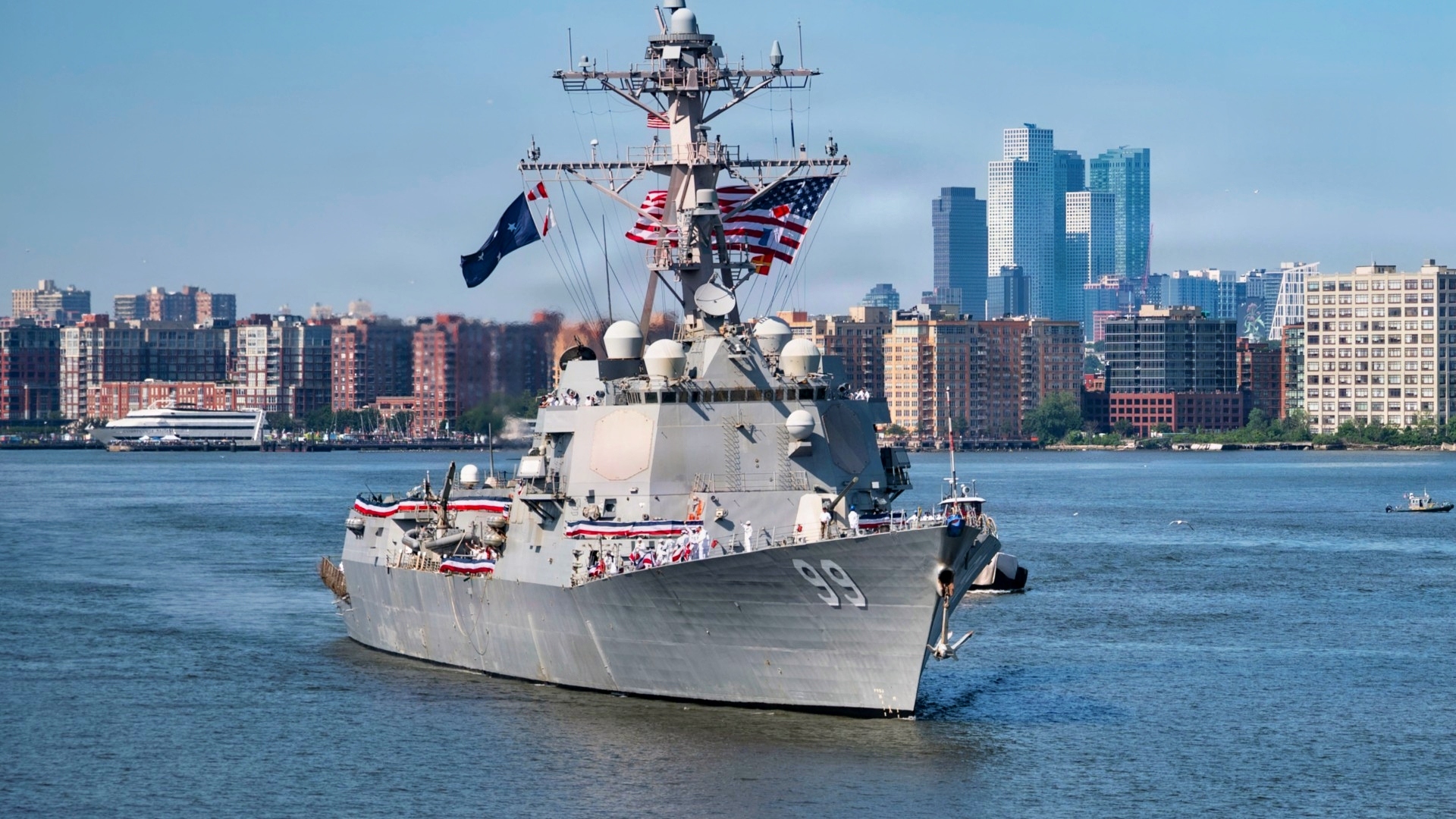
Arleigh Burke-class guided-missile destroyer USS Farragut (DDG 99) arrives at Pier 88 during the International Naval Review (INR) 250 Parade of Sail in New York, July 4, 2026. The Parade of Sail marks the opening of INR 250, a multinational maritime celebration commemorating the 250th anniversaries of the U.S. Navy, Marine Corps, and the nation, honoring the sea services’ enduring commitment to defending the United States and strengthening partnerships with allied and partner nations. For 250 years, our Navy and Marine Corps stood the watch—constant, unabated in mission, faithfully preventing crisis and resolute in defending America’s independence. INR 250 honors the Navy, Marine Corps, and Coast Guard’s enduring role on, under, and above the seas. (U.S. Navy photo by Mass Communication Specialist 2nd Class Janiel Adames)
A National Iranian Tanker Company very large crude carrier, or VLCC, was seen on Friday loading roughly 2 million barrels of crude oil at the Azarpad jetty on Kharg Island.
The news, from TankerTrackers, is the first observed crude loading at Kharg since late July, when U.S. pressure effectively brought oil export activity to a halt.
And while it may seem like cautious optimism from Iran, the news could well be the beginning of a new phase of the conflict driven by aggressive anti-U.S. sentiment from the IRGC’s new leadership.
There is not yet public confirmation that Iran intends to send the vessel through the American blockade, but if the fully laden tanker leaves Kharg Island and then tries to export its cargo, it would create a test for President Donald Trump that could end in embarrassment.
Either Washington allows millions of barrels of oil through the strait, weakening the credibility of the blockade, or U.S. forces move in, stop the tanker, and risk an escalation that current U.S. missile stockpiles may not be able to sustain for very long.
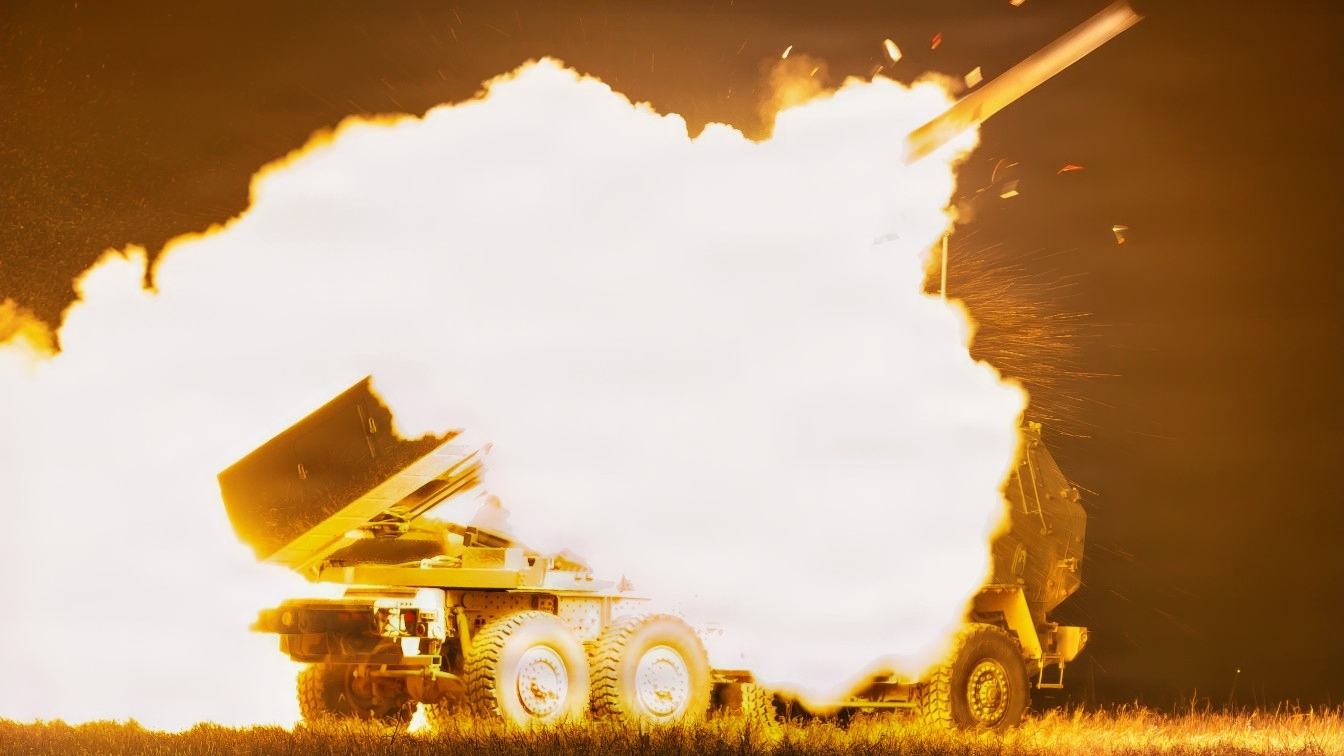
U.S. Soldiers assigned to the 3rd Battalion, 321st Field Artillery Regiment, 18th Field Artillery Brigade, fire a M142 High Mobility Artillery Rocket System (HIMARS) during their Table 15 qualification on Fort Bragg, North Carolina, March 30, 2026. Table 15 is a mandatory U.S. Army training and certification exercise for field artillery batteries that tests their ability to integrate artillery fires into a realistic tactical scenario. (U.S. Army photo by Sgt. Austin Robertson)
A Potential Test of Trump’s Blockade
The loading at Kharg Island is a major development so soon after Tehran reshuffled its military leadership.
Kharg Island is the beating heart of Iran’s crude export industry and historically handles the overwhelming majority of the country’s seaborne crude exports.
Earlier this month, shipping data showed that no tankers had loaded at the island since the end of July as the reimplemented U.S. blockade prevented empty vessels from reaching Iranian terminals and loaded vessels from departing normally.
That changed this week, with satellite analysis from maritime intelligence company Windward showing Kharg’s western terminal becoming active again on August 12 after 25 consecutive days without a vessel at the terminal.
TankerTrackers identified an Iranian VLCC loading approximately 2 million barrels on Friday, but questions remain about where the vessel will go once it is full.
U.S. Central Command (CENTCOM) has shown that the blockade is much more than a threat.
As of Friday, U.S. forces had reportedly redirected 62 commercial vessels, disabled three and boarded two while enforcing restrictions around Iran. Earlier this week, American forces disabled another Iran-bound vessel.
A fully loaded VLCC leaving Kharg would, therefore, present a much more politically and militarily sensitive confrontation than simply turning away an empty commercial vessel – and this could be a test of Trump’s resolve at a time when Tehran is feeling particularly emboldened.
Iran Becomes More Confrontational
A potential confrontation between a laden tanker and the U.S. military follows Supreme Leader Mojtaba Khamenei’s decision to reshuffle Iranian military and security leadership.
The news saw the promotion of veteran Revolutionary Guard figures who favor a more confrontational posture toward Washington, even following five months of U.S. and Israeli strikes.
Former IRGC commander Mohsen Rezaei was appointed secretary of the Supreme National Security Council, placing an experienced Revolutionary Guard veteran at the center of Iranian strategic decision-making.
Ahmad Vahidi, another veteran hardliner, has taken command of the IRGC, while Hossein Taeb has returned to lead the Basij paramilitary organization.
The effects are now being seen.
Taeb declared on Thursday that the Strait of Hormuz is under the “control and management” of Iran, directly contradicting President Donald Trump’s own claims that the United States has “total control” over the waterway.
Tankers Are Being Attacked Again
Not only is Iran potentially preparing for a new confrontation with the U.S. military, but the IRGC has also resumed striking commercial vessels passing through the Strait of Hormuz.
Two vessels operated by the UAE’s state-owned ADNOC were attacked by drones while traveling through the Strait of Hormuz on Thursday evening, with the UAE blaming Iran and describing the incidents as acts of piracy by the Revolutionary Guards. No casualties were reported.
Iran has also demonstrated a number of maritime capabilities throughout the war, even following sustained U.S. strikes.
In March, Tehran claimed that an underwater attack drone struck tankers near Basra in Iraq, an unusually important development because unmanned underwater weapons could give Iran another way to threaten shipping beyond missiles, aerial drones, mines and fast-attack boats.
Thursday’s ADNOC attacks were reported to be aerial drone attacks rather than underwater strikes, but it remains clear that Iran has a range of methods it can employ against maritime traffic.
And Trump’s problems are just getting worse.
Iran is emboldened; it has less to lose, tankers are being attacked again, and the U.S. military may be forced to strike an Iranian vessel filled with millions of barrels of oil, thereby initiating a new confrontation and returning to a war that Washington has so far proved it cannot win.
About the Author: Jack Buckby
Jack Buckby is a British researcher and analyst specializing in defense and national security, based in New York. His work focuses on military capability, procurement, and strategic competition, producing and editing analysis for policy and defense audiences. He brings extensive editorial experience, with a career output spanning over 1,000 articles at 19FortyFive and National Security Journal, and has previously authored books and papers on extremism and deradicalization.


